Genetics - A. V. Sivolob 2008
Genetics of Multicellular Eukaryotes
Cytoplasmic Heredity: Mitochondrial and Chloroplast Genetics
Mitochondrial Genomes
Present in almost all eukaryotes with few exceptions, Cell/35.html">Mitochondria play a central role in ATP synthesis and several other essential physiological processes. The number of mitochondria per cell can range from just a few (e.g., in sperm Cells) to several thousand (in hepatocytes). Each mitochondrion may carry multiple copies of DNA (mtDNA), which, in complex with Proteins, form a Structure similar to prokaryotic nucleoids.
METABOLISM/28.html">The Genetic Code used by the mitochondria's own Translation system exhibits some deviations from the universal codon-to-amino acid assignment table (see Fig. 2.1). Specifically, the universal stop codon UGA encodes Tryptophan in the mitochondria of most species; in Yeast mitochondria, the CUG codon specifies Threonine instead of leucine; in mammalian mitochondria, AUA specifies Methionine instead of isoleucine, and so forth.
It is widely believed that most eukaryotes possess a circular mtDNA molecule. While this is frequently the case, accumulating evidence in recent years shows that mtDNA is linear in A large number of eukaryotes (such as the malaria parasite, Hydra, certain Fungi, and unicellular Algae). Sometimes, as in Yeasts, the linear mtDNA molecule is a so-called concatemer consisting of large identical sequence regions that repeat in tandem. Linear mtDNAs are characterized by specific terminal structures: complementary strands covalently closed at the ends, specific terminal proteins attached to the molecule's ends, or telomere-like terminal repeats of varying lengths.
Typically, mitochondrial genomes (mitochondriomes) are represented by a single "chromosome," though there are exceptions. For instance, the mitochondria of the fungus Spizellomyces punctatus contain three distinct circular DNA molecules. In the protist Amoebidium parasiticum, the mitochondriome consists of several hundred linear molecules that vary in size and sequence. The plant Mitochondrial Genome generally consists of several molecules of different sizes. One of these, the "main chromosome," contains the majority of genes, while smaller circular forms—which are in dynamic equilibrium both with each other and with the main chromosome—are generated through intra- and intermolecular recombination enabled by homologous regions (Fig. 6.13). Mitochondrial Genome Rearrangements resulting from recombination events lead to deletions, duplications, inversions, or insertions of specific nucleotide sequences or entire genes. Such alterations can cause not only the disruption of existing genes but also The Emergence of new functional genes. This restructuring of the mitochondrial genome is believed to be Nucleus-controlled and serves as one of The regulatory mechanisms governing the efficiency of mitochondrial Gene Expression.
Class="center">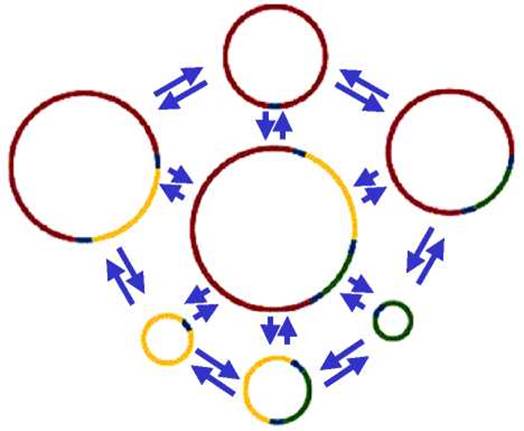
Fig. 6.13. Scheme of The formation of circular molecules of different sizes in plant mitochondria. Recombination occurs at homologous regions highlighted in the same color.
Mitochondrial genomes vary significantly in size: from 6 kb in apicomplexans (such as malaria parasites) to 2.4 Mb in muskmelon. In animals, mtDNA is generally small, averaging 13–19 kb. Relatively large mitochondriomes (ranging from 20 to 42 kb) are found in Mollusks, nematodes, and certain insects. Higher plant mitochondriomes are large (ranging from 180 kb to 2.5 Mb) and contain a considerable amount of repetitive sequences and open reading frames with unknown Functions. A characteristic feature of plant mitochondriomes is the presence of integrated chloroplast DNA fragments.
The gene repertoire in mitochondrial genomes ranges from 5 in plasmodia to 100 in the flagellate Reclinomonas americana. For most eukaryotes, the average number of mitochondrion-encoded genes is 40–50, of which 12–20 encode proteins. The mitochondrial genomes of all eukaryotes encode the large and small ribosomal RNA subunits of the mitochondrial ribosome, as well as a partial (sometimes complete) set of their own tRNAs. Proteins encoded by mitochondriomes are primarily involved in Electron Transport and ATP synthesis: the ATP synthase subunit (atp gene) and Respiratory Chain complex components (nad, sdh, cob, cox genes). The mtDNA of plants and certain unicellular organisms contains ribosomal protein genes. The yeast mitochondriome is somewhat atypical in its gene composition, harboring, among others, genes for endonucleases and Reverse Transcriptase.
The variation in mitochondriome size is driven by non-coding sequences; there is virtually no correlation between mtDNA size and gene number. An exceptionally high proportion of non-coding mtDNA sequences (50–70%) is characteristic of higher plants. Some of these sequences are part of introns (mainly found in fungal and higher plant Mitochondrial Genes, whereas mammalian genes lack introns), which are spliced out of transcripts during Processing. The majority of non-coding regions consist of intergenic spacers.
All Components of the mitochondrial Replication and Transcription apparatuses, as well as a portion of the translation machinery, are encoded by the nuclear genome. Consequently, mitochondrial gene expression remains under the strict control of The Nucleus.
Last update: 11/08/2026
Editorial and Educational Adaptation: This material has been compiled based on the primary/original source text. The project team performed an editorial review, corrected technical inaccuracies, structured sections, and adapted the content for an educational format.
What was processed:
- elimination of formatting defects (OCR errors, structural breaks, corrupted characters);
- editorial organization of content;
- standardization of terminology in accordance with academic sources;
- verification of factual statements against the original source text.
All mentions of the author, publication year, and origin of the primary text have been preserved in accordance with the source.