Fundamentals of Molecular Biology - V.I. Rezyapkin 2009
Genome rearrangements
Immunoglobulin gene rearrangements
IMMUNOGLOBULINS are Proteins of The Immune System that exhibit antibody activity. Their primary function is to recognize foreign macromolecules and participate in the body's Immune Response. There are five distinct classes of immunoglobulins: IgG, IgA, IgM, IgD, and IgE. Representatives of these different classes vary across several parameters (Table 9.1).
Table 9.1
Class="center">Characteristics of Immunoglobulins
|
Immunoglobulin Class |
Relative Molecular Weight |
Carbohydrate Content, % |
Serum Concentration, mg % |
|
lgG |
140 000 |
2 |
800-1680 |
|
lgM |
900 000 |
10 |
50-190 |
|
IgA |
170 000 and above |
7 |
140-420 |
|
lgD |
180 000 |
12 |
3-40 |
|
lgE |
196 000 |
10 |
0,01-0,14 |
Immunoglobulin molecules consist (Fig. 9.14) of two identical heavy H-chains (Heavy) with a relative Molecular Weight of 55,000 – 70,000 and two identical light L-chains (Light) with a relative molecular weight of approximately 22,000. Both L- and H-chains contain variable (V) and constant (C) regions. The variable regions in different immunoglobulin molecules differ in their Primary Structure and are responsible for antigen recognition, whereas the constant regions determine the subsequent fate of the antigen-antibody complex. The constant Regions of the heavy chains across various immunoglobulin classes differ significantly in their Amino Acid Sequence. These domains determine the specific class membership of a given immunoglobulin and impart the unique properties to each class of Antibodies.
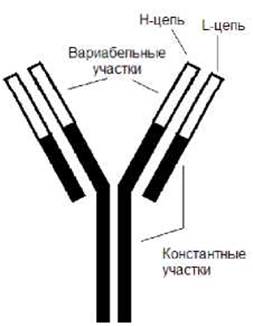
Fig. 9.14. Immunoglobulins
Lymphocytes, which are Cells of the immune system, are responsible for The production of immunoglobulins. Notably, in immature lymphocytes—as in other cells—immunoglobulin genes are not expressed. This is because the Organization of immunoglobulin genes in mature lymphocytes differs significantly from that in immature lymphocytes or other Cell types. Lymphocyte maturation is accompanied by profound rearrangements of immunoglobulin genes, As a result of which lymphocytes acquire The ability to produce immunoglobulins of a specific Specificity.
In immature lymphocytes, immunoglobulins are encoded by three Gene families: two encode the L-chains and one encodes the H-chains.
In immature lymphocytes, the immunoglobulin H-chain is encoded by four sets of segments (Fig. 9.15): V (variable segments), D (diversity segments), J (joining segments), and C (constant segments). The Genome contains several hundred V-segments, approximately 15 D-segments, and 4 J-segments. During lymphocyte maturation, the DNA encoding the variable region of the H-chain is formed by the deletion of extensive DNA stretches and the rejoining of any single V-, D-, and J-segment to form the V-D-J region (Fig. 9.15). Different lymphocytes recombine different V-, D-, and J-segments during maturation; thus, each lymphocyte possesses its own unique combination of joined segments. This exact mechanism accounts for the vast Water/126.html">Diversity of the variable regions in immunoglobulin H-chains. The newly formed V-D-J DNA region subsequently joins with one of the C-genes (Fig. 9.15). These C-genes determine the immunoglobulin class (IgG, IgA, IgM, IgD, and IgE). The immunoglobulin H-chain genes resulting from these DNA rearrangements are transcribed to produce RNA, which, upon maturation, serves as a template for the Synthesis of the corresponding immunoglobulin chains (Fig. 9.15).

Fig. 9.15. Schematic diagram illustrating immunoglobulin H-chain gene rearrangements
In immature lymphocytes, each immunoglobulin L-chain is encoded (Fig. 9.16) by variable segments (V-segments), joining segments (J-segments), and constant segments (C-segments). The genome contains hundreds of different V-segments and several J-segments. During lymphocyte maturation, DNA segments encoding the L-chains undergo rearrangements similar to those of the H-chain DNA. As a result of these rearrangements (Fig. 9.16), any single V- and J-segment is brought into proximity with a C-segment. Different V- and J-segments are brought together in different lymphocytes, meaning each lymphocyte possesses its own distinct set of joined segments. The resulting genes (Fig. 9.16) are transcribed to produce pre-mRNA. Following Processing, which includes splicing, the pre-mRNA is translated to drive the synthesis of immunoglobulin L-chains.

Fig. 9.16. Schematic diagram illustrating immunoglobulin L-chain gene rearrangements
Within lymphocytes, L- and H-chains assemble into immunoglobulins specific to particular Antigens. The Diversity of their variable regions is driven by the immunoglobulin gene rearrangements discussed above. The existence of antibodies with varying specificities is primarily determined by the random combination of segments forming the immunoglobulin variable regions during gene rearrangement. The number of possible immunoglobulin variable regions is further increased because the segments encoding the variable regions are joined with a degree of enzymatic imprecision during rearrangement. Furthermore, the joining of segments involves the deletion or insertion of a small number of bases, which in turn significantly expands the diversity of variable regions across both light and heavy immunoglobulin chains.
As noted above, immunoglobulin H-chains are encoded by a single gene family, whereas L-chains are encoded by two gene families. Since each locus in the genome of diploid organisms is represented by two alleles, one might expect that H-chain gene rearrangements would generate Two Types of H-chains and four types of L-chains in every lymphocyte. However, this is not the case. Only one H-chain and one L-chain are synthesized in each lymphocyte. Why does this happen? The reason is that H-chain gene rearrangements occur first, followed only later by L-chain rearrangements. Moreover, H-chain gene rearrangements initially take place in only one of the two Chromosomes. If a functionally active H-chain gene is successfully formed, rearrangements of the corresponding locus on the second chromosome are blocked. Conversely, if the rearrangements result in a functionally inactive gene, the gene rearrangements are then triggered on the second chromosome. Once The formation of a single H-chain gene in one of the chromosomes is successfully completed, L-chain gene rearrangements are initiated. In this case as well, rearrangements occur sequentially, where the rearrangement of each subsequent locus is permitted only if unsuccessful recombinations occurred in the preceding loci. Consequently, this ensures that only one functionally active L-chain gene is formed. Thus, each lymphocyte contains only a single actively expressed H-chain gene and a single actively expressed L-chain gene. Lymphocytes that fail to form functional H- and L-chain genes undergo apoptosis.
Last update: 12/08/2026
Editorial and Educational Adaptation: This material has been compiled based on the primary/original source text. The project team performed an editorial review, corrected technical inaccuracies, structured sections, and adapted the content for an educational format.
What was processed:
- elimination of formatting defects (OCR errors, structural breaks, corrupted characters);
- editorial organization of content;
- standardization of terminology in accordance with academic sources;
- verification of factual statements against the original source text.
All mentions of the author, publication year, and origin of the primary text have been preserved in accordance with the source.