Human Anatomy (with the Fundamentals of Dynamic and Sports Morphology) - Ivanitsky, M. F. 2008
The Doctrine of the Nervous System
General Part
The Nervous system, together with the Sense Organs (sensory system) and the endocrine apparatus, regulates the vital activity of the body as a whole and its individual parts, particularly human motor activity. Control, regulation, and coordination of the morphological and functional states of the body are carried out through neurohumoral pathways, while the nervous and Sensory systems ensure its interaction with the environment.
Regulatory influences can be exerted both at the organ level and at a deeper tissue and cellular level. For instance, skeletal Muscle contraction occurs through the action of motor (effector) nerve impulses on its muscle fibers. The chemistry of this contraction is driven by metabolic processes taking place within the sarcoplasm and ultrastructural elements of the muscle fiber at THE MOLECULAR LEVEL. Furthermore, these processes are regulated primarily via humoral pathways by the Endocrine glands.
The effectiveness of an athlete's motor activity depends to a considerable extent on the level of development, condition, and training status of these regulatory systems.
Thus, the Organs of the nervous and sensory systems, along with the endocrine apparatus, direct and regulate diverse bodily processes (including movement), thereby preserving the unity and integrity of the Organism, maintaining the constancy of its internal environment (Homeostasis), and ensuring its interaction with the external environment.
The ability to respond to incoming stimuli is characteristic of all tissues and Cells to some degree; however, only Nervous Tissue (see its Structure on p. 35), which forms the nervous system, can provide a high degree of differentiation for these responses.
The primary property of the nervous system is its ability to perceive stimuli, conduct them as centripetal nerve impulses, and transmit centrifugal impulses to various organs, whose function is carried out primarily in response to the stimuli perceived by the nervous system. This mechanism by which the body responds to a stimulus—that is, to Changes in the external or internal environment—through the Central Nervous System is called a reflex. The material basis of a reflex is the reflex arc, which in its simplest form consists of two or three Neurons: sensory (afferent), association (or interneuron), and motor (efferent). Complex reflex arcs consist of A large number of neurons.
Class="center">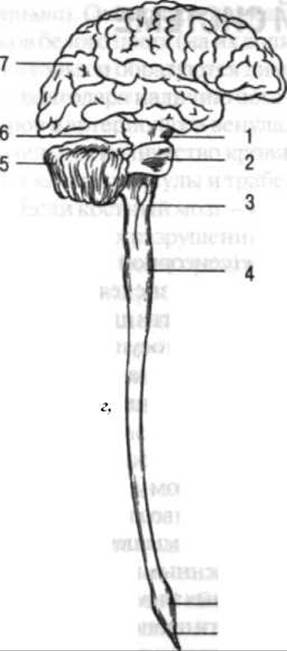
Fig. 104. Brain AND SPINAL cord (lateral view, semi-schematic):
1 — cerebral peduncle; 2 — Pons; 3 — Medulla Oblongata; 4 — cervical enlargement of the Spinal Cord; 5 — Cerebellum; 6 — fissure between the occipital lobe of the cerebral hemisphere and the cerebellum (enlarged); 7 — cerebral hemisphere; 8 — lumbosacral enlargement; 9 — medullary cone (after G.F. Ivanov)
At the same time, the nervous system not only regulates the body's responses to external or internal stimuli, but also largely determines the relationships between organs, ensuring coordination in the execution of their Functions.
The great Russian physiologist I.P. Pavlov emphasized that The activity of the nervous system is directed, on the one hand, toward uniting and integrating the work of all PARTS OF THE body, and on the other hand, toward connecting the organism with the external environment and balancing it with the outside world.
The nervous system plays a vital role in enabling all human movements, particularly those of athletes, by regulating and controlling the work of skeletal Muscles. A muscle and the nerve supplying it constitute a functional unit known as the neuromuscular apparatus. The nervous system regulates the force and speed of muscle contraction, the degree of muscle tension or relaxation, as well as its nutritional and metabolic processes.
Through the sense organs, via the sensory Innervation of the Skin and The Musculoskeletal System, the nervous system enables athletes to orient themselves in their surrounding environment and in space, perceive their body posture, and coordinate movements.
The nervous system is generally subdivided into the central and peripheral nervous systems, as well as the somatic and autonomic (vegetative) systems.
The central nervous system includes the brain and spinal cord (Fig. 104), while the Peripheral Nervous System comprises the neural structures that connect the central nervous system to individual organs and Tissues of the body (nerves, ganglia, plexuses) as well as the nerve endings located within organs (sensory or afferent, and motor or efferent).
The somatic nervous system is considered to be that part which innervates the soma—namely the body proper, which conventionally includes the motor apparatus, integument, sense organs, and the mucous membranes of certain cavities, such as the oral and nasal cavities. The Autonomic (vegetative) nervous system is the part that innervates Internal Organs, glands, Blood Vessels, and so forth. In addition, it participates in the innervation of striated muscles (by regulating their METABOLISM), which consequently feature dual innervation.
The nervous system develops from the outer germ layer, the ectoderm. At the early stage of embryonic development, a neural groove appears on its posterior, dorsal side, which subsequently develops into the neural tube. Its anterior end forms three consecutive dilations—the so-called primary brain vesicles—which later develop into the brain. The remaining part of the neural tube gives rise to the spinal cord. The peripheral nervous system is formed through outgrowths of neural tissue extending from the neural tube.
Last update: 08/08/2026
Editorial and Educational Adaptation: This material has been compiled based on the primary/original source text. The project team performed an editorial review, corrected technical inaccuracies, structured sections, and adapted the content for an educational format.
What was processed:
- elimination of formatting defects (OCR errors, structural breaks, corrupted characters);
- editorial organization of content;
- standardization of terminology in accordance with academic sources;
- verification of factual statements against the original source text.
All mentions of the author, publication year, and origin of the primary text have been preserved in accordance with the source.