Basics of Evolution - Korzh O.P. - 2006
Part III. PATHS OF LIFE DEVELOPMENT
Chapter 18. Development of Lower Organisms
18.1. Concepts of Prebiological Evolution
Organic compounds were synthesized abiotically under conditions that existed on Earth over 3,500 million years ago. Individual organic molecules (Amino Acids and NUCLEOTIDES) are capable of combining to form larger polymers (Polypeptides and polynucleotides). It is quite clear that the first such polymers arose by chance, but subsequently became capable of influencing the Formation of other polymers—a process linked to THE PRINCIPLE OF nucleotide complementarity and the mechanisms of template synthesis, which play a central role in information transfer within biological systems.
Protometabolism is presumably an unknown set of Chemical Reactions that ultimately led to The formation of biologically active macromolecules, among which RNA was of the utmost importance. Today, the ability of ribozymes (catalytic RNAs) to catalyze various chemical processes, including phosphorylation, has been proven.
In any copying process, errors occur that ultimately lead to a substantial diversification of these polymers. At the same time, molecules with different sequences of their constituent parts exhibit distinct chemical properties determined by their tertiary (unique) structures. The three-dimensional folding of a polynucleotide affects its stability and Replication capacity.
It has been experimentally proven that a replicating RNA molecule appears to be subject to natural Selection: depending on specific conditions, one sequence or another begins to predominate.
Thus, an RNA molecule possesses two key features that are necessary Prerequisites for the evolutionary process: informational (Genetic information encoded in The nucleotide sequence and transmitted during replication) and functional (a unique Structure that determines The Nature of the molecule's interaction with its environment).
These properties underpin The Theory of the so-called RNA world, according to which RNA and Cofactors constituted the necessary set of Enzymes to carry out all chemical reactions in primitive cellular structures. It is believed that with the advent of RNA replication, the principle of Darwinian evolution, driven by the selection of specific molecules, first became possible. A consequence of this prebiological development was the dominance of a type of molecule that optimally combined replication capacity and stability (the feasibility of such a process has been demonstrated in laboratory conditions).
Nucleic Acids are well-suited for storing and transmitting information, whereas the catalytic capabilities of polypeptides are significantly higher. Therefore, at a certain stage of evolution, METABOLISM/28.html">The Genetic Code emerged, through which RNA began to direct primitive Protein Synthesis. Given that the genetic code is virtually universal in All living organisms, it is assumed that they all descend from a single primitive Cell Lineage that fortuitously developed an efficient protein synthesis mechanism.
As soon as nucleic acids began to code for the enzymes that directly ensured their own replication, The Need for an external membrane arose. The selection of RNA molecules based on the quality of the Proteins they coded for only began after a enclosed space appeared within which the proteins synthesized by that RNA were retained. The exact time of The Cell membrane's appearance (Fig. 18.1) is unknown, but following its emergence, RNA molecules not only evolved on The basis of their own structure but also began to influence the traits of The Cell as a whole.
Class="center">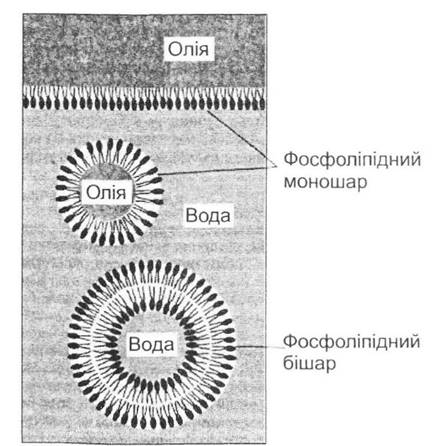
Fig. 18.1. Diagram of the probable Formation of the phospholipid bilayer, which forms the basis of the cell membrane (after B. Alberts et al., 1994)
Experiments on abiogenic synthesis have demonstrated the relative ease of obtaining a significant amount of substances required for the subsequent formation of membrane structures. Lipid films formed on the Water surface can, upon agitation, produce spherules and bilayers As a result of spontaneous aggregation.
This is how the primitive primordial cell emerged; it differed from all modern Cells in that its genetic information was stored in RNA rather than DNA. It is believed that RNA, being more active molecules, was the first to engage in prebiological evolution (it is possible that the first cells contained significantly fewer components even compared to modern Mycoplasmas). The processes of replication and damage repair in DNA molecules occur much more efficiently than in RNA; therefore, following The Development of protein synthesis mechanisms and significant cellular complexification, the more stable, predominantly double-stranded DNA molecules assumed the function of information storage. Proteins synthesized by the primordial cell became the primary catalysts for all processes, while RNA began to serve as a liaison between DNA and proteins.
However, certain problems challenge the plausibility of the RNA world hypothesis. First is the requirement for vast amounts of ribose in prebiological times for the subsequent formation of RNA. The difficulty in accumulating such reserves is explained, on the one hand, by the synthesis of A wide variety of CARBOHYDRATES and, on the other hand, by their high instability and relatively rapid degradation (at 25 °C, the half-life of ribose does not exceed 300 days). Attempts to resolve these issues involve the Introduction of a pre-RNA world. Peptide nucleic acids are among the candidates for the probable genetic material in this scenario. Furthermore, there is as yet no explanation for the mechanisms of cytosine formation (its rate of degradation far exceeds all plausible synthesis mechanisms), without which the replication mechanisms in modern cells are considered unfeasible. To address this problem, several theories have been proposed in which macromolecules utilize alternative replication mechanisms.
One of the most fascinating hypotheses is A.G. Cairns-Smith's theory of inorganic evolution, according to which clay crystals served as the foundation for the formation of life. Under certain conditions, clay particles can form peculiar "crystal genes" capable of templating and replication (Fig. 18.2). Organic substances, gradually interacting with the crystals and influencing their shape and growth, replaced the inorganic substrate, a process that culminated in the complete "abandonment" of the clay framework.
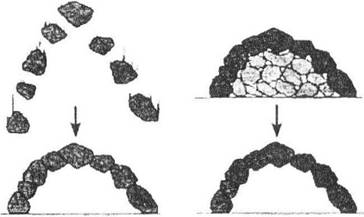
Fig. 18.2. A.G. Cairns-Smith's metaphorical comparison of the formation of a complex structure through highly improbable events (left) versus the formation of the same structure on a scaffold, which in modern organisms could have been clays (from Ya.M. Danko, 2001)
According to current views of many specialists on the evolution of prebiological structures, the low emissivity of the young sun at the dawn of Earth's development caused continuous glaciation on its surface, lowering temperatures to -40 °C. At the same time, such low temperatures not only do not hinder the development of life but, conversely, facilitate the preservation of various organic molecules. This concept helps resolve another paradox: the concentration of organics in the "primordial soup," even if utilizing all of Earth's carbon, would not exceed 1%. Freezing processes could have facilitated the concentration of organic substances to the level necessary for their normal polymerization.
An even more extravagant hypothesis is that life originated deep underground—under conditions devoid of sunlight and atmospheric oxygen, independent of surface events. Geochemical energy released at the ocean floor could provide a sun-independent energy source (modern hydrothermal vents function precisely in this manner). Naturally, such conditions are suitable exclusively for the development of Bacteria, but their evolution could proceed with almost no limitations.
Last update: 07/08/2026
Editorial and Educational Adaptation: This material has been compiled based on the primary/original source text. The project team performed an editorial review, corrected technical inaccuracies, structured sections, and adapted the content for an educational format.
What was processed:
- elimination of formatting defects (OCR errors, structural breaks, corrupted characters);
- editorial organization of content;
- standardization of terminology in accordance with academic sources;
- verification of factual statements against the original source text.
All mentions of the author, publication year, and origin of the primary text have been preserved in accordance with the source.