Plant Physiology - Musienko M.M. 2001
Plant Physiology and Biotechnology: Achievements and Development Prospects
Space Phytophysiology
In the era of cosmonautics, space phytobiology is developing intensively. It studies the GROWTH AND DEVELOPMENT of lower and higher plants under METABOLISM/18.html">The Influence of spaceflight factors, primarily microgravity as a constant and dominant factor in orbital flight. Therefore, space phytobiology serves as the experimental foundation of gravitational biology, the goal of which is to elucidate The Role of gravity—a cardinal geophysical factor in the evolution and vital activity of living organisms on Earth. This became possible only with the dawn of the space era, since gravity under terrestrial conditions cannot be altered for any prolonged period.
A series of space, biological, and model (clinostating) experiments with unicellular green Algae and higher plants (mosses, Water ferns, gymnosperms, and angiosperms), organ, Cell, and tissue cultures, as well as protoplasts grown and developed during flight, have proven:
·the fundamental feasibility of growing plants under microgravity conditions;
·the preservation and realization of the genetic determinism of morphogenesis and Cell Differentiation under these conditions;
·the diverse impact of microgravity on Plant Growth and vital activity, which manifests as changes in growth rate, biochemical composition, enzyme activity, and the intensity of core physiological processes.
It has been shown that in the absence of a gravitational vector, the ROOT's gravisensing apparatus—the root cap—forms but fails to function; that is, amyloplast-statoliths do not sediment in the basal part of statocytes (Photo 2, a, b).
The normal spatial orientation of plant Organs is governed by photo- and chemotropisms.
A major breakthrough in space biology is the discovery of cellular gravisensitivity, which is rooted in substantial alterations in the directionality of cellular metabolism. At the structural level, this is reflected in changes to the Cytoplasm's ultrastructure: increased vacuolization (Photo 2, c, d), expansion of the agranular Endoplasmic reticulum, a reduction of starch content in amyloplasts (Photo 3, a, b) and plastid size, uneven widening of the intrathylakoid space, an increase in the cellular chondriome volume and the cristae-to-matrix ratio, the appearance of large, often round Mitochondria with regularly arranged cristae and a condensed matrix (Photo 3, c, d), specific modifications of the peripheral cistern of the dictyosome's distal pole (Photo 3, e, f), an increase in lipid droplet volume, thinning of The Cell wall, and the appearance of electron-dense globules associated with the Plasmalemma and endoplasmic reticulum membranes containing calcium, etc.
These Structural and functional organelle changes during cell growth, differentiation, and vital activity are general in nature, regardless of species or tissue affiliation, yet they may also carry information regarding the dys-, hyper-, or hypofunction of specific cell types and organs.
It has been established that Changes in the rate and directionality of metabolic processes in plant Cells under the influence of microgravity lead to the acceleration of: 1) the growth and differentiation of meristematic cells and cells growing by elongation, and 2) the senescence of differentiated cells, resulting in a shortened period of meristematic activity and organismal ontogeny.
It is likely that metabolic activation under microgravity conditions—achieved through an increased functional load on cellular Organelles and altered enzyme activity—sustains cellular viability, driving adaptation to microgravity through self-regulatory mechanisms. However, this process occurs against a backdrop of accelerated Aging, as indicated primarily by a weak yet persistent and steady increase in membrane Lipid Peroxidation intensity under these conditions. These theoretical achievements of space phytobiology are utilized in developing space crop production tools as an autotrophic link in controlled ecological life support systems for humans during long-duration spaceflights, as well as in establishing space cellular biotechnologies.
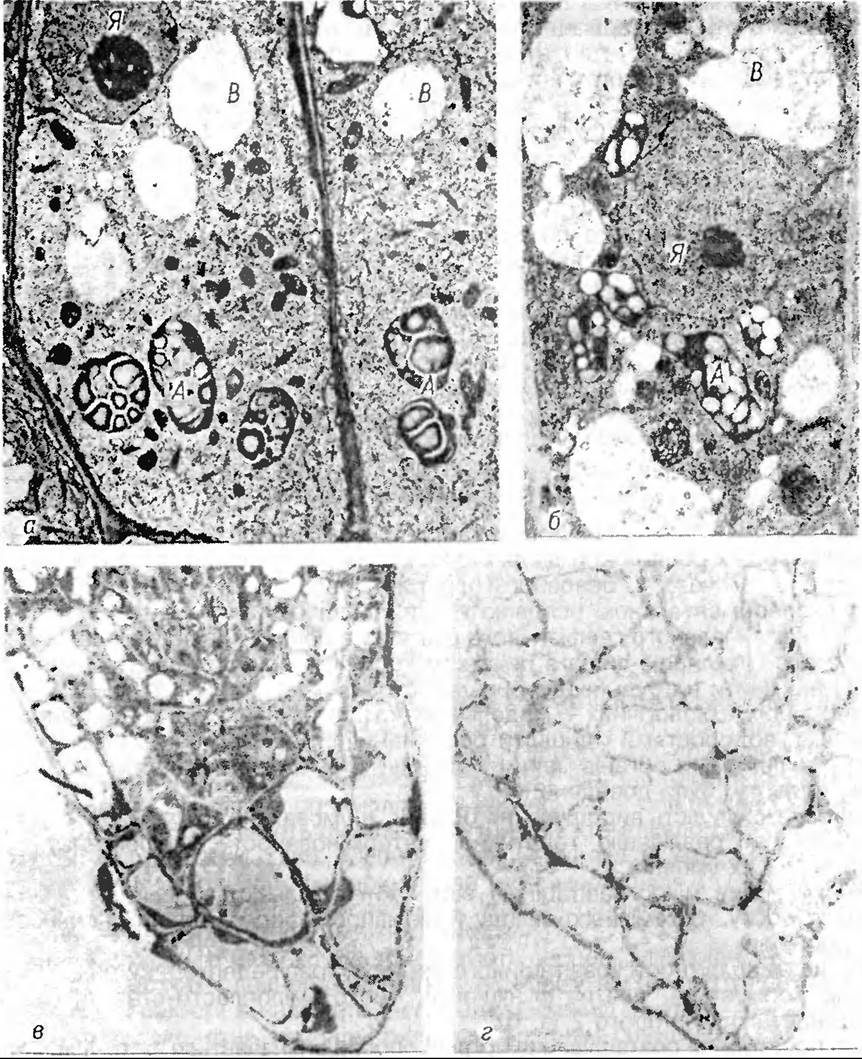
Class="center">Photo 2. Statocytes of the main root (a, b) and lateral root apices (c, d) of Arabidopsis thaliana: a, c — control, b — clinostating, d — spaceflight, 65 days. A — amyloplast, V — vacuole, N — Nucleus (photos provided by E.L. Kordium)
The current advancement of research in this direction has led to THE CONCEPT OF cultivating plants on space stations, beyond the influence of Earth's gravitational field. Plants are expected to become one of the most critical components of independent closed-loop life support systems in orbital complexes, providing flight participants not only with food but also by Processing human waste products. They can absorb O2 during Respiration and exhale CO2, while green plants ensure the reverse gas exchange process via Photosynthesis. Human metabolic waste will partially fulfill the Nutritional Requirements of the plants, and the water released through Transpiration, upon proper Condensation, could serve as drinking water for the crew. In space, plants can utilize electric lamp light powered by the spacecraft's external solar panels. Although plant organisms will reside in a gravity-free environment, their spatial orientation can be influenced by weak centrifugal forces and phototropism.
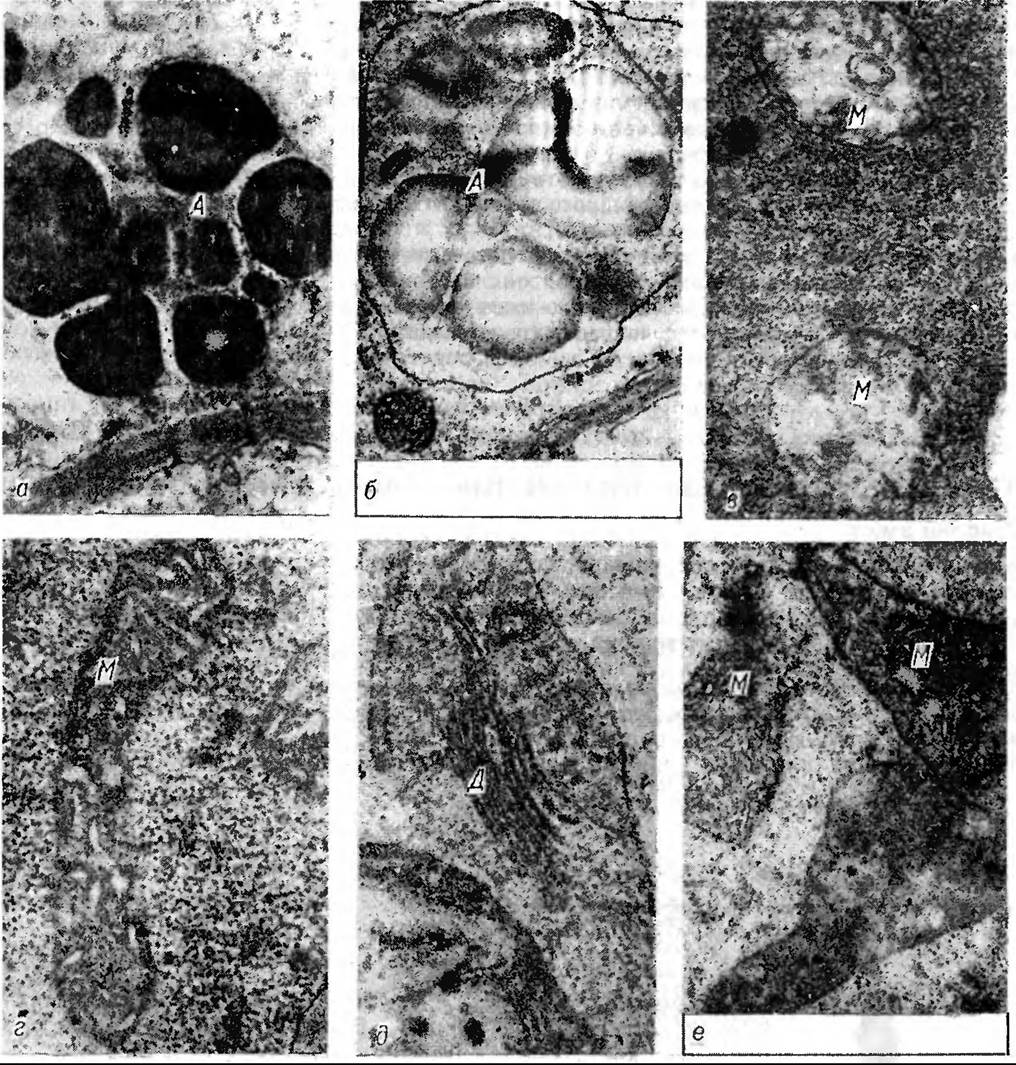
Photo 3. Statocyte fragments of Pisum sativum (a, b), meristematic Cells of the main root of P. sativum (c-e) and Impatiens balsamina (f): a, c — control, b, d, f — spaceflight, 7 days (b, d), 13 days (f), A — amyloplast, D — dictyosome, M — mitochondrion (photos provided by E.L. Kordium)
Space exploration has also opened up new Perspectives for humanity in utilizing plant resources on our home planet, Earth. Monitoring plant cover using photography and spectrophotometry across various wavelengths allows for the characterization of vegetation, assessment of nutrient status and disease damage, and the execution of large-scale Ecological and Physiological experiments. There is hope that in the future, these can be harnessed for the benefit of all humankind.
Thus, by applying traditional plant physiology knowledge and modern technology, biotechnology can make a significant contribution to:
·increasing the yield, nutritional quality, and shelf life of food and feed crops;
·enhancing crop resistance to diseases and pests to reduce the demand for chemical pesticides;
·developing safe and effective Methods of biological control against disease-vector insects, particularly those resistant to pesticides;
·improving soil fertility and the efficiency of plant nutrient uptake;
·utilizing phototrophic controlled biosyntheses to produce Pharmaceuticals, food products, and raw Materials, and introducing novel non-traditional crops;
·implementing more cost-effective and efficient methods for wastewater Treatment and hazardous industrial waste disposal;
·providing renewable sources of energy and raw materials by unlocking the physicochemical mechanisms of photosynthesis and utilizing organic waste and biomass.
Future discoveries will undoubtedly surpass our boldest dreams and vastly broaden the horizons of modern knowledge about the plant Organism. A long road lies ahead of us on this path, and the future will depend heavily on the wisdom and professional training of those now entering the third millennium—who, I hope, include the readers of this book.
Last update: 07/08/2026
Editorial and Educational Adaptation: This material has been compiled based on the primary/original source text. The project team performed an editorial review, corrected technical inaccuracies, structured sections, and adapted the content for an educational format.
What was processed:
- elimination of formatting defects (OCR errors, structural breaks, corrupted characters);
- editorial organization of content;
- standardization of terminology in accordance with academic sources;
- verification of factual statements against the original source text.
All mentions of the author, publication year, and origin of the primary text have been preserved in accordance with the source.