MODERN BOTANY - P. RAVEN - 1990
SECTION I. THE PLANT CELL
CHAPTER 2. THE EUKARYOTIC CELL
Cells are the Structural and functional units of living organisms (Fig. 2-1). The smallest living organisms consist of a single Cell, whereas the largest are composed of billions of cells, each performing a specific function and remaining relatively independent. The realization that all organisms are made of cells stands as one of The most significant theoretical Milestones in the history of biology, providing a unified framework for studying all living things. At THE CELLULAR LEVEL, even the most distantly related species share striking similarities in Structure and Biochemical properties. The Cell Theory was formulated in the early 19th century, long before Darwin proposed his theory of evolution, yet these two fundamental concepts are intimately connected. The similarities among cells echo the long evolutionary history that links modern organisms—including plants and humans alike—to the first cellular structures that emerged on Earth billions of years ago.
There are many diverse types of cells. The Human Body alone consists of more than a hundred types of cells. A single teaspoon of pond Water contains not just one single-celled Organism, but likely hosts several hundred species from the pond ecosystem. Plants are made of cells that look entirely different from those in the human body, and insects possess cell types found neither in plants nor in vertebrates. Thus, a defining feature of cells is their incredible diversity.
Another, even more fundamental feature is their similarity. Every living cell is a closed and partially independent unit enclosed by a Plasma Membrane, or Plasmalemma (often simply called The Cell membrane), which regulates the Transport of substances and ensures the Structural and Biochemical Separation of the cell from its environment. The interior of the cell is filled with Cytoplasm, which in most cells contains a variety of Organelles along with dissolved or suspended substances. Furthermore, every cell contains DNA, which encodes Genetic information (see Chapter 8). METABOLISM/28.html">The Genetic Code is universal across all organisms, whether bacterium, oak tree, or human.
Prokaryotes and Eukaryotes
All organisms can be divided into two major groups: PROKARYOTES AND EUKARYOTES. These terms derive from the Greek word *karion*, meaning kernel or nut. Thus, prokaryote means "before The Nucleus," while eukaryote means "possessing a true, or well-defined, nucleus."
Class="center">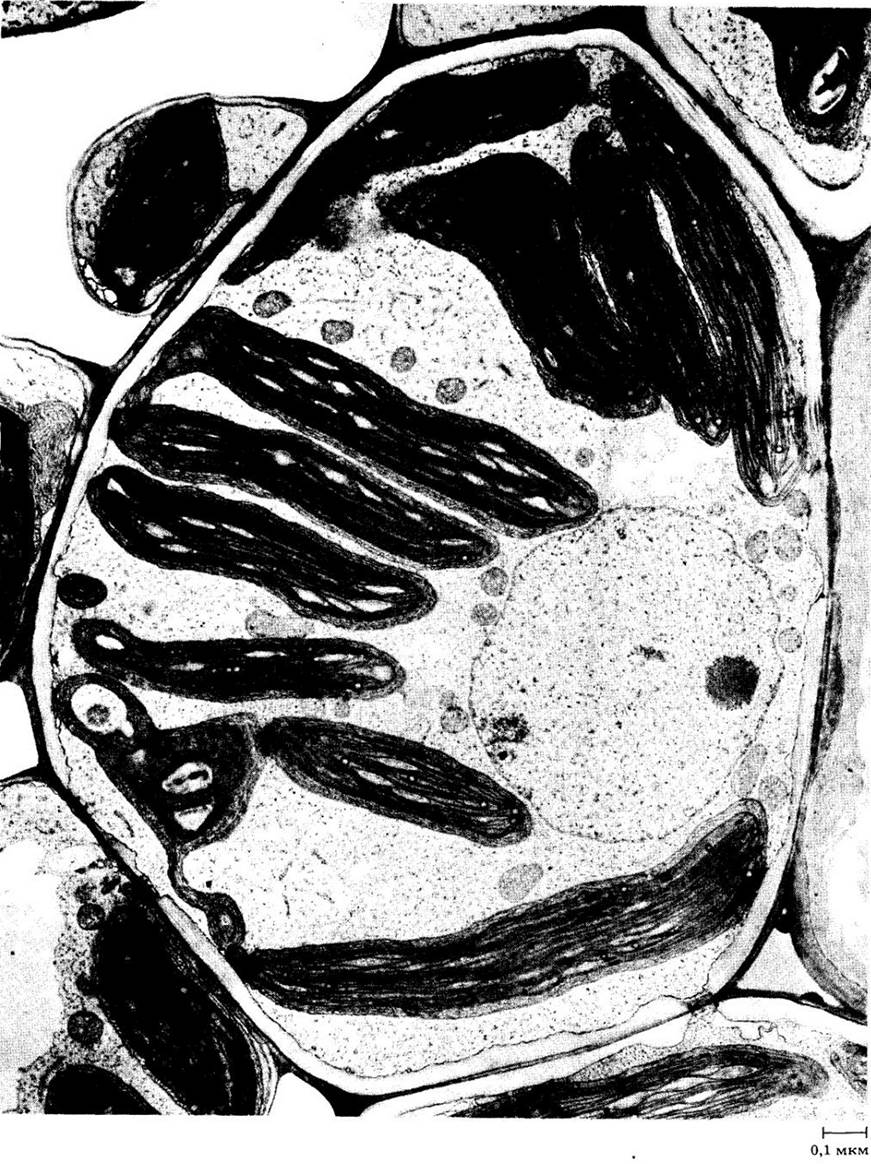
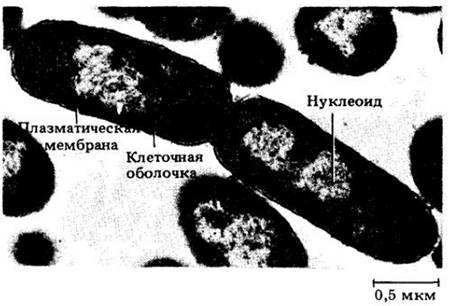
Prokaryotes are also referred to as Bacteria. This group includes cyanobacteria, formerly known as blue-green Algae (see Chapter 11). The primary distinction between prokaryotic and Eukaryotic cells is that prokaryotic DNA is not organized into complex, protein-bound structures called Chromosomes, nor is it enclosed by a membrane (Fig. 2-2). Bacteria also lack other specialized, membrane-bound structures.
Fig. 2-2. The bacterium *Escherichia coli* is a common and typically harmless inhabitant of the Human digestive tract, serving as an example of a Introduction/4.html">Prokaryotic Cell. This rod-shaped organism possesses a Cell wall, a plasma membrane, and cytoplasm. Two dividing cells are visible, not yet fully separated from each other. The DNA is located in a less granular region called the nucleoid, situated in the center of the cell. The cytoplasm appears granular due to numerous Ribosomes, which are the sites of Protein Synthesis. Ribosomes are tiny bodies approximately 20 nm in diameter.
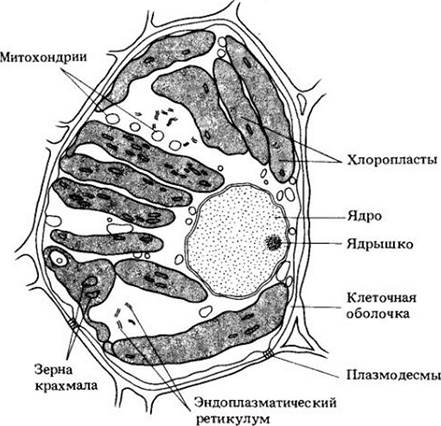
Eukaryotic cells are partitioned into distinct compartments (Fig. 2-1). Protein-associated DNA is organized into chromosomes located within a nucleus, which is bounded by a double membrane (the nuclear envelope). Eukaryotic cells are typically larger than Prokaryotic Cells.
Fig. 2-1. Left: A cross-section of a plant cell (from a bundle sheath of a corn leaf, *Zea mays*) viewed under an Electron microscope. The diagram on the right labels various cellular structures. The nucleus, which houses genetic information, is visible at the bottom right, with its nucleolus clearly distinguishable. Also visible are Chloroplasts (organelles where Photosynthesis takes place) and Mitochondria (organelles where nutrients are broken down to release and store energy). Some chloroplasts contain light-colored, oval starch grains.
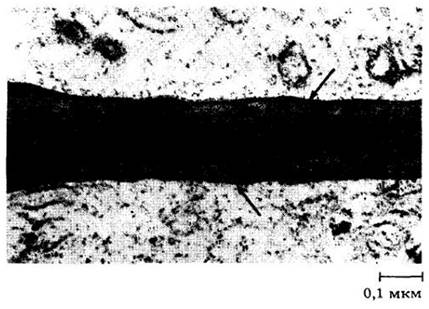
The compartmentalization of eukaryotic cells is achieved through membranes. When viewed under an electron microscope, the membranes of cells from various organisms appear trilaminar, or three-layered (Fig. 2-3). Two dark layers, each about 25 Å thick, are separated by a lighter layer approximately 35 Å thick. This three-layered Membrane Structure is referred to as a unit membrane.
Fig. 2-3. At high magnification, the cell membrane appears three-layered (dark-light-dark). The photograph shows the Plasma Membranes (indicated by arrows) on either side of the middle lamella between two leaf endodermis Cells of the fern *Blechnum brasiliense* (or *Vittaria* species). Such membranes are called unit membranes.
Last update: 07/08/2026
Editorial and Educational Adaptation: This material has been compiled based on the primary/original source text. The project team performed an editorial review, corrected technical inaccuracies, structured sections, and adapted the content for an educational format.
What was processed:
- elimination of formatting defects (OCR errors, structural breaks, corrupted characters);
- editorial organization of content;
- standardization of terminology in accordance with academic sources;
- verification of factual statements against the original source text.
All mentions of the author, publication year, and origin of the primary text have been preserved in accordance with the source.