MODERN BOTANY - P. RAVEN - 1990
SECTION IV. DIVERSITY
CHAPTER 12. VIRUSES
Viral Replication
Prior to Replication, the viral nucleic acid is freed from its capsid and envelope. For example, in bacteriophage T4, the capsid remains outside the host Cell; in other Viruses, the capsid or envelope separates from the nucleic acid inside The Cell; in a third case, they may be dissolved by host cell Enzymes. In some viruses, certain Proteins must be introduced into the infected cell in a complex with the nucleic acid, as many of these proteins function as polymerases essential for viral replication. Once the viral genome is released from the capsid or envelope within the host cell, subsequent events can proceed via one of two pathways.
1. The virus multiplies by co-opting the cell's genetic apparatus. Viral reproduction occurs in three stages. First, viral Nucleic Acids "coerce" the cell into synthesizing new viral enzymes. Second, virus-specific Nucleic Acids and Proteins are synthesized in the required quantities. Finally, Viral Particles are assembled. These stages overlap in time and are genetically regulated, resulting in The production of A large number (sometimes thousands) of viral particles per cell. In the case of Bacteriophages, progeny viral particles exit the host Cells by destroying them. Such cells are said to have undergone lysis (from the Greek lysis, meaning loosening or dissolution), and such viruses are termed lytic. Productive infection does not always lead to lysis. Many animal viruses exit the cell by budding from The Plasma Membrane, whereas plant viruses move through plasmodesmata and eventually via the Vascular Tissues to other PARTS OF THE plant.
2. The viral genome integrates into the host cell genome. Certain bacteriophages, for instance, possess DNA fragments homologous to Regions of the bacterial genome. These viruses can integrate into the cell genome via recombination, in which case they are referred to as temperate phages, since cell lysis does not occur. The integrated virus is called a prophage. Viruses involved in Transduction are temperate phages. Some animal viruses are also temperate, although no such cases are known among plant viruses.
In DNA viruses, such as the vaccinia virus causing livestock disease, the DNA directs the synthesis of mRNA, which in turn serves as a template for the synthesis of various proteins. DNA may be single- or double-stranded. In most RNA viruses, such as tobacco mosaic virus, The Genome is represented by a single-stranded molecule. Within the host cell, a complementary strand is synthesized on this molecule, serving as a template for the production of new RNA. These strands bind to cellular Ribosomes and function as Messenger RNA, directing the synthesis of viral coat Proteins and Enzymes.
The METABOLIC ACTIVITY OF viruses can significantly alter host cell METABOLISM. In a single species of Clostridium, the production of the lethal toxins responsible for botulism occurs only with the active and prolonged participation of specific bacteriophages. Uninfected Bacteria do not produce these toxins. Even more remarkably, infection by a different bacteriophage induces the exact same bacterial strain to produce toxins that contribute to The Development of gas gangrene and numerous other diseases. Until recently, botulism and gas gangrene were thought to be caused by different species of Clostridium, but it is now believed they are caused by the same species, albeit infected by different bacteriophages. Similarly, some "new" species of plants and Fungi have later turned out to be long-known species that acquired specific traits under The Influence of viral infection.
Diversity of Viruses
No one knows how many viruses exist, and new species can almost always be isolated by investigating new groups of organisms. Virus nomenclature is currently undergoing intensive development; the Latin binomial names accepted in modern Taxonomy are not typically applied to viruses. Bacteriophages are designated by letters and numbers, such as T7 (where T stands for "type"). Plant viruses usually have common names, such as TMV for tobacco mosaic virus; animal viruses are sometimes given Latin names similar to bacteria. The MAIN TYPES OF viruses are discussed below.
RNA Viruses
Single-stranded RNA viruses are subdivided into positive-sense (plus-strand) and negative-sense (minus-strand) genomes. In the former case, the RNA Functions directly as mRNA, whereas in the latter, a complementary strand is synthesized to serve as a template for viral mRNA production. In turn, positive-sense RNA viruses are divided into two groups depending on the presence or absence of an envelope. For example, tobacco mosaic virus is nonenveloped. Nonenveloped positive-sense RNA viruses include poliovirus and FOOT-and-Mouth disease virus. Furthermore, this category accounts for approximately one-third of all viruses causing human respiratory diseases.
Enveloped positive-sense RNA viruses include arboviruses, which are transmitted by Arthropods and cause numerous diseases, particularly in tropical regions. Yellow fever, for instance, is transmitted from infected monkeys to humans by mosquitoes.
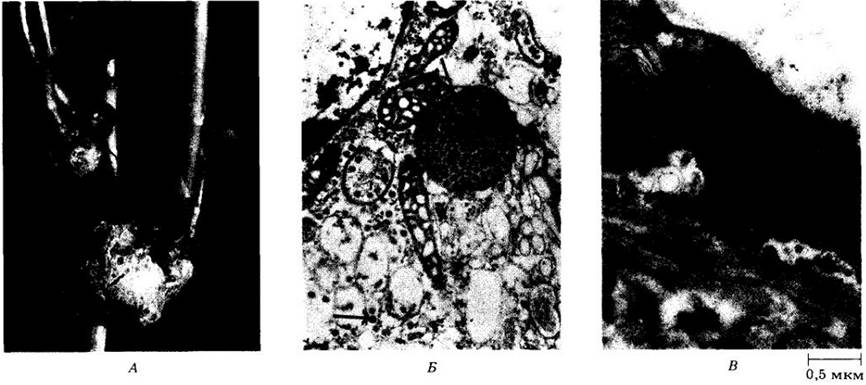
Negative-sense RNA viruses cause such diseases as rabies, measles, mumps, Newcastle disease in poultry, and various animal plagues. All of these viruses, with the exception of the rabies virus, belong to the paramyxovirus group and possess a complex Structure. They are enveloped, measure 300 nm in diameter, and internally resemble the tobacco mosaic virus, in which protein subunits are arranged helically around the RNA. Influenza virus is also a negative-sense RNA virus whose genome consists of a single-stranded RNA. Viruses with double-stranded RNA include the wound tumor virus of plants (Fig. 12-8), which has an unusual replication process and is transmitted by leafhoppers.
Class="center">Fig. 12-8. A. Tumors on white sweet clover (Melilotus alba) induced by wound tumor virus. B. Wound tumor virus particles (indicated by arrows) in an electron micrograph of a host plant cell. C. The leafhopper (Agallia constricta), a vector of the wound tumor virus. Electron micrograph of an epidermal cell of Agallia. Numerous viral particles are visible in the upper left, forming honeycomb-like aggregates. Individual viral particles can be seen in the lower right. Like many plant viruses, the wound tumor virus contains double-stranded RNA.
Introduction/6.html">DNA-containing viruses
Double-stranded DNA viruses cause Papillomas (papillomaviruses) and herpes (Herpesviruses). Herpesvirus infections lead to The formation of ulcers and fluid-filled blisters on mucous membranes (the so-called "cold sores"). In many cases, herpesviruses cause genital infections, chickenpox, shingles, mononucleosis, certain types of Cancer, and fatal systemic infections in newborns. Another group of such DNA-containing viruses—Poxviruses—includes larger and more complex viruses, such as vaccinia virus. Hepatitis B is caused by a virus containing partially double-stranded DNA, whereas hepatitis A is caused by an RNA virus.
Two groups of DNA-containing viruses—caulimoviruses and geminiviruses—infect plants. The molecular properties of geminiviruses are unusual; they consist of two virions with imperfect icosahedral structures. Each virion encloses a single-stranded DNA molecule, and both molecules are required for infection to occur. Bean golden mosaic is caused by geminiviruses transmitted by whiteflies. Another disease, maize streak, is caused by a virus spread by leafhoppers.
Cauliflower mosaic virus is transmitted by aphids and belongs to the group of double-stranded DNA caulimoviruses. The particles of these viruses are icosahedral in shape. Breaks in the DNA molecule prevent the formation of a continuous double helix along its entire length. Caulimoviruses are being intensively studied because they can potentially serve as vectors for introducing desired genes into plants.
Plant Viral Diseases
Over a thousand known plant diseases are caused by viruses belonging to approximately 100 different genera (Fig. 12-8). Plant viral diseases are typically spread by invertebrate vectors such as insects or nematodes. Sucking insects, such as aphids and leafhoppers, transmit the virus via sap extracted from the phloem or epidermal cells. Some viruses multiply within the vector just as efficiently as they do in the Cells of the infected plant.
Necroses are characterized by the appearance of dead tissue patches, whereas mosaic diseases cause leaves or other plant parts to become mottled; both of these widespread disorders are caused by viruses. In mosaic disease, small light-green and yellow spots or large streaks appear on the leaves or other green parts of the plant. Sometimes the entire infected plant may appear lighter in color than a healthy one. Yellow spots or marginal chlorosis on the leaves of certain crops are caused by viruses, and variegated flower coloration is also the result of a viral infection transmitted from generation to generation (Fig. 12-9).
Fig. 12-9. Variegated tulip flowers. This coloration is caused by a virus.

Mosaic viruses primarily affect parenchyma tissues, reducing or completely depleting the number of Chloroplasts. Others accumulate in the sugar-rich phloem sap and can lead to the death of its cells. Viral diseases significantly reduce cereal crop yields worldwide, affecting a vast number of species. Virus-free plants can be obtained through tissue culture; in this process, the virus-free tip of the meristematic tissue is excised from the parent plant and cultivated in vitro, where it gives rise to a new plant. This method has successfully increased yields in potatoes and rhubarb.
An interesting discovery was recently made regarding the rice necrotic mosaic virus, which stunts plant growth upon infection. In 1982, S. K. Ghosh of the Indian Central Institute of Scientific Research discovered that certain plants (such as jute, a source of coarse fibers for sacks and ropes) actually grow better when infected with the virus than when healthy. This phenomenon remains unexplained. While this example highlights the complex nature of virus-plant interactions, it is logical to assume that such cases will be profitably harnessed for economic purposes in the future.
Plant viruses typically contain RNA, with the exception of caulimoviruses and geminiviruses (see p. 179). In most cases, the capsid of plant viruses consists of a single type of protein (or two types in comoviruses). A hallmark feature of RNA-containing plant viruses is their frequently fragmented genome. Preparations of certain viruses contain several outwardly identical TYPES OF VIRAL particles, with each particle carrying a distinct RNA fragment. The genome of many viruses is represented by two to four RNA fragments of varying sizes, each encapsidated separately, meaning that viral particles can be heterogeneous in shape and density. The pathways by which RNA fragments interact to ensure infectivity vary across different virus groups. In positive-sense single-stranded RNA viruses, replication occurs in two stages: first, a negative strand is synthesized using the original RNA as a template, and then a positive strand (mRNA) is synthesized on the newly formed template.
Last update: 07/08/2026
Editorial and Educational Adaptation: This material has been compiled based on the primary/original source text. The project team performed an editorial review, corrected technical inaccuracies, structured sections, and adapted the content for an educational format.
What was processed:
- elimination of formatting defects (OCR errors, structural breaks, corrupted characters);
- editorial organization of content;
- standardization of terminology in accordance with academic sources;
- verification of factual statements against the original source text.
All mentions of the author, publication year, and origin of the primary text have been preserved in accordance with the source.