MODERN BOTANY - P. RAVEN - 1990
SECTION IV. DIVERSITY
CHAPTER 12. VIRUSES
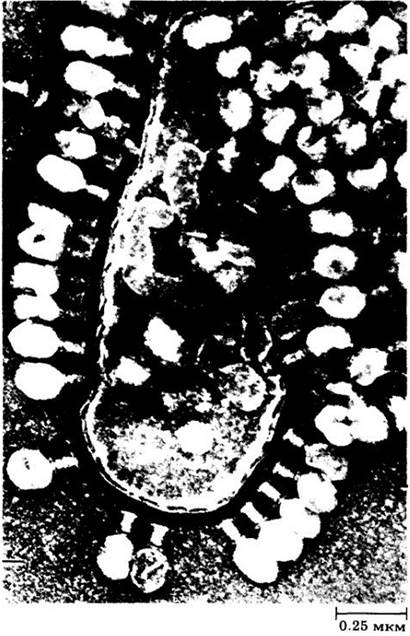
A virus consists mainly of genomic nucleic acid that replicates within a host Cell, utilizing the host's enzymatic systems to synthesize virus-specific Nucleic Acids and Proteins (Fig. 12-1). Because a virus cannot grow or reproduce on its own, it cannot be considered a "living" Organism in the traditional sense. Depending on the type of virus, its core contains either DNA or RNA, which may be single- or double-stranded. All Viruses possess a protein coat (capsid) that encloses the nucleic acid; some also feature an outer, lipid-rich envelope surrounding the capsid. The protein or lipoprotein coat "recognizes" the surface to which the virus adsorbs and protects the nucleic acid within the virion.
Class="center">Fig. 12-1. T2 bacteriophage infecting an Escherichia coli cell. The Introduction of viral DNA has caused the bacterial cell to undergo lysis.
Viruses are of great significance because they are widespread in plants and other organisms, frequently causing disease. In humans, viruses cause numerous conditions, including smallpox, chickenpox, measles, mumps, Influenza, respiratory illnesses (often complicated by secondary bacterial infections), infectious hepatitis, yellow fever, poliomyelitis, rabies, herpes, and AIDS (Acquired Immunodeficiency Syndrome). Sometimes viruses of the same group can infect both plants and animals. Disease results from a drastic disruption of the normal metabolic processes of the infected cell. Many viral diseases in animals can be prevented through immunization, the effectiveness of which against smallpox was first demonstrated in the 1790s by the English physician Edward Jenner. However, as established, viral infections are difficult to treat because viruses are insensitive to Antibiotics. Fortunately, in many cases, The Immune System limits the further spread of the infection.
Cells of a living organism can be infected simultaneously by various viruses. Occasionally, a virus isolated from one host can infect the cells of another. Consequently, it is difficult to determine the exact number of virus species in existence today; at least 400 plant viruses have been described and categorized into 25 groups. Viruses affect not only eukaryotic organisms but also Bacteria. Bacterial viruses are called Bacteriophages ("bacteria eaters") or simply phages. Phages are an essential tool in modern molecular biology; by investigating the interactions between phages and bacteria, we have gained profound insights into the mechanisms of Protein Synthesis AND Gene Organization. Viruses are widely used in research on METABOLISM/36.html">DNA Replication, gene regulation, Transcription, Translation, RNA Processing, and The Nature of Cancer. They essentially serve as natural vectors for Genetic information, making them indispensable in modern biotechnology. They have provided the basis for vectors used to transfer genes into bacterial, animal, and plant cells. The Use of viruses in Plant Genetic Engineering will undoubtedly expand in the near future and have a significant impact on botanical and agricultural research. Furthermore, scientists believe that, alongside bacteria, viruses could be harnessed to stimulate the synthesis of useful and valuable substances within cells.
Various Forms of insect-infecting viruses are currently being studied to develop novel biological pest control Methods. Some success has already been achieved; for instance, in the USA, the cotton bollworm (Heliothis zeae) is effectively controlled using a virus. These control methods are practically harmless compared to the repeated application of chemical pesticides; moreover, the virus exhibits a high degree of Specificity toward its target parasites, which is critically important.
The Nature of Viruses
The existence of viruses was first discovered during The Study of tobacco mosaic disease. It was found that the CAUSATIVE AGENT OF this disease could pass through a porcelain filter normally used to trap bacteria. Viruses range from 17 to 300 nm in diameter. Thus, in terms of size, they are comparable to molecules; for example, a hydrogen atom has a diameter of about 0.1 nm, while the size of an average protein molecule spans tens of nanometers.
As mentioned above, viruses reproduce only within living cells; many of them are highly specific regarding the type of cells they infect. They radically alter the biosynthetic processes of the host cell, with the viral nucleic acid redirecting The Cell to synthesize virus-specific structures, thereby competing with the host's genetic apparatus (see Fig. 8-3). For example, respiratory viruses replicate in the Cells of the respiratory mucosa, causing typical cold symptoms. Viruses generally have a narrow host range; one rapid method for identifying unknown bacteria involves using specific bacteriophages that lyse particular bacterial cells (Fig. 12-1). Conversely, the response of certain plant species to an unknown virus can be used (in combination with other methods) to identify that virus.
Until the 1930s, viruses were regarded as extremely small bacteria. This view was disproven in 1933 when Wendell Stanley, working at the Rockefeller Institute, extracted and purified tobacco mosaic virus from infected plants. The purified virus precipitated in the form of crystals. Crystallization is one of the primary tests for the presence of a chemically pure compound free of impurities; thus, it became clear that from
a chemical standpoint, a virus is much simpler than a living organism. When Stanley dissolved the needle-like crystals and applied the solution to a tobacco leaf, the characteristic symptoms of mosaic disease reappeared. This demonstrated that the virus retains its infectivity even after crystallization and resuspension.
Most plant viruses, like the tobacco mosaic virus, contain only RNA, whereas other viruses contain only DNA. In contrast to viruses, all cellular organisms contain both Types of Nucleic acids. Viruses lack Ribosomes as well as the Enzymes required for protein synthesis and energy generation. In this regard, viruses are fundamentally different from organisms with Cellular Organization.
Last update: 07/08/2026
Editorial and Educational Adaptation: This material has been compiled based on the primary/original source text. The project team performed an editorial review, corrected technical inaccuracies, structured sections, and adapted the content for an educational format.
What was processed:
- elimination of formatting defects (OCR errors, structural breaks, corrupted characters);
- editorial organization of content;
- standardization of terminology in accordance with academic sources;
- verification of factual statements against the original source text.
All mentions of the author, publication year, and origin of the primary text have been preserved in accordance with the source.