MODERN BOTANY - P. RAVEN - 1990
SECTION IV. DIVERSITY
CHAPTER 11. BACTERIA
Conclusion
Bacteria belong to prokaryotes; they lack a defined Nucleus and membrane-bound cellular Organelles, and they do not reproduce sexually. Their genetic material is represented by a single circular molecule of double-stranded DNA. With the exception of Mycoplasmas and spiroplasmas, bacteria possess a rigid Cell wall. In all groups except archaebacteria, The Cell wall consists of a peptidoglycan macromolecule and sometimes contains lipopolysaccharides that make up the major part of its outer layer. Bacteria are typically unicellular organisms, although following division they may remain attached to
one another, forming filaments or other pseudo-multicellular structures.
Most bacteria are heterotrophs; along with Fungi, they function as decomposers in the global ecosystem. Based on their metabolic type, bacteria can be divided into diverse groups; the majority are heterotrophs, but There are also photosynthetic forms (photoautotrophs) as well as chemoautotrophs. Some bacteria are strict aerobes, others are obligate anaerobes, and facultative anaerobes also occur. Many species play a vital role in the nitrogen, sulfur, and carbon cycles. Others cause diseases in animals and plants.
Photosynthetic bacteria are divided into at least five groups, including cyanobacteria and Prochloron, which contain chlorophyll a typical of photosynthetic eukaryotes. Chemosynthetic bacteria obtain energy by oxidizing inorganic molecules. Some of them oxidize Proteins AND AMINO acids, converting ammonia into nitrites, while others transform nitrites into nitrates, thus playing an indispensable role in The Nitrogen Cycle. Furthermore, many cyanobacteria can fix atmospheric nitrogen or form layered chalky structures known as stromatolites.
Bacteria can be rod-shaped (bacilli), spherical (cocci), or spiral (spirilla). If the cell wall fails to divide completely, daughter Cells may form clusters, filaments, or dense aggregates. Bacteria sometimes possess flagella and are capable of locomotion; flagella may cover the entire cell surface or be localized at one pole. The rotational movement of flagella allows bacteria to navigate through Water, swim toward nutrients, or avoid toxic substances. Some bacteria bear short, rod-like appendages called fimbriae. Bacteria can also move by gliding.
Archaebacteria, many of which are methanogenic, possess a unique rRNA nucleotide sequence. They survive in extreme environmental conditions and resemble organisms that existed during the Cytology/cytology/16.html">Early stages of life's evolution.
Mutations, along with a high rate of reproduction, are the primary drivers of bacterial Variability. Genetic recombination also occurs, involving The transfer of DNA from one cell to another. This transfer can take place via conjugation, transformation (the passive uptake of DNA fragments present in the environment), or Transduction (the injection of DNA into a bacterial cell by a bacteriophage).
Appendix 1. Bacteria and Fossil Fuels
It was previously believed that deposits of oil, coal, and natural gas originated primarily from marine plankton and land plants that inhabited swamps or similar environments under warm, mild climates. It has now become evident that bacteria, which decomposed the remains of these organisms, played a crucial role in The formation of fossil fuels. French researchers discovered traces of bacterial biochemical activity in petroleum, and recently, bacteria themselves have been identified within it using an Electron microscope.
Class="center">These bacteria were discovered in oil shales from Toolbooka (Queensland, Australia) and illustrate the work of Miriam Glickson. The shales under study date back to the Cretaceous period and are 120 million years old. A. Filamentous bacteria, likely cyanobacteria; fragments of these filaments are visible. Such bacterial remains, together with abundant calcareous inclusions within the shale matrix, led Dr. Glickson to conclude that cyanobacteria were the primary source of organic matter present in the shales. B. Doughnut-shaped bacteria resembling Flectobacillus marinus. They decompose planktonic protists and are occasionally preserved in petroleum deposits, which were largely formed As a result of The activity of these bacteria.
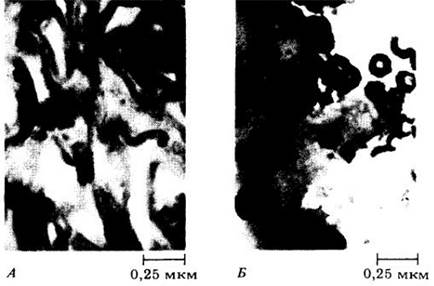
At the Australian National University in Canberra, geologist Miriam Glickson collected and concentrated organic material from 120-million-year-old oil-rich shales. The researcher dried it, embedded it in resin, prepared sections for Electron Microscopy, and discovered several types of bacteria. Some resembled currently living marine species that decompose Algae and other organic matter, while others resembled cyanobacteria. Preliminary results obtained by Dr. Glickson suggest that bacteria played a lesser role in petroleum formation in freshwater bodies than in marine environments.
Appendix 2. Citrus Canker
One of the most severe outbreaks of this disease began relatively recently—in August 1984, when citrus seedlings with yellow and brown specks were discovered in a nursery in Avon Park, Florida. They were found to be infected with canker caused by one of over 100 strains of the bacterium Xanthomonas campestris. Other members of this species infect peach trees, legumes, cabbage, and other plants, but the strain infecting citrus poses a particular threat to agricultural producers. Within four months of the Discovery of the diseased plants, 7 million citrus seedlings perished in Florida despite all efforts to halt the spread of the disease. Substantial funding was invested in the USA to study this disease.
Citrus canker, which spread extremely rapidly across Florida in 1984. A. Infected orange fruit and leaves. B. Damaged stem of an orange tree.

Citrus canker (whose symptoms include lesions on stems, leaves, and fruit) spreads very rapidly; it is transmitted via packing crates, wrapping Materials, transported plants, and numerous other pathways. Strains of bacteria affecting citrus vary in their symptoms, sites of infection, and the specific citrus species susceptible to them.
Prior to the 1984 tragedy, Florida had been free of citrus canker for forty years. What caused the new outbreak? Unfortunately, none of the strains that infected plants in the 1930s survived, although comparison with the new strain would have been valuable. The new strain was introduced from abroad: nearly 5,800 shipments of canker-infected fruit were intercepted by inspectors at U.S. ports between 1971 and 1983, illustrating the immense economic importance of rigorous agricultural import controls.
Only The Development of resistant citrus cultivars, such as those grown in Japan, will restore the Florida citrus industry, which in 1983 had a turnover of $2.5 billion. Approximately 58% of all orange juice consumed by Americans in the 1980s came from Florida, and another 35% from Brazil.
Last update: 07/08/2026
Editorial and Educational Adaptation: This material has been compiled based on the primary/original source text. The project team performed an editorial review, corrected technical inaccuracies, structured sections, and adapted the content for an educational format.
What was processed:
- elimination of formatting defects (OCR errors, structural breaks, corrupted characters);
- editorial organization of content;
- standardization of terminology in accordance with academic sources;
- verification of factual statements against the original source text.
All mentions of the author, publication year, and origin of the primary text have been preserved in accordance with the source.