MEDICAL BOTANY - A.G. Serbin - 2003
SECTION 3. SYSTEMATICS
SUPERKINGDOM EUCARYOTA — EUCARYOTA. KINGDOM PLANTAE
DIVISION GYMNOSPERMAE — GYMNOSPERMAE
Gymnosperms are seed plants that flourished during the Mesozoic era. Today, the division comprises about 800 species. Like other archegoniates (mosses, horsetails, clubmosses, and ferns), gymnosperms possess archegonia, but unlike them, their dissemination and reproduction occur through seeds rather than spores. Seeds are believed to have first emerged in seed ferns, which are currently known from Upper Devonian fossils.
THE ECOLOGICAL AND national economic significance of gymnosperms is difficult to overestimate. The subzone of coniferous forests, or taiga, stretches in a vast, continuous belt across Europe and Asia from the Atlantic to the Pacific Ocean. The mixed forest subzone is well-represented in the European part of the forest zone. Forest biocenoses are home to numerous game animals, birds, and beneficial insects, for which needles, young shoots, cones, and seeds serve as an indispensable food source. Coniferous forest air is distinguished by an elevated content of ozone and phytoncides, which possess disinfecting properties. Gymnosperm plants provide the bulk of valuable structural and decorative timber, serve as raw Materials for The production of Cellulose, rayon, viscose, and staple fiber, and are a source of resins, balsams, camphor, alcohol, acetic acid, Vitamins, Tannins, and other substances. The seeds of many species contain fatty oils.
Forest conservation, afforestation, and careful, rational management should be a priority for every individual and the entire community.
The division Gymnosperms is subdivided into six classes: seed ferns and Bennettitales (extinct classes known only from fossils), cycads (relict, rare plants surviving in tropical and subtropical Regions of the globe — Middle America and Southeast Asia), ginkgoes, conifers, and gnetophytes. Ginkgoes originated in the Permian period and have survived to the present day represented by a single species — Ginkgo biloba (growing wild in China and cultivated in botanical gardens worldwide as the last representative of a dying Class and as a valuable medicinal plant).
Class Conifers — Pinopsida
This is the most widespread and numerous group of modern gymnosperms, comprising about 700 species. Conifers are the best adapted to contemporary environmental conditions, having achieved a high degree of xeromorphism: in winter, they transpire several dozen times less Water than angiosperms. Conifers are distributed all along the perimeter of the Pacific Ocean. The most ancient and currently most widely represented center of origin is the Chinese region — Japan and China.
Main characteristics of conifers:
✵ represented by evergreen trees, and more rarely shrubs and lianas;
✵ plants are heterosporous, usually monoecious, and wind-pollinated; pollen typically features two air bladders;
✵ ROOT system is taproot-based, with well-developed mycorrhizae;
✵ stem exhibits monopodial growth;
✵ leaves are needle-like (needles), lasting 2 — 3 years, or scale-like;
✵ sporangia are located on modified leaves — micro- and megasporophylls, which are aggregated into male and female cones, or strobili, respectively;
✵ seeds are not protected by a pericarp and lie exposed (naked) on the megasporophylls;
✵ embryo possesses multiple cotyledons and a prolonged dormant period;
✵ wood consists of tracheids, with no vessels; sieve tubes of the phloem lack companion Cells;
✵ all Organs are typically permeated with schizogenous resin ducts;
✵ a chemosystematic feature is the presence of phytoncides, Essential Oils, resins, and balsams.
Cone Structure
In appearance, gymnosperm cones are diverse and specific. They vary in size, shape, spatial orientation, coloration, structure and shape of sporophylls, adaptations for seed release, and other features. However, the fundamental structural principle of cones is uniform. Cones consist of an axis, separated from the vegetative part of the plant, which represents a shortened SHOOT bearing spore-bearing leaves — sporophylls.
The male cone axis (Fig. 3.91) is covered with microsporophylls, each bearing two microsporangia, or pollen sacs, on its underside. Inside these, haploid microspores are formed, which, following mitotic divisions, develop into the male gametophyte, or pollen grain. The pollen grain consists of a vegetative Cell and an antheridial cell, enclosed by two wall layers: the inner layer—the intine—is thin and elastic, whereas the outer layer—the exine—is thickened and features a spinulose-porous structure. The exine forms two bladder-like air sacs that facilitate wind pollination.
Fig. 3.91. Life Cycle of Scots pine (Pinus sylvestris): A — mature sporophyte; B — vegetative-reproductive shoot of the sporophyte bearing male cone clusters and female cones at various stages of maturity; C — young sporophyte; D — male gametophyte; E — female gametophyte; 1 — annual vegetative and reproductive shoots; 2, 3 — shortened previous-year reproductive shoots with fertilized and mature female cones; 3 — scale leaf; 4 — axillary leaf-bearing shortened shoot; 5 — pair of needles; 6 — young female cones (general view and longitudinal section detail); 7 — male cones (general view and longitudinal section); 8 — microsporophyll (cross and longitudinal sections); 9 — microsporangia with microspores; 10 — pollen development; 11 — bract scales; 12 — seed scales (longitudinal section and bottom view); 13 — ovules; 14 — seed with membranous wing; a — exine; b — intine; c — air sacs; d — antheridial cell; e — vegetative cell; f — spermatogenous cell; g — pollen tube

The female cone axis (Fig. 3.91) bears megasporophylls, or seed scales, on the inner surface of each being two megasporangia, or ovules. In the majority of gymnosperms, the female cone also possesses sterile bract scales typically situated beneath and appressed to the seed scales. Within the megasporangia, four megaspores are produced via meiotic (reduction) division, of which only one remains viable and develops into the haploid endosperm—the female gametophyte tissue. Near the micropyle, Cells of the endosperm give rise to two archegonia containing egg cells.
Fertilization in gymnosperms was first studied and described by the Russian naturalist I.N. Gorozhankin in 1880.
Pollen landing on a seed scale adheres to a viscous droplet secreted through the micropyle and is drawn inside the ovule, after which the cone scales close tightly and are sealed with resin. After 1 to 2 years, the pollen begins to germinate (Fig. 3.91). The vegetative cell elongates into a pollen tube that grows toward the archegonia, carrying the spermatogenous cell, which divides to form two non-motile sperm cells. Upon reaching the archegonium, the pollen tube ruptures; one sperm cell fuses with the egg cell, while the other degenerates. The resulting diploid zygote develops into the seed embryo. Nutrients accumulate in the endosperm and residual nucellus, and the integuments of the ovule transform into the seed coat.
The seed embryo, comprising a primary root, hypocotyl, apical bud, and several cotyledons, remains dormant for a certain period. Typically after 1.5 to 2 years, and occasionally longer, the cones reach their final size, turning brown and woody. Most often, upon seed maturation, the cone scales separate, the seeds are shed, and the cones fall. In some cases, the cones do not drop but disintegrate into individual scales, thereby releasing the seeds. In many conifers, the seeds feature a membranous wing that AIDS in wind dispersal. The seeds germinate after a prolonged dormant phase.
The class Coniferopsida (conifers) is divided into seven orders. We will focus on the Characteristics of Selected families within the orders Pinales and Cupressales.
Family Pinaceae — Pine family
In terms of geographical distribution and ecological dominance, the Pinaceae surpass all other families of vascular plants. They are evergreen, rarely deciduous trees with diverse crown shapes, occasionally prostrate shrubs. The leaves are needle-like (needles), scale-like, or narrowly lanceolate. Generic and specific variations in needle Morphology involve their size, cross-sectional shape, color, and arrangement on shoots. In some representatives, all shoots are similar and ordinary, with spirally arranged leaves (Picea, Abies). In other conifers, shoots are of several types: ordinary elongated or growth shoots (vegetative and mixed), and shortened shoots (vegetative and reproductive). Shortened vegetative shoots arise from the axils of scale leaves on ordinary shoots and bear clusters of needles (Pinus, Larix, Cedrus). Reproductive shoots are also termed cone-bearing shoots as they carry cones. Male cones are small, solitary, or aggregated into clusters. Female cones are large, solitary, and vary in shape, size, spatial orientation, and scale structure (Table 3.3). Pollen grains possess two air bladders. Seeds are typically furnished with a membranous wing.
Genus Pine — Pinus. This is the largest genus in the family, uniting about 100 species native to Eurasia and North America. Many ornamental species have been introduced to Great Britain, Crimea, South America, and even South Africa.
Representatives of the genus are evergreen trees with a conical crown, reaching 50–75 m in height with a trunk diameter of up to 4 m. Elongated shoots are covered with scale leaves, in the axils of which lie highly shortened shoots bearing fascicles of 2, 3, 5, or more needles. Seeds mature 1.5 to 2 years after pollination. Cones are deciduous.
Widely distributed across Central, Northern, and Western Europe, Scotland, and Siberia is Scots pine — Pinus sylvestris (Fig. 3.91). These are light-demanding, fast-growing trees that can live up to 400 years, reaching heights of up to 40 m, and typically forming pure pine forests (pinewoods). The bark on the trunk is reddish-brown, whereas on the branches it is yellowish and flaky. Elongated shoots bear spirally arranged scale leaves. Shortened shoots carry pairs of stiff, sharp, glaucous-green needles 4 to 7 cm long. Male cones are small, clustered into spike-like inflorescences at the tips of young shoots. Female cones are conical, occasionally oval, 2–5 cm long and 1–3 cm thick, gray, brown, or dark green; initially upright, they later become horizontal or pendant, eventually opening by parting their scales. Bract scales are shorter than seed scales. The apophysis (exposed surface) of the seed scales is smooth, flat, and dull gray-brown. Seeds are borne on a downward-curved stalk, obovate or elliptic, ranging from yellow-brown to nearly black, with a lanceolate wing that is three times the length of the seed.
Pine needles are rich in ascorbic acid, tannins, and essential oils, and are used to prepare vitamin-rich beverages and anti-asthmatic mixtures according to Traskov's formula. Coniferous paste, produced from pine shoot tips ("pine paws"), contains up to 30 mg% carotene, 300 mg% chlorophyll, 50 mg% Vitamin C, alongside other vitamins and phytoncides, and is used as a wound-healing agent. Pine buds are ingredients in diuretic and expectorant herbal mixtures and inhalation preparations. Gum resin (oleoresin), possessing wound-healing and bactericidal properties, is extracted from pine resin. Turpentine and rosin are obtained from oleoresin via steam distillation. Pure turpentine (spirit of turpentine) is utilized as a local counter-irritant and rubefacient, as well as a disinfectant for Upper Respiratory Tract infections. Dry distillation of wood yields tar, which is applied in the Treatment of Skin diseases.
Siberian pine (Siberian cedar) — P. sibirica (Fig. 3.92). This species occupies vast areas in Siberia and Mongolia. Shortened shoots bear five flattened, stiff needles 6–13 cm in length. The leaf sheaths at the Base of the needle fascicles shed During the first year of life. Cones are light brown, oval-cylindrical, egg-shaped, sometimes nearly spherical, and large (up to 13 cm long and 5 cm thick), oriented upright or slightly deflected to the side. They do not open by gaping scales but fall intact. The scale shields feature a terminal pyramid. Seeds are bluntly triangular, rough, dark brown or black, slightly glossy, large (up to 14 mm long), wingless, and enclosed in a woody seed coat.
Fig. 3.92. Pinus sibirica
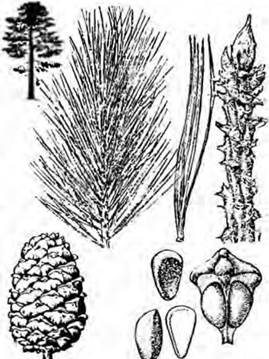
The seeds ("cedar nuts") are edible and contain up to 65% nutritious fatty oil. All PARTS OF THE plant are rich in resin, balsam, vitamin C, and phytoncides. The wood is relatively soft and is used for manufacturing pencils.
Pine forests in the Crimea and Transcaucasia are formed by Pallas pine, or Crimean pine — P. pallasiana. The Italian stone pine, or umbrella pine — P. pinea, is cultivated in the Crimea; it features an umbrella-shaped crown, large cones, and wingless edible seeds resembling "cedar nuts." The seeds ("pine nuts") of Pino edulis are also consumed as food. Along the Mediterranean coast grows the cluster pine — P. pinaster, whose large resinous cones swell and loosen upon maturation and release substantial heat when burned. Bristlecone pine — P. longaeva, native to the USA (Utah), possesses needles capable of Photosynthesis for up to 45 years.
Genus Spruce — Picea. This genus comprises up to 50 species distributed across Northern Europe, Central and Eastern Asia, and North America. These are slender trees with conical crowns, 1.5–2 m in diameter and 60–90 m in height. They are shade-tolerant and long-lived (surviving up to 500–600 years). The bark is thin and contains tannins. Shortened shoots are absent. Needles are borne singly on persistent leaf cushions (sterigmata) on the bark and remain on the tree for up to 7 years. Needles are stiff, leathery, sharp, four-angled or flat with two keels, acute or obtuse. Female cones are green and erect prior to maturation, becoming dark brown and pendent upon maturity. Bract scales are concealed beneath the seed scales. Mature cones dehisce in the autumn of their first year, shedding their seeds and subsequently falling. Male cones are produced on previous year's shoots in the axils of scale leaves.
Spruce wood finds application as a construction material, fuel, and raw material in the pulp and paper industry, as well as for musical instruments. Wood distillation yields tar, rosin, and turpentine. Tannins are extracted from the bark. The needles are rich in ascorbic acid and essential oils, which are Components of the drug "Pinabin," possessing spasmolytic and bacteriostatic properties.
Widespread across Western Europe, the European part of Russia, and North America is Norway spruce (European spruce) — P. abies (P. excelsa) (Fig. 3.93, A). Its cones are cylindrical, light brown, 8–20 cm long and 3–4 cm thick. Seeds are oblong-ovate, light brown to nearly black, with a reddish wing reaching 15 mm in length. In Western Siberia and the northeastern European part of Russia grows Siberian spruce — P. obovata, which is characterized by smaller, egg-cylindrical, light-brown cones compared to other species. Its seed scales are broad, convex, and entire-margined. Ornamentally cultivated species include blue spruce — P. pungens with blue or silvery needles, as well as Oriental spruce, elegant spruce, and others.
Fig. 3.93: A — Picea abies; B — Abies alba
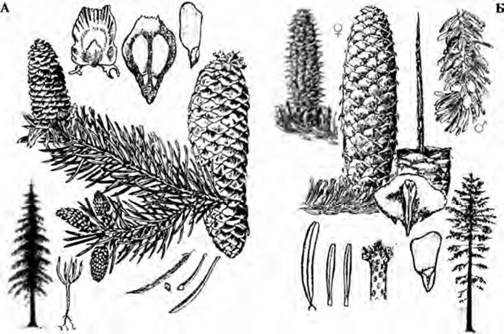
Genus Abies (fir). Trees reaching a height of 60–100 m with a trunk diameter of up to 2 m. The crown is conical or pyramidal; the bark is thin, smooth, and grayish-white, containing resin cavities. Firs are widely distributed in Europe, Asia, North America, and North Africa. In northern regions, they grow in flatlands, whereas in more southern areas, they are confined to mountains. A distinctive feature is that on elongated vegetative shoots, the needles are arranged in two rows in a pectinate (comb-like) fashion and attached by a narrow, stalk-like, heel-like base. The needles are solitary, leathery, flat, blunt, rounded or slightly notched, soft, and feature two white stomatal bands on the underside. The needles on cone-bearing shoots are four-sided, with a whitish band on each face. Mature cones are upright, situated at the ends of the previous year's shoots, and mature in their first year. In autumn, they disintegrate, leaving the axes attached to the shoots. The seeds are triangular, with a long, broad wing.
A representative species of this genus is Siberian fir (Abies sibirica), which covers an area of over 100 million hectares in Western Siberia. The wood is
white; the needles vary in length; and the cones are oval-cylindrical, light brown, and resinous, with bract scales that do not extend beyond the seed scales. In the Carpathians grows the silver fir, European fir, or common fir (Abies alba) (Fig. 3.93, B). The cones are brown, cylindrical, 10–16 cm long and 3–5 cm thick. The bract scales, with outwardly curved tips, extend beyond the seed scales. The seeds are light brown, wedge-triangular, rough, matte, glabrous, and emit a balsamic aroma. The wing is twice as long as the seed, wedge-shaped, leathery, brown, shiny, and glabrous. In the Krasnodar Krai and the Caucasus, Nordmann fir or Caucasian fir (Abies nordmanniana) is found. Widely distributed across the Northern Hemisphere is balsam fir (Abies balsamea). Its upright cones reach up to 10 cm in length, and all its parts are rich in resin, serving as a source of "Canada balsam," which is used for cementing lenses in optical instruments.
Firs are valuable timber, resinous, medicinal, vitamin-yielding, tannin-bearing, and ornamental plants. Their wood is light and soft, utilized as a material for crafts and construction. Borneol alcohol—the Starting Material for camphor synthesis—is obtained from the needles of young branches, known as "fir paws" (fir twigs). Fir balsam is used in medicine as a bactericidal agent and in microtechnique.
Genus Larix (larch). Includes about 20 large deciduous trees with lifespans up to 600 years, distributed across Asia, Europe, and North America. They are characterized by a whorled branching pattern. The bark is thick and reddish-brown. The wood is rich in resin, which imparts a reddish tint. The needles are soft, flat, and light green, occurring singly on elongated shoots and in clusters on short shoots borne on leaf cushions. Pollen lacks air sacs. The seeds are egg-shaped with a small wing and mature within a single growing season. Male cones are located at the ends of leafless, very short shoots. Female cones are small and form at the tips of short shoots. After maturation, they open to release the seeds, remain on the branches for 2–3 years, and then drop off.
Most widely distributed in the northern and eastern parts of Europe and in Western Siberia is Siberian larch (Larix sibirica). Mature cones are egg-shaped, occasionally cylindrical, and brown. The upper margin of the seed scales is nearly straight to slightly wavy. Bract scales are shorter than the seed scales and do not protrude from beneath them. Opened cones reach up to 3 cm in length and 2.5–3.0 cm in diameter. The seed is broadly ovoid, light brown, 0.5 cm long, with a wing reaching up to 1.5 cm in length.
In the Carpathians, as well as in Central and Western Europe, grows European larch or deciduous larch (Larix europaea / Larix decidua) (Fig. 3.94). The cones are oblong-ovoid, brown, with seed scales slightly reflexed outward. The upper margin of the bract scale is acute, shaped like a dark brown pointed tip that projects beyond the seed scale. The seeds are light brown, rough, and together with the wing reach 1 cm in length. Another widely distributed species is Tamarack or American larch (L. laricina).
Fig. 3.94. Larix decidua
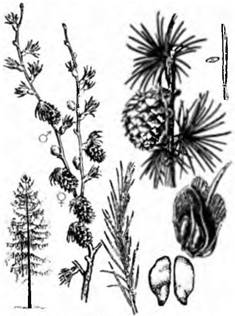
Larch wood is resistant to decay and is used in shipbuilding. Due to their deciduous nature, larches tolerate urban atmospheric pollution and are widely used in urban landscaping and green construction.
Genus Cedrus (cedar). Represented by tall (up to 50 m), robust, long-lived trees with spreading or pyramidal crowns. The needles are more or less rigid, prickly, and three- to four-sided; they are arranged singly and spirally on elongated shoots, and in clusters of 30–40 on short shoots. The cones are large, barrel-shaped, upright, mature in 2–3 years, and disintegrate upon ripening. Cedar wood has a pleasant, specific aroma and is very durable, featuring a light yellowish sapwood and a dark heartwood. Four cedar species are known: Cedar of Lebanon (Cedrus libani), growing in the mountains of Turkey, Lebanon, and Syria, with lifespans up to 3,000 years; Atlas cedar (Cedrus atlantica), found in Morocco and Algeria; Cyprus cedar (Cedrus brevifolia), growing in the mountains of Cyprus; and Himalayan cedar or deodar (Cedrus deodara), typical of the flora of Afghanistan, Pakistan, and northern India. Lebanon and Himalayan cedars are cultivated in Crimea. A distinctive feature of Himalayan cedar
(Fig. 3.95) is that its seeds, 3–4 mm in diameter, contain a high amount of resin, making them unpalatable to birds and rodents. This cedar is also distinguished by its resinous and durable wood.
Fig. 3.95. Cedrus deodara

The characteristics of mature cones of certain species of the family Pinaceae are presented in Table 3.3.
Table 3.3. Characteristics of mature female cones in selected Pinaceae species
Species and Traits |
Position on shoot and spatial orientation |
Shape; color; dimensions (cm) |
Seed scales |
Bract scales |
Seed maturation period; cone transformation |
Scots pine (Pinus sylvestris) |
One to two at the tips of young shoots; pendant |
Ovoid, dark brown, 3–6 long, 2–4 wide |
Dense, with rhombic, slightly convex apophyses (shields) |
Lanceolate, small, shorter than seed scales |
18–20 months. Dehiscence and fall off after seed dispersal |
Norway spruce (Picea abies) |
One at the tips of previous year's shoots; pendant |
Elongate-cylindrical, brown, glossy, 10–16 long, 3–4 wide |
Truncate or rounded, erose-dentate along the margin |
Shorter than seed scales, oblong-rhombic |
12–13 months. Dehiscence and fall off after seed dispersal |
Siberian fir (Abies sibirica) |
One near the tips of previous year's shoots; upright |
Rounded-cylindrical, grayish-brown, 5–9 long, 2–4 wide |
Velvety, rounded, finely denticulate along the outer margin |
Longer than seed scales, with a recurved tip |
5–6 months. Disintegrate into individual seed-bearing scales |
Siberian larch (Larix sibirica) |
One at the tips of short shoots; pendant |
Ovoid, oval, brownish-red, 2–5 long, 1–3 wide |
Leathery-woody, spoon-shaped, pubescent |
Shorter than seed scales, appearing as small spine-like tips at their base |
5–6 months. Dehiscence and fall off after seed dispersal |
Family Cupressaceae (Cypresses)
Includes about 130 evergreen shrubs and trees lacking resin canals, but containing numerous idioblast cells filled with resin. Leaves are scale-like or needle-like, small, arranged oppositely or in whorls of three, rarely four. Cones are woody or fleshy, with fused scales.
Genus Juniperus (juniper). Comprises about 70 species growing in temperate, tropical, and subtropical zones.
Juniper wood is resistant to decay and has been used since ancient times for building houses, ships, and automotive parts. Currently, juniper forests have become very scarce, making comprehensive conservation measures necessary.
A typical representative of the family is common juniper (Juniperus communis) (Fig. 3.96), widely distributed in the forest and forest-steppe zones of Europe, the Mediterranean region, North America, and Canada. This is a small, long-lived (up to 2,000 years) dioecious shrub or small tree.
Fig. 3.96. Juniperus communis

The needles are arranged in whorls of three, needle-like, acute, whitish on the upper side and green on the lower side. The cones are small, with fleshy scales. They mature over two years, forming dark blue galbuli (berry-like cones) containing three seeds and essential oil cavities.
Common juniper galbuli (cones) are a component of diuretic herbal teas and are used as a spice in the liqueur, canning, meat and dairy, and confectionery industries. The essential oil derived from these cones is an ingredient in juniper balm, a wound-healing agent. The needles possess phytoncide activity.
In the south of the European part of Russia and in the Caucasus grows the poisonous Savin juniper — J. sabina. When crushed, its shoots emit a sharp, unpleasant odor. The needles are soft and non-prickly. The cones contain 1 — 6 seeds. The essential oil and balm are used in perfumery and other industries.
Genus Thuja — Thuja. The genus is represented by 12 species. The most widespread and widely cultivated in many countries is northern white-cedar — Thuja occidentalis (Fig. 3.97, A). Native to North America. It is a tree about 15 m in height. The shoots are flat and horizontal within the crown. The leaves are scale-like, dark green or brownish, arranged in opposite decussate pairs, densely imbricate. The leaves on the flat sides of the shoot are acute, triangular-cuneate, with a rounded or oval-convex resin gland on the back. The leaves on the margins of the shoot are oblong-navicular. Female cones mature in 1 year, becoming oblong, light brown or brownish, 1 — 1.3 cm long, 0.5 — 0.8 cm thick. The scales are coriaceous; seeds are flat, light brown, winged. Thuja is valued for its wood and ornamental qualities, tolerates adverse urban conditions well, and contains phytoncides.
Fig. 3.97: A — Thuja occidentalis; B — Biota orientalis
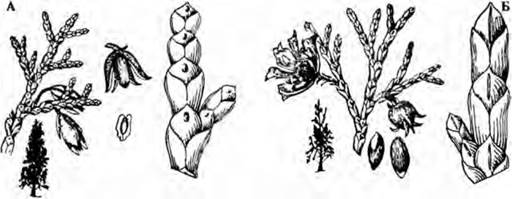
The oriental arborvitae, Platycladus orientalis (Thuja orientalis, Biota orientalis), originates from China (Fig. 3.97, B). Unlike Thuja, the leaves of Platycladus lack resin glands.
Last update: 07/08/2026
Editorial and Educational Adaptation: This material has been compiled based on the primary/original source text. The project team performed an editorial review, corrected technical inaccuracies, structured sections, and adapted the content for an educational format.
What was processed:
- elimination of formatting defects (OCR errors, structural breaks, corrupted characters);
- editorial organization of content;
- standardization of terminology in accordance with academic sources;
- verification of factual statements against the original source text.
All mentions of the author, publication year, and origin of the primary text have been preserved in accordance with the source.