ZOOLOGY OF CHORDATES: STUDY GUIDE - Zakharenko M.O. - 2015
CHAPTER 5. HIGHER VERTEBRATES
5.2. Characteristics of individual bird representatives
Superorder RATITES - PALAEOGNATHAE
Order Struthioniformes
Represented by a single extant species — the common ostrich, Struthio camelus — which currently inhabits the Deserts and semi-deserts of Africa (Fig. 241).
Class="center">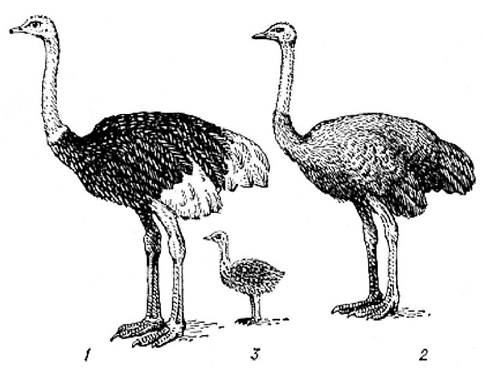
Fig. 241. African ostrich:
1 - male, 2 - female, 3 - juvenile
The largest of all living birds, with a mass reaching 75–100 kg. Flightless, fast-running. The wing Skeleton is shortened, the furcula is reduced, and the Sternum lacks a keel. The hindlimb has only two digits. Feathers cover the entire body uniformly. Remiges and rectrices serve a decorative function. Males are black with white wing and tail feathers, while females are brownish. They feed on coarse plant matter, which is ground down in the gizzard. Typically, 2 to 5 females remain with a single male, laying eggs weighing about 1.5 kg in a shared nest. At night, the clutch is incubated by the male, and by day — by the females in turn. After 67 weeks, sighted, down-covered chicks hatch, capable of feeding independently. The chicks roam together with adult birds. Sexual maturity is reached at the age of 3–5 years.
Order Apterygiformes
The smallest of the ratite birds, weighing only 2–3 kg. Three species of a single genus, kiwis (Apteryx australis), inhabit the forests and scrublands of New Zealand (Fig. 242). The wing skeleton and shoulder girdle are heavily reduced; the bill is long and slender; unlike all other birds, the nostrils are located at the tip of the bill. They are nocturnal in habit. They feed on invertebrates. The female lays one, rarely two eggs weighing up to 450 g. Incubation and chick-rearing are carried out primarily by the male. Birds reach sexual maturity at the age of 3–5 years.
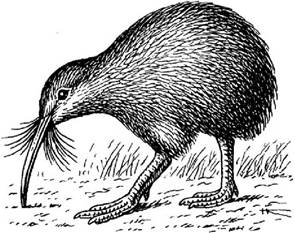
Fig. 242. Little spotted kiwi
Order Casuariiformes
Casuariiformes include the emu (Dromaius novaehollandiae) and the southern cassowary (Casuarius casuarius), which are Australian birds (Fig. 243).

Fig. 243. Emu and cassowary
Emus inhabit the steppes and scrub deserts of Australia. Their mass reaches 40–55 kg. They feed on the vegetative parts of plants. The female lays 8–10 eggs; the male incubates them and rears the chicks. Outside the breeding season, they gather in flocks of several dozen birds. Three species of cassowaries inhabit the forests of New Guinea and northeastern Australia. These are large, black birds weighing up to 80–90 kg, featuring bare patches of brightly colored blue or red Skin on the HEAD and Neck. A horny casque (helmet) is developed on the head. They live solitarily or in small groups. They feed on fruit. The female lays 3–5 eggs, which are incubated by the male, who also tends to the brood.
Order Rheiformes
The greater rhea (Rhea americana) inhabits the savannas and semi-deserts of South America and has a mass of 20–25 kg. Their plumage is brownish, and their hindlimbs possess three digits each. Between 2 and 6 females stay with a single male, laying up to 20–30 eggs in a nest scrape dug by the male. The clutch is incubated exclusively by the male for 6 weeks. Sexual maturity is reached at the age of 2–3 years (Fig. 244).
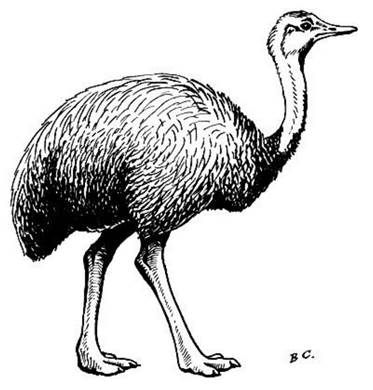
Fig. 244. Rhea
Order Tinamiformes
Terrestrial birds of the forests and steppes of South America, resembling partridges (Fig. 245).
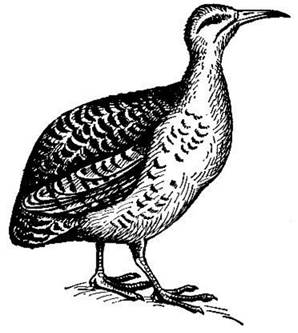
Fig. 245. Tinamou
The sternum features a well-developed keel, and the wing skeleton and Pectoral Girdle are of a typical avian Structure. The wings are short and broad. Short rectrices are covered by upper tail coverts. While capable of active flight, they take off reluctantly when escaping predators. They feed on a variety of PLANT AND ANIMAL matter. Females lay 2–3 clutches, which are incubated by the males, who also tend to the broods. The chicks hatch with their eyes open and covered in down, leave the nest almost immediately, and feed independently. The adult birds merely brood and protect the chicks and help them forage.
Order Gaviiformes – Loons
The order comprises 5 species of aquatic birds distributed across the temperate and northern latitudes of the Northern Hemisphere (Fig. 246).

Fig. 246. Gaviiformes:
1 - Red-throated loon, 2 - Yellow-billed loon, 3 - Arctic loon
The body and neck of these birds are elongated, and the narrow head bears a straight, slender bill. The legs are set far back, and the three forward-facing toes are webbed. They are exceptional swimmers and divers, practically incapable of walking on land, and possess a rapid flight. They feed on fish and aquatic invertebrates, diving to depths of up to 25 m. The female lays 2 eggs in a primitive nest near the Water, and both parents share incubation. The chicks hatch down-covered and are immediately able to swim and dive proficiently. The parents feed the chicks for 1.5 months until they are able to fly.
Order Podicipediformes – Grebes
Aquatic birds distributed across water bodies over almost the entire globe. A total of 20 species (Fig. 247).
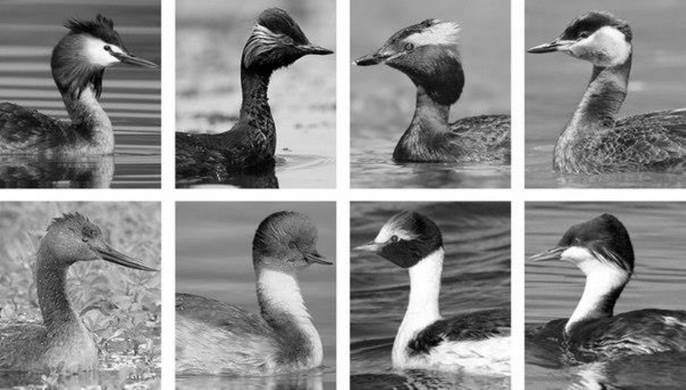
Fig. 247. Grebes:
1 - Great crested, 2 - Black-necked, 3 - Horned, 4 - Red-necked, 5 - Magellanic, 6 - Silver, 7 - White-tufted,
8 - Junin
Each toe in these birds has a broad cutaneous lobe and terminates in a flat nail. The plumage is exceptionally dense. They do not walk on land. They are highly skilled swimmers and divers. Their flight is direct. They feed on aquatic invertebrates, small fish, and amphibians. They build floating nests in reed beds. The female lays 4–6 eggs, which are incubated by both parents. The chicks are covered in thick down with a striped pattern. They swim alongside their parents and rest on their parents' backs or under their wings. They begin an independent life at the age of 5–6 weeks, once they are capable of flight.
Order Procellariiformes – Tubenoses
About 80 species of seabirds that spend their entire lives at sea, coming ashore only during the breeding season. Most species nest in the Southern Hemisphere, while some winter in the seas of the Northern Hemisphere. In appearance, they resemble gulls (Fig. 248).

Fig. 248. Procellariiformes:
1 - Snow petrel, 2 - Wandering albatross, 3 - Grey petrel (storm petrel), 4 - White-faced storm petrel
They are exceptional flyers and swimmers, but can dive only from a plunge, submerging only shallowly. Unlike other birds, their nostrils are enclosed in horny tubes on the sides of the bill. Three toes are webbed. They feed on marine invertebrates, fish, carrion, and galley refuse from ships. They nest in colonies on marine coasts. Monogamous; the female lays a single egg. Albatrosses weigh 8–10 kg with a wingspan of up to 3–4 m. The chicks are capable of flight starting at 6
months of age. Various petrels and storm petrels are generally much smaller.
Order Sphenisciformes – Penguins is represented by 16 extant species. Distributed in the Southern Hemisphere, with the majority of species inhabiting sub-Antarctic islands and Antarctica (Fig. 249).

Fig. 249. Emperor penguin
Penguins are flightless birds that swim and dive exceptionally well. Their forelimbs are modified into flippers—Organs of propulsion during swimming and diving—while their short hind limbs act as rudders, and their toes are webbed. On land, they stand and walk with an upright body posture. Their wing bones are flattened, joints have limited mobility, and the pectoral girdle and sternum keel are well developed. Feathers are densely set in the skin and fit tightly against one another, preventing the penetration of water and wind. Substantial fat deposits in the Connective Tissue of the skin perform a thermal insulation function. They feed in the sea on small fish, crustaceans, and Mollusks. They nest in colonies that can number tens of thousands of pairs, which remain stable for several years. They lay 1-2 eggs in short burrows, rock crevices, or directly on the ground. Both partners take turns incubating the eggs. The chicks hatch with open eyes and are covered in short, dense down; the parents feed them for 3-6 months. Outside the breeding season, they roam the sea, only occasionally coming ashore to rest. Small penguin species
reach a mass of 1.5-3 kg, whereas the emperor penguin, Aptenodytes forsteri, has a mass of up to 40 kg.
Order Pelecaniformes - Sphenisciformes
Diverse aquatic birds in appearance, with all four toes connected by a swimming web (Fig. 250).

Fig. 250. Pelecaniformes:
1 - Gannet, 2 - Anhinga, 3 - Frigatebird, 4 - Tropicbird, 5 - Great cormorant, 6 - Great white pelican
There are 50 species in total. The bills of these birds are highly diverse, and their plumage is dense and tightly adhering. The coloration of males and females is similar. The flight pattern varies among different groups—from slow to swift and maneuverable. They walk slowly and clumsily on land. They are good swimmers. Some species dive well, while others dive only from a plunge. They are monogamous. They nest in colonies ranging from tens to thousands of pairs on sea coasts or near large freshwater bodies. Nests are built on the ground, on rock ledges, or in trees. The clutch contains 1 to 6 eggs, which are incubated by both partners. Chicks hatch blind and naked, remaining in the nest for 6-15 weeks until they are able to fly. The parents feed the chicks. After fledging, the young birds roam together with their parents. They find food in the water. The great white pelican is a large bird with a mass of 9-14 kg, featuring a long, flat bill and a gular pouch of skin between the Branches of the lower jaw. It feeds on fish, which it scoops up with its pouch. It flies slowly and swims well, but does not dive.
Order Ciconiiformes - Ciconiformes
Long-billed, long-necked, and long-legged birds varying in size (with a mass from 100 g to 6 kg) that inhabit the shores of water bodies and marshes (Fig. 251).

Fig. 251. Ciconiiformes:
1 - Grey heron, 2 - Black stork, 3 - Black-crowned night heron, 4 - Eurasian bittern, 5 - Glossy ibis
About 120 species. Plumage is sparse. Flight is slow. In flight, their extended legs project far beyond the tail. They are distributed almost everywhere, except for high latitudes. They feed on a diverse animal diet. Monogamous. They nest in colonies, often including several species, and rarely in isolated pairs. Carelessly built nests are located in reeds or in the forks of tree and shrub branches. The clutch contains 2-8 eggs. Chicks hatch naked, with barely open eyes, or with open eyes and covered in down. They remain in or near the nest until they can fly. Both partners feed the chicks. Outside the breeding season, they stay in small flocks, and some species are solitary.
Herons (Ardeidae) comprise about 60 species that vary greatly in size (mass from 100 g to 3-4 kg) but are similar in appearance: a conical bill with sharp edges, a long flexible neck, and a hind toe almost equal in length to the front ones. They live on the shores of water bodies and in marshes. They stalk their prey while standing in shallow water and seize it with a lightning-fast motion of the head.
Storks (Ciconiidae) differ from herons in their larger size (up to 5-6 kg), a stout bill, a less flexible neck, and a shortened hind toe. They nest in isolated pairs. They search for food by walking slowly across forest clearings, meadows, and the shores of water bodies. The white stork, Ciconia ciconia, nests in villages and even cities (Fig. 252).

Fig. 252. White stork
Order Phoenicopteriformes - Phoenicopteriformes
Flamingos (Phoenicopteridae) are large (mass 2.5-4.5 kg) long-necked and long-legged birds with a long, strongly curved bill (Fig. 253).
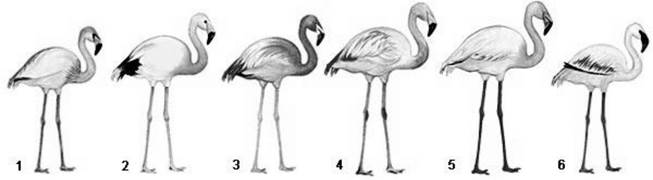
Fig. 253. Various species of flamingos
The edges of the bill and Tongue bear horny lamellae that form a filtering apparatus. The forward-directed toes of the FOOT are connected by a swimming web. They feed in shallow water by filtering water and mud, straining out invertebrates and Algae. They nest in colonies on the shallow waters of saline lakes. Nests are mounds of dried mud and shells up to 0.5 m high. Chicks hatch with open eyes, covered in down, and begin to fly at the age of about two months. There are 6 recognized species distributed in the tropics and subtropics.
Order Anseriformes - Anseriformes
About 150 species of waterbirds (weighing from 200 g to 10 kg). The bill is usually more or less flattened, covered with a soft horny sheath with a robust thickening at the tip. Transverse horny lamellae are located on the edges of the bill and the fleshy tongue, forming a filtering apparatus. The legs are short, and the forward-facing toes are connected by a web. The muscular gizzard features a strong cuticle. Plumage is dense. The molt of flight feathers occurs simultaneously, causing these birds to lose The ability to fly for 2–5 weeks. Flight is fast. On land, they walk with a waddling gait. They swim exceptionally well, and some species are skilled divers. In some species, pairs remain bonded until one of the partners dies (swans, geese); the female incubates the clutch while the male guards the nesting territory, and both parents lead the brood. In many ducks, pairs form only for the mating season, with only the female incubating and leading the brood, while the males gather in flocks and migrate to molting areas. Nests are built on the ground near water bodies, though some species nest in tree hollows. Hatchlings emerge covered in dense down, and by the second day, they run and swim well, with some species also diving. They feed independently; the adult bird merely protects the chicks and occasionally warms them. Outside the breeding season, they stay in small flocks.
The group comprising geese and swans includes 21 species (Fig. 254).
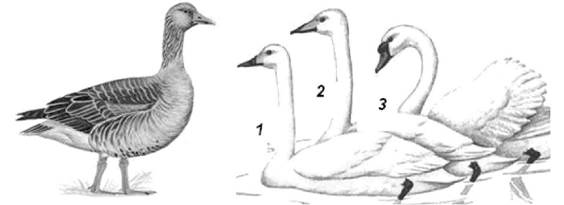
Fig. 254. Anseriformes:
1 - Greylag goose, 2 - Bewick's swan, 3 - Whooper swan, 4 - Mute swan
These birds weigh between 1 and 10 kg. Males and females have identical coloration. They feed primarily on plant food on land and in shallow water. The whooper swan (Cygnus cygnus) nests in overgrown, large water bodies.
Ducks (Anatidae) comprise about 120 species (Fig. 255).
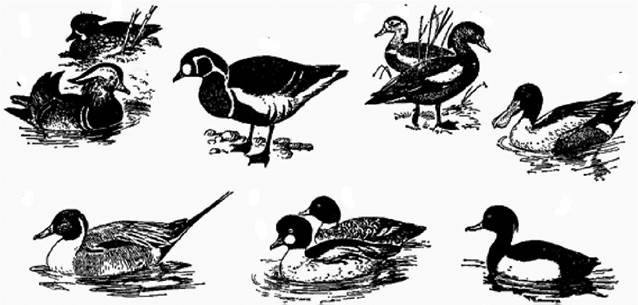
Fig. 255. Anseriformes:
1 - Mandarin duck, 2 - Red-breasted goose, 3 - Tufted duck, 4 - Northern shoveler, 5 - Northern pintail, 6 - Common goldeneye, 7 - Greater scaup
Males are larger than females and more brightly colored. Dabbling ducks, which nest near all types of water bodies, are the most widespread. Their mass ranges from 200 g to 1.5 kg. They feed on a diverse diet by straining water and silt, filtering out invertebrates, eating seedlings and soft rhizomes of aquatic plants, and gathering acorns and fallen seeds on land. While foraging, they do not dive, instead submerging only their neck and the front part of their body. Almost all species of waterfowl are game birds hunted for sport.
Order Falconiformes - Falconiformes
This order unites about 270 species (ranging in mass from 60 g to 12 kg) with a characteristic predatory appearance. They are distributed worldwide and inhabit all terrestrial landscapes. The bill is short but strong, with a sharply curved, downward-pointing sharp tip. At the Base of the bill is the cere—a patch of bare, often brightly colored skin where the external nostrils open. The musculature of the breast and hind limbs is well developed. Strong toes end in large, curved talons. The eyes are large. The Esophagus and crop are highly distensible. The walls of the muscular gizzard are relatively weak. Most commonly, females are larger than males, though in some species, males have brighter coloration than females. They walk very little on the ground. Flight is fast and precise, and many species are capable of sustained soaring. They feed on animal matter and are active during the day. They are monogamous; in some species, pair bonds last until the death of one partner. They nest in solitary pairs, actively defending their nesting territory, and only a few species nest in groups. The nest—a haphazard pile of branches—is located in tree forks, on rock ledges, or on the ground. Large species lay 1–3 eggs, while smaller ones lay up to 4–7. Both partners incubate the clutch and feed the chicks. The chicks hatch downy and sighted. They remain in the nest for 1.5–2 months in smaller species and 3–4 months in larger ones, until they learn to fly. The order is divided into two suborders: New World vultures (Cathartinae) and falcons (typical birds of prey, Falconinae).
New World vultures are a distinct group of 6 species found exclusively in the Americas (Fig. 256). They differ from other birds of prey in several minor anatomical details. They feed on carrion, which they locate while soaring in flight, and rarely catch live prey. The populations of these birds are declining sharply.
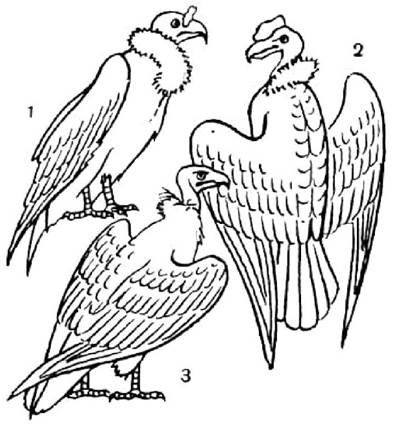
Fig. 256. New World vultures: 1 - King vulture, 2 - Andean condor, 3 - California condor
The family Accipitridae (suborder Falconinae) comprises about 200 species (Fig. 257).

Fig. 257. Silhouettes of birds of prey in flight: a - Golden eagle; b - Black kite; c - Northern goshawk; d - Western marsh harrier;
e - Common buzzard
Accipiters either wait for prey while sitting in cover or fly along forest edges to snatch startled animals. Short, rounded wings and a long tail provide maneuverability, allowing these hawks to pursue prey—primarily birds—through the tree canopy. Larger raptors, such as various eagles, spot prey (hares, large birds) while soaring high in the air and plunge toward it swiftly; sometimes they ambush rodents (such as susliks) by waiting near their burrows. Kites are typical polyphages, feeding on insects, rodents, small birds, and various carrion, including fish. They search for prey by flying over fields, meadows, and water bodies, or by walking on the ground. They also feed on animal carcasses, which they locate by soaring in the air for hours at such a height that the bird (with a wingspan reaching 3 m) is nearly invisible from the ground.
The falcon family (Falconidae) feeds on animal matter and generally does not eat carrion (Fig. 258).

Fig. 258. Representatives of the Falconidae family:
1 - Peregrine falcon, 2 - Gyrfalcon, 3 - Eurasian hobby, 4 - Merlin, 5 - Common kestrel, 6 - Red-footed falcon
Main hunting method: rapid flight followed by a swooping attack on flying or running prey. Large falcons feed on mammals and birds, sometimes preying on animals larger than themselves (ducks, hares). Small falcons feed on mouse-like rodents and large insects, less frequently catching small birds. To this day, in certain regions, large falcons, hawks, and golden eagles are used as birds of prey for sport and even commercial hunting.
This order includes about 250 species of terrestrial or ground-dwelling arboreal birds with a characteristic gallinaceous appearance. They inhabit all terrestrial landscapes. The beak is short and convex. Wings are short and wide. Legs are strong. A capacious crop is separated from the esophagus. The muscular Stomach has thick walls and is lined with a tough cuticle. For better grinding of food, they swallow stones that accumulate in the muscular stomach and act as gizzard stones. They feed on plant food: vegetative plant parts, fruits, seeds; they also eat various invertebrates. In many species, males are larger than females and more brightly colored. The difference in size among various species is very large, ranging from 45 g to 8-10 kg.
Order Galliformes – Galliformes
Megapodes – Megapodiidae – a family of gallinaceous birds inhabiting the islands of the Malay Archipelago and Australia (Fig. 259).
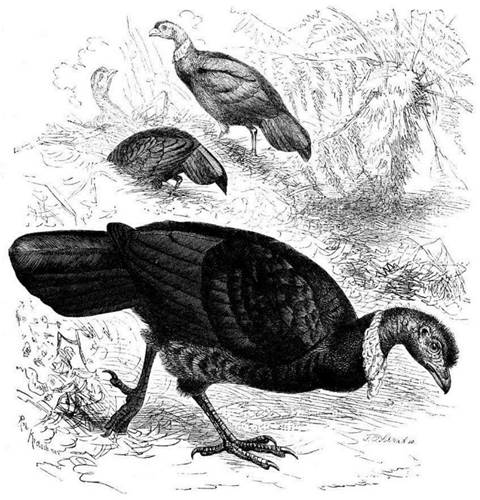
Fig. 259. Megapodes
Long before the breeding season begins, the male digs a pit and fills it with plant debris. The height of such a mound can exceed 1 m. Gradually, the Temperature inside the mound rises As a result of decomposition. After that, the female lays eggs in the passages
dug by the male. The male stays near the nest constantly. When the temperature in the nest rises, he digs into the pit to cool the clutch; conversely, when the temperature drops, he piles an additional layer of debris on top. Incubation of each egg lasts about 2 months. Chicks hatch covered in short down, possess small wings, and are capable of short fluttering flights. The chicks leave the nest, hide in the underbrush, and begin an independent life.
Grouse – Tetraonidae – found in the temperate and northern latitudes of the Northern Hemisphere, numbering 18 species (Fig. 260).
They lead a ground-dwelling or terrestrial-arboreal lifestyle. Forest species—such as the capercaillie and black grouse—feed on the ground in summer, and in trees during winter, where they eat buds, catkins, berries, and needles. Mating in these polygamous birds takes place at lek sites; only the female incubates the eggs and tends to the brood. The chicks are well-downed and sighted, feeding independently from the very first day.
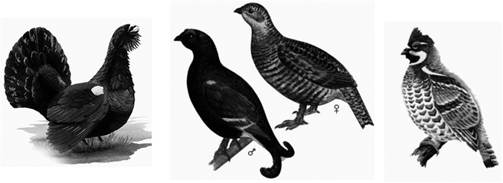
Fig. 260. Grouse:
1 - Capercaillie, 2 - Black grouse, 3 - Hazel grouse.
Pheasants – Phasianidae – the main family of the order, numbering 175 species (Fig. 261).

Fig. 261. Pheasants:
1 - quail, 2 - pheasant (a - male, b - female), 3 - red junglefowl (a - male, b - female), 4 - Caspian snowcock, 5 — great argus
They inhabit forests, steppes, deserts, and in the mountains extend up to the snowline.
Food is gathered exclusively on the ground. Some species are polygamous, while others are monogamous, though pairs in many species persist only for the egg-laying period. Nests are built on the ground. Only the female incubates the eggs, though in some species both parents tend the brood. Chicks are capable of flight at the age of 1 to 2 months. Pheasants of the tropical zone are particularly diverse—including pheasants, peacocks, arguses, wild fowl, quails, partridges, etc. Virtually all gallinaceous species are targets for sport hunting and, in some places, commercial hunting.
Order Gruiformes – Gruiformes
Comprises about 190 species, varying greatly in size (mass from 30 g to 16 kg), appearance, and ecological traits. The order is divided into 8 suborders and 20 families.
The true crane family – Gruidae comprises 14 species of long-legged and long-necked birds weighing from 2 to 15 kg (Fig. 262).

Fig. 262. Gruiformes:
1 - Common crane: a - in flight, b - chick, c - adult and juvenile birds, 2 - Eurasian coot, 3 - Spotted crake, 4 — Corncrake
These birds have a straight, spear-like beak. Widely distributed across the globe, they inhabit marshes and meadows, with some species living in steppes. Pair bonds last for several years. This family is characterized by complex courtship rituals featuring group and paired "dances". Nests are built on the ground, containing clutches of 1-2 eggs. The chicks begin to fly at the age of 5-9 weeks. They feed primarily on plant matter.
The rail family, Rallidae, comprises 120 species (weighing from 30 g to 2 kg). They inhabit dense vegetation along water bodies, in marshes, and on damp meadows. They are fast runners, and some are strong swimmers and divers. They are reluctant flyers. Nests are built on the ground, with clutches of 6-12 eggs. Both parents participate in incubation and brood-rearing.
The chicks hatch with their eyes open and are covered in thick down.
The bustard family, Otididae, includes 22 species of birds resembling gallinaceous birds (weighing up to 16 kg). They inhabit the steppes and semi-deserts of the Eastern Hemisphere. They feed on a diverse diet of plant and animal matter. Clutches consist of 1-5 eggs; the chicks hatch precocial (with open eyes, well-downed) and feed independently.
Order Charadriiformes
Comprises 300 species of aquatic or semi-aquatic birds.
Suborder Charadrii contains 13 families grouping 180 species (Fig. 263).
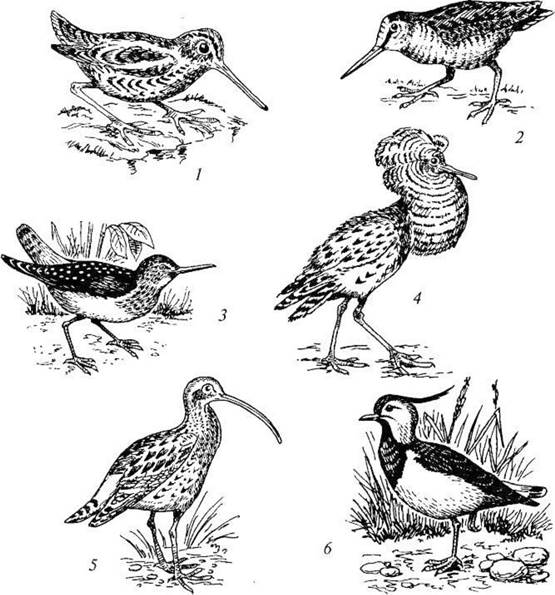
Fig. 263. Sandpipers:
1 - Common Snipe, 2 - Eurasian Woodcock, 3 - Green Sandpiper, 4 - Ruff, 5 - Eurasian Curlew, 6 — Northern Lapwing
Widely distributed across the globe. They inhabit tundras, meadows, steppes, and shores of water bodies, with a small number of species living in forests. They feed on various invertebrates gathered on land and in shallow water. Most species are monogamous. The clutch typically consists of four eggs. The chicks are covered in down and forage independently from the first days of life.
Suborder Larinae comprises about 90 species (Fig. 264).

Fig. 264. Order Charadriiformes: 1-4 gulls, 5,6 terns
The bill is elongated, sometimes with a hook at the tip. The toes are webbed. The wings are long and pointed. Food is located by flying over the water and diving at spotted prey. They feed on small fish and various invertebrates, with some also eating berries. Monogamous, nesting in colonies. They lay 2-3 eggs, which are incubated by both parents. The chicks are sighted and covered in thick down.
Suborder Alcae includes a single family comprising about 20 species of seabirds that spend their entire lives outside the breeding season in the open sea (Fig. 265).
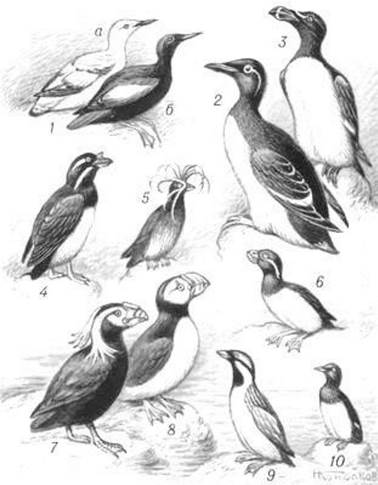
Fig. 265. Representatives of the Alcidae family:
1 - Black Guillemot: a - in winter, b - in summer, 2 - Common Murre, 3 - Razorbill, 4 - Horned Puffin, 5 - Parakeet Auklet, 6 - Least Auklet,
7 - Tufted Puffin, 8 - Atlantic Puffin, 9 - Ancient Murrelet, 10 — Little Auk
All species are strong swimmers and divers, descending to depths of several tens of meters; in the water, they propel themselves by flapping their wings (underwater flight). They are monogamous and nest in colonies, with some species forming seabird colonies ("bird cliffs") alongside gulls and other species.
Order Columbiformes
Unites about 300 species of predominantly herbivorous birds. The crop is well developed. Plumage is dense. Wings are elongated and pointed. Flight is fast and maneuverable. They walk and run well. The order is divided into two families whose representatives differ sharply from one another.
The sandgrouse family, Pteroclidae, comprises 16 species (weighing 300-500 g) that inhabit the arid steppes and deserts of Africa and South Asia. The bill is small, without a cere, and the legs are short. They nest in groups, laying 3 eggs. The chicks hatch sighted and covered in down. They feed on green plant parts and terrestrial invertebrates. Outside the breeding season, they roam in large flocks.
The dove family, Columbidae, includes 290 species of medium-sized birds, although both small species (weighing 30 g) and large ones (up to 3 kg) also occur (Fig. 266).
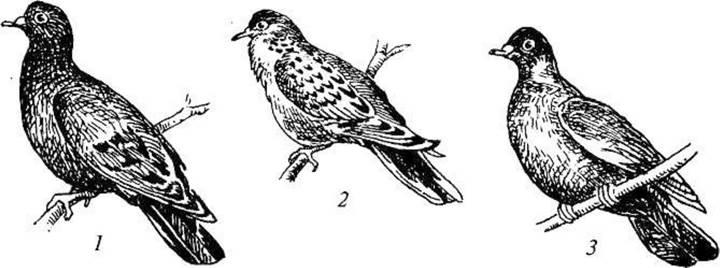
Fig. 266. Columbiformes:
1 - Stock dove, 2 - European turtledove, 3 — Common wood pigeon
The bill is slender and elongated, featuring a hooked tip and a cere covering the nostrils. They nest solitarily or occasionally in small groups, constructing platform nests of twigs in trees, and sometimes utilizing tree cavities or rock crevices. The clutch typically consists of 2 eggs. The chicks hatch altricial, covered in sparse down. Parents feed them "crop milk," which is produced by the sloughing of epithelial Cells from the crop wall combined with Lymph. In warmer regions, some species produce 2–3 clutches per year. Their diet is diverse and primarily plant-based, rarely including animal matter.
Order Psittaciformes - Parrots
This order unites about 325 species of arboreal birds ranging in mass from 10 g to 1 kg. Parrots possess a distinctive Morphology: a massive beak with a sharp hook and a cere; strong feet with two toes pointing forward and two backward; and a capacious crop. Many species exhibit brightly colored plumage, and some feature long tails (Fig. 267).
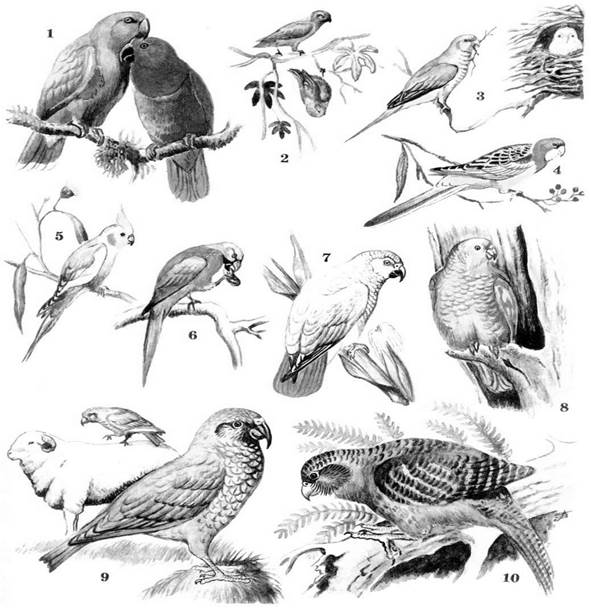
Fig. 267. Representative Psittaciformes:
1 - Pair of green-winged macaws (male on the left), 2 - Hanging parrots, 3 - Monk parakeet, 4 - Rosella, 5 - Cockatiel, 6 - Rose-ringed parakeet, 7 - African grey parrot, 8 - Blue-fronted amazon, 9 - Kea, in the Background: Kea attacking a sheep, 10 — Kakapo
These birds possess high associative cognitive abilities, excellent memory, and the capacity for vocal mimicry. They predominantly nest in tree hollows, laying 8 white eggs. The chicks hatch naked and blind, and are fed by both parents. Parrots are gregarious and feed mainly on plant material.
Order Cuculiformes - Cuckoos
Comprises about 130 species of birds ranging in mass from 20 g to 1 kg, distributed across nearly all continents, though the majority inhabit tropical regions (Fig. 268).

Fig. 268. Appearance of the common cuckoo (different morphs)
The bill is elongated and slightly curved. Two toes of the foot point forward, while two point backward. They feed on various insects and other small animals. More than half of the species are monogamous, building a rudimentary nest and laying 2–6 eggs, which are incubated by both partners, who also jointly feed the nestlings. Brood parasitism is observed in certain species: some occupy other birds' nests to incubate their own clutch, while others drop their eggs into the nests of other species. The order includes about 140 species of nocturnal raptors that inhabit all global landscapes. The bill is strong, with a large, sharp terminal hook and a cere partially concealed by stiff bristles. The feet are powerful, with strong, curved talons. Large forward-facing eyes enhance the field of binocular Vision. Hearing is exceptionally well-developed. Soft, downy plumage ensures silent flight. They feed on diverse animal prey, relying primarily on hearing rather than sight during hunting. Monogamous by nature, they nest in tree hollows, rock crevices, or rodent burrows. Incubation begins with the first egg laid, meaning eggs and nestlings of different ages can be found in the same nest simultaneously. The female incubates the clutch while the male brings her food. Chicks hatch blind but downy, remaining in the nest for 6 weeks.
Order Strigiformes - Owls
Small, medium, or large altricial birds. Nocturnal predators with exceptionally keen vision and hearing (Fig. 269).
Owls possess a sleek yet robust body, an extraordinarily large head, very large forward-gazing eyes framed by a facial disc of radiating feathers, broad concave wings, and a short tail. The beak is strongly curved downward, terminating in a small hook and lacking notches. Medium-sized limbs are typically feathered almost to the claws, which are large, long, and strongly curved.
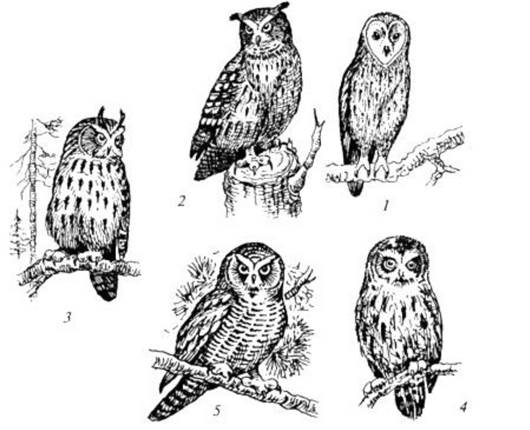
Fig. 269. Strigiformes:
1 - Barn owl, 2 - Eurasian eagle-owl, 3 - Long-eared owl, 4 - Tawny owl, 5 - Northern hawk-owl
Owl plumage is typically cryptically colored—subdued, though occasionally quite striking—and almost always matches the surrounding environment. Their flight is virtually silent thanks to dense, soft plumage.
When foraging, these birds rely on their acute hearing, which allows them to pinpoint even the faint rustle of prey. Nests are most commonly established in tree hollows, rock crevices, or less frequently in abandoned nests of other birds, human structures, or on the ground. Owls form permanent pair bonds: females incubate the eggs while males assist in feeding the nestlings. Chicks hatch downy but blind, with closed ear openings. Owls inhabit every continent and climate zone, ranging from the cold lands of the Arctic Circle to the equator, and from sea level up to elevations of 5,000 meters. While forests are their primary habitat, they also populate steppes, deserts, agricultural areas, and urban environments.
Order Caprimulgiformes - Nightjars
Comprises about 90 species weighing from 50 to 700 g, exhibiting a crepuscular or nocturnal lifestyle (Fig. 270).
They inhabit forests, steppes, and deserts, predominantly in the tropics. Their bill is small, but the Mouth gape is wide: the jaw joint is located behind the eye. Their flight is silent and agile; prey consisting of various insects is caught on the wing, with only a few species hunting on the ground. Monogamous; the clutch consists of 1 - 2 eggs laid in a depression on the ground, though some species nest in tree hollows. The nestlings are fed even after they begin to fly.

Fig. 270. Nightjars: European nightjar and great potoo
Order Caprimulgiformes - Apodiformes
Divided into two suborders that are well-differentiated from each other.
Suborder Swifts - Apodidae includes about 60 species of small birds (weight 20-100 g) with a small bill and long, narrow wings. The mouth gape is wide and the legs are short. Their flight is swift (up to 120 - 170 km/h) and agile; birds spend almost all their time in the air. They live in mountains, forests, and in human settlements and cities. They feed on insects caught in flight and drink on the wing. Some species build nests in tree hollows, rock crevices, building cracks, etc. (Fig. 271).

Fig. 271. Swifts: common swift and alpine swift
Other species build nests from saliva that hardens in the air, attaching them to branches, cliffs, and building walls. Adult common swifts (Apus apus) migrate south after the onset of cold weather, while the nestlings enter a state of torpor, which can last for 5 - 8 days until the adults return.
Suborder Hummingbirds - Trochilidae encompasses 320 species of very small birds (weight starting from 1.6 g) (Fig. 272).

Fig. 272. Hummingbirds
Distributed in North and South America. The bill is thin and long, often curved; the muscular tongue rolls into a tube when sucking nectar. The plumage of males is very bright, with a metallic sheen, whereas females and young birds are dull-colored. Flight is rapid. While gathering insects from flowers or sipping nectar, hummingbirds can hover in place in the air for a long time. At night, with a drop in temperature, they enter a state of torpor. They do not form pairs. The female builds a small, deep nest, incubates a clutch of 1 - 2 eggs, and feeds the nestlings alone. They act as pollinators for certain plants.
Order Woodpeckers - Piciformes
Encompasses about 400 species of birds weighing from 6 to 300 g, living predominantly in trees (Fig. 273).

Fig. 273. Woodpeckers:
1 - Black woodpecker, 2 - European green woodpecker, 3 - Syrian woodpecker, 4 - White-backed woodpecker, 5 - Great spotted woodpecker, 6 - Eurasian wryneck
Food is gathered in the canopy and on trunks, rarely on the ground. Monogamous. They nest in tree hollows, and some dig nesting burrows. Nestlings hatch blind and altricial (naked), remaining in the nest until they are able to fly. The order is divided into 2 suborders.
Suborder Primitive woodpeckers - Galbulae includes 170 species distributed in forests and shrublands of the tropical zone. They feed on fruits, seeds, and various insects, including bees and wasps; certain species are capable of digesting wax. Some species are typical brood parasites.
Suborder True woodpeckers - Pici comprises about 200 species of birds with the typical appearance of woodpeckers. Distributed in the temperate and tropical latitudes of both hemispheres. The bill is straight and strong. Two toes point forward and two backward; the claws are strong and strongly curved. The thin, long tongue can be extended to the length of the bill, and bristles on it allow insects to be extracted from crevices. When moving along tree trunks, woodpeckers cling to bark irregularities and prop themselves up with their stiff tail. They gather various insects from trunks and branches, excavating them from under the bark. They also feed on seeds.
Order Passerines - Passeriformes
A very large order uniting about 5,000 bird species (approximately 60% of all extant birds). Distributed on all continents except Antarctica, they vary greatly in size, appearance, and ecological traits.
They feed on animal or plant matter, and some species are omnivorous. Most are monogamous, though polygamy also occurs. Nests are built with great care in branches, rock crevices, tree hollows, on the ground, etc. Nestlings hatch blind and naked, remaining in the nest until they reach adult size and are fully feathered. The order is divided into 4 suborders comprising 50 - 70 families.
Suborder Broadbills - Eurylaimi includes 14 species of forest birds distributed in Africa and Southeast Asia. In A number of features, they are similar to Coraciiformes.
The suborder Tyrant Flycatchers and their allies, or suboscines (Clamatores), comprises about 1,000 species distributed across the tropics of both hemispheres. They are particularly diverse and abundant in South America.
The suborder primitive songbirds (Menurae) includes only 4 species found in limited regions of Australia. Lyrebirds externally resemble pheasants (weight 500-800 g). They inhabit forests, run swiftly, and fly only rarely. During courtship displays, the male spreads his tail so that it resembles a lyre. They are polygamous; only the female builds the nest, incubates the single egg, and feeds the chick.
The suborder songbirds (Passeres / Oscines) counts about 4,000 species. They are widespread across all latitudes and continents, trailing only the suboscines in South America in terms of species richness and Abundance. The size (ranging from 4 g to 1.5 kg), appearance, and habits of these birds vary greatly. Their lower Larynx features 5–7 well-developed pairs of vocal Muscles, with the lower rings fused into a bony tympanum or resonating chamber. Several families of this suborder are described below.
The lark family (Alaudidae) includes about 70 species inhabiting open landscapes (Fig. 274).
The hind toe ends in a long, straight claw. They forage on the ground for invertebrates and seeds. Nests are built on the ground. Males sing in flight.

Fig. 274. Larks:
1 - Wood lark, 2 - Eurasian skylark, 3 - Horned lark, 4 — Crested lark
The swallow family (Hirundinidae) comprises about 80 species of pointed-winged, strong-flying birds (Fig. 275).
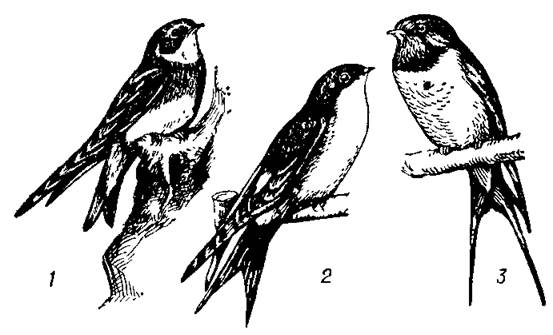
Fig. 275. Swallows:
1 - Sand martin, 2 - Common house martin, 3 — Barn swallow
The bill is small, but the gape of the mouth is large. Their prey—various insects—is caught in mid-air or snatched on the wing from branches, rocks, and the like. They nest along riverbanks and forest edges, with many species living in human settlements. Some species build nests from soil particles cemented with sticky saliva, while others dig burrows or nest in tree cavities.
The crow family (Corvidae) comprises about 100 fairly large species (weight 50 g to 1.5 kg). They have a large head with a stout bill. They nest in trees, rock crevices, and tree hollows. Many species are omnivorous.
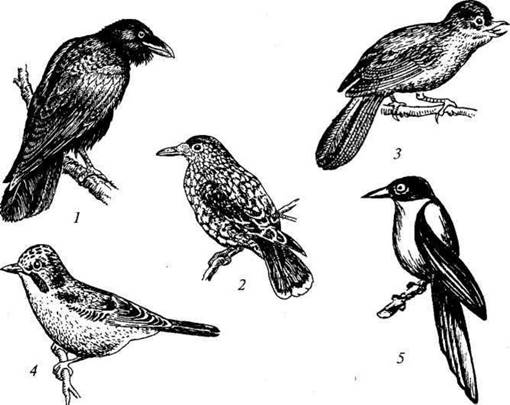
Fig. 276. Corvids:
1 - Common raven, 2 - Spotted nutcracker, 3 - Siberian jay, 4 - Eurasian jay, 5 - Azure-winged magpie
The bird of paradise family (Paradisaeidae) encompasses about 40 species.
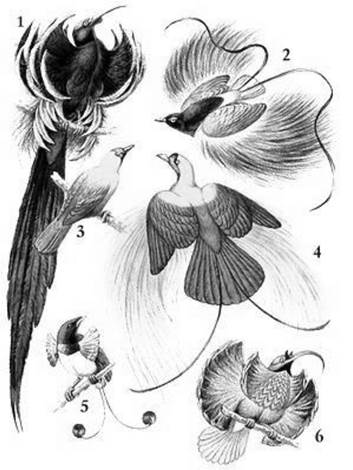
Fig. 277. Birds of paradise:
1 - Trumpet manucode, 2 - Blue bird-of-paradise, 3, 4 - Greater bird-of-paradise, 5 - King bird-of-paradise,
6 - Ribbon-tailed astropia
The plumage of females is dominated by grey-brown shades. They perform communal courtship displays—10 to 20 males gather in the tree canopy, fluffing their feathers, striking various poses, taking flight, and landing again amid calls. Only the female cares for the chicks.
The tit family (Paridae) consists of small birds that nest primarily in tree cavities. Clutch sizes reach 10–16 eggs; incubation is performed by the female, whom the male feeds, while both parents feed the nestlings. They feed on insects, berries, and seeds (Fig. 278).
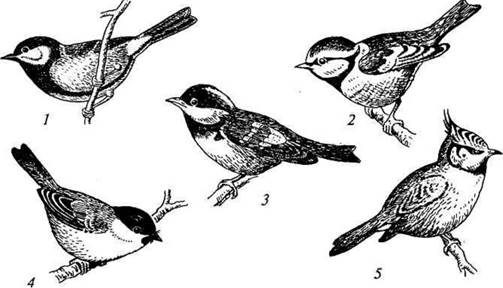
Fig. 278. Tits (Paridae):
1 - Great Tit, 2 - Azure Tit, 3 - Coal Tit, 4 - Willow Tit, 5 — Crested Tit
The family Sylviidae (warblers) comprises over 400 species of small birds weighing 6–40 g (Fig. 279).
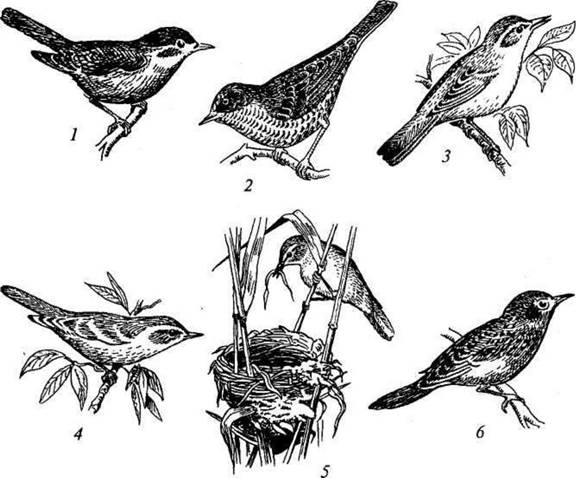
Fig. 279. Warblers:
1 - Blackcap, 2 - Barred Warbler, 3 - Wood Warbler,
4 - Icterine Warbler, 5 - Eurasian Reed Warbler near its nest, 6 - River Warbler
Most species inhabit all types of landscapes. Many are exceptional songbirds. They feed on various invertebrates and berries, and are migratory.
The thrush family, Turdidae, encompasses about 300 bird species of various sizes (weighing 10–200 g) and appearances. They inhabit all terrestrial landscapes, feeding on invertebrates, seeds, and berries. Many species are remarkable songbirds.
The wagtail family, Motacillidae, comprises approximately 50 species of small birds (weighing 20–30 g) with a characteristic appearance, inhabiting open landscapes or forest edges.
The starling family, Sturnidae, includes about 100 species inhabiting open landscapes and forest edges of the Eastern Hemisphere, although the European Starling (Sturnus vulgaris) has been successfully introduced in North America and many islands. They nest in shelters such as tree cavities, building crevices, etc. They forage on the ground, trees, and shrubs, feeding on various invertebrates, berries, seeds, and plant sprouts. They are beneficial as destroyers of mass pest insect species.
The finch family, Fringillidae, comprises about 500 species.
Widespread and inhabiting diverse landscapes ranging from tundras to mountains, many species are fine songbirds. Males have brighter plumage than females. They feed primarily on seeds, but also consume large quantities of insects, foraging in tree canopies, among grasses, and on the ground. They feed their nestlings with insects (Fig. 280).
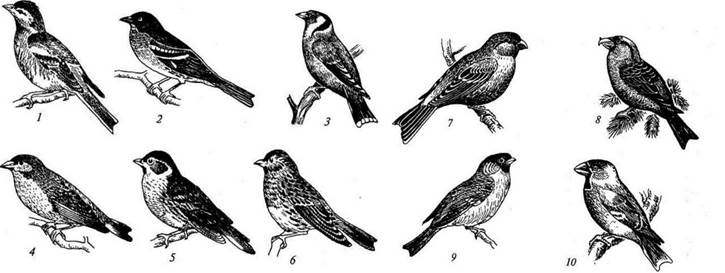
Fig. 280. Finches:
1 - Common Chaffinch, 2 - Brambling, 3 - European Goldfinch, 4 - European Greenfinch, 5 - Eurasian Siskin, 6 - Common Redpoll, 7 - Pine Grosbeak,
8 - Red Crossbill, 9 - Eurasian Bullfinch, 10 - Hawfinch
Last update: 19/08/2026
Editorial and Educational Adaptation: This material has been compiled based on the primary/original source text. The project team performed an editorial review, corrected technical inaccuracies, structured sections, and adapted the content for an educational format.
What was processed:
- elimination of formatting defects (OCR errors, structural breaks, corrupted characters);
- editorial organization of content;
- standardization of terminology in accordance with academic sources;
- verification of factual statements against the original source text.
All mentions of the author, publication year, and origin of the primary text have been preserved in accordance with the source.