BIOLOGY Volume 2 - A Guide to General Biology - 2004
17. COORDINATION AND REGULATION IN ANIMALS
17.2. The Nervous System (CNS and PNS)
17.2.2. Reflexes and Reflex Arcs
The simplest form of response mediated by The Nervous System is a reflex. It is a rapid, automatic response to a stimulus that occurs without conscious (voluntary) control by the Brain. In other words, it is an involuntary (unconscious) action. The same stimulus always elicits the exact same response. The pathway taken by nerve impulses during a reflex is called a reflex arc.
The simplest reflex arc in humans consists of two Neurons: a sensory neuron and a motor neuron. A classic example of a simple reflex is the knee-jerk reflex. In other cases, the reflex arc involves three neurons: a sensory, an interneuron (Relay), and a motor neuron. A simplified version of such a reflex—triggered, for instance, by pricking a finger with a pin—is shown in Fig. 17.17. This is a spinal reflex, meaning its pathway passes through the Spinal Cord rather than the brain. It is important to emphasize that in this case, nerve fibers run through the spinal cord in one direction. The processes of sensory neurons enter the spinal cord via the dorsal ROOT, while the processes of motor neurons leave via the ventral root. The Cell bodies of all these neurons are located within the CNS (the spinal cord): for sensory neurons, they reside in the dorsal root ganglion, while for interneurons and motor neurons, they are located in the Gray matter of the spinal cord. The gray matter appears gray because it is densely packed with nerve cell nuclei. The surrounding White matter is lighter in color because it consists of unmyelinated/anucleate nerve fibers.
Class="center">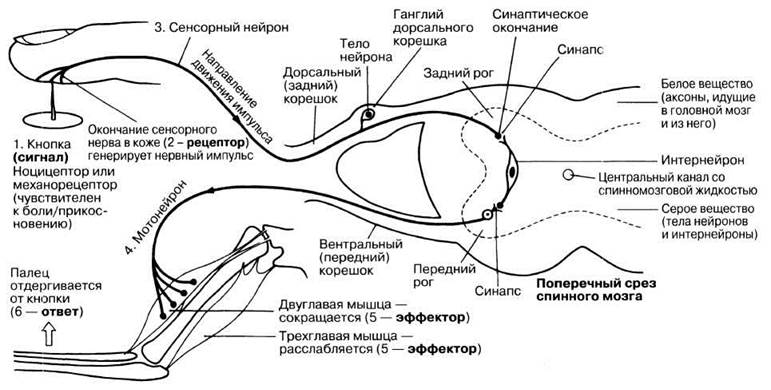
Fig. 17.17. Simplified diagram of a reflex and a reflex arc. The numbers in parentheses indicate the Main Components of any reflex arc. These components are: 1 — stimulus; 2 — receptor; 3 — sensory (afferent) neuron; 4 — motor (efferent) neuron (motoneuron); 5 — effector; 6 — response.
Significance of Reflexes
The simple reflex arc described above allows animals, including humans, to adapt automatically (involuntarily) to environmental changes—for instance, adjusting pupil size in response to varying light levels or maintaining balance during movement. It also helps regulate internal bodily processes, such as Heart rate or breathing rate, and protects the body from injuries like cuts or Burns. All of these Functions contribute to maintaining a stable internal environment, otherwise known as Homeostasis.
More Complex Reflexes
In more complex cases, a sensory neuron in the spinal cord forms a synaptic connection with another sensory neuron whose axon extends up to the brain. The brain processes the incoming sensory information and stores it for future use. Additionally, the brain can transmit motor nerve impulses along a descending pathway directly to spinal motoneurons via synapses; these spinal motoneurons then initiate the effector response.
Conditioned Reflexes
Conditioned reflexes are a type of reflex activity in which The Nature of the response depends on past experience. These reflexes are always coordinated by the brain. The foundation of all conditioned reflexes—whether it is salivation at the sight and smell of food, grooming habits, or the recognition of danger (Sec. 17.9)—is learning. The first to be studied was the classical (Pavlovian) conditioned reflex. I. P. Pavlov demonstrated that if a dog is repeatedly fed shortly after the ringing of a bell, it will eventually salivate in response to the bell alone, even in the absence of food.
Many conditioned reflexes are modifications of simpler, innate (unconditioned) reflexes. For example, if an adult grabs an empty, hot metal frying pan, they will most likely drop it immediately. However, with an equally hot, but expensive ceramic pot containing boiling soup, they will probably set it down quickly but carefully. This difference in behavior indicates that we are dealing with a conditioned reflex involving memory and conscious decision-making by the brain. In both cases, the stimulus generates impulses that travel via sensory neurons to the brain. Upon arrival, the brain analyzes these impulses, taking into account information from other Sensory Organs (such as the eyes) to determine the source of the stimulus. This new information is compared with data already stored in the brain regarding the potential consequences of an automatic spinal reflex. In the case of the metal pan, the brain concludes that dropping it will cause no harm to either the pan or you: it generates impulses in an excitatory motor pathway that travel down the axon to the spinal cord, synaptically stimulating the spinal motoneuron responsible for the reflex. Nerve conduction along this pathway is so rapid that impulses from the excitatory motor pathway reach the specific motoneuron simultaneously with impulses from the interneuron of the initial reflex arc. The effects of both sets of impulses summate, and excitatory impulses travel down the spinal motoneuron axon to the effector Muscle, causing the pan to be dropped.
In contrast, when dealing with a full, hot ceramic pot, the brain quickly calculates that dropping it could scald one's legs, ruin the food, and shatter expensive cookware. By holding onto the pot and Setting it down carefully, one suffers only minor finger burns. Having made this decision, the brain sends impulses to the spinal motoneurons, but this time along an inhibitory pathway. These impulses reach the spinal motoneuron at the same time as the excitatory impulses from the interneuron and cancel them out. As a result, no impulses reach the effector Muscles, and the pot is held securely. Simultaneously, the brain can issue a different motor program, allowing the pot to be set down quickly and carefully.
The description of reflex arcs and reflex activity presented above is highly simplified. The full process of coordination, integration, and control of bodily functions is far more complex. For instance, specific neurons interconnect different levels of the spinal cord that control, say, arm and leg movements, coordinating The activity of one level with another, while yet another group of neurons provides overall control from the brain.
Processes not involving the contraction of voluntary (skeletal) muscles are regulated by reflexes mediated by the Autonomic (vegetative) nervous system.
Last update: 06/08/2026
Editorial and Educational Adaptation: This material has been compiled based on the primary/original source text. The project team performed an editorial review, corrected technical inaccuracies, structured sections, and adapted the content for an educational format.
What was processed:
- elimination of formatting defects (OCR errors, structural breaks, corrupted characters);
- editorial organization of content;
- standardization of terminology in accordance with academic sources;
- verification of factual statements against the original source text.
All mentions of the author, publication year, and origin of the primary text have been preserved in accordance with the source.