Biochemistry in Tables, Schemes, and Graphs - S.D. Zhamsaranova 2009
Lipid Metabolism and Functions
Lipids are organic substances characteristic of living organisms, insoluble in Water but soluble in organic Solvents and in each other.
Class="center">
Functions OF MAJOR HUMAN LIPIDS
Lipid class |
Functions |
Predominant localization in the body |
Triacylglycerols |
Storage of energy material. Thermal insulation, mechanical protective function |
Adipocytes |
|
ethanolamine Inositol bisphosphate |
Structural components of membranes; phosphatidylcholine is also a structural element of Lipoproteins, a component of surfactant that prevents alveolar collapse (in this case, R1 and R2 are palmitic acids) |
Cell membranes. Monolayer On the surface of lipoproteins. Lung alveoli |
Sphingophospholipids - sphingomyelins |
Major structural components of neural tissue membranes |
Myelin sheaths of Neurons Gray matter of the Brain |
|
a) cerebrosides, b) gangliosides |
Components of neural tissue membranes. Antigenic structures on The surface of various cell types; receptors. Structures that mediate cell-cell interactions |
Outer layer of cell membranes |
Membrane components. Precursor in the synthesis of Bile acids and Steroid Hormones |
Cell membranes. Blood lipoproteins |
Structure OF MAJOR PHOSPHOGLYCERIDES
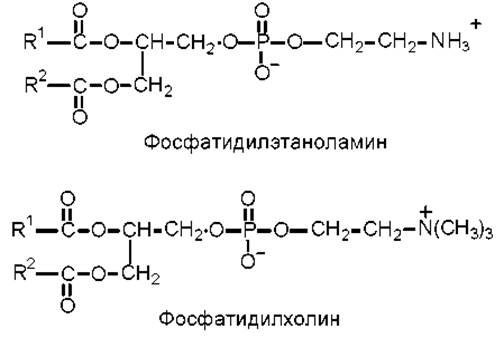
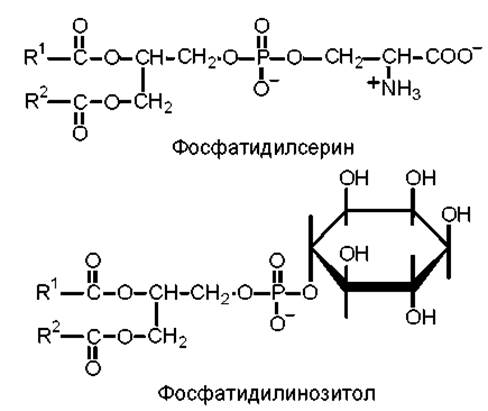
FATS - triacylglycerols - represent the most compact and energy-dense form of energy storage.
Functions of fat:
- ENERGY;
- PROTECTIVE.
Adipose tissue:
a) protects Organs from mechanical damage.
b) participates in thermoregulation.
Fatty acids found in The Human Body share common structural features:
1. An even number of carbon atoms.
2. A linear (unbranched) carbon chain.
3. Polyunsaturated fatty acids contain ONLY ISOLATED double bonds (separated by at least two single bonds).
4. Double bonds have exclusively the cis-configuration.
Based on the number of double bonds, fatty acids can be divided into SATURATED (no double bonds), MONOUNSATURATED (one double bond), and POLYUNSATURATED (two or more double bonds).
SELECTED SATURATED AND Unsaturated fatty acids OF HUMAN LIPIDS
Acid name |
Cn:m |
ω |
Z,% |
1 |
2 |
3 |
4 |
|
Saturated fatty acids |
|||
Myristic |
14:0 |
1.2 |
|
Palmitic |
16:0 |
30.0 |
|
Stearic |
18:0 |
15.3 |
|
Arachidic |
20:0 |
2.3 |
|
|
Unsaturated fatty acids |
|||
Palmitoleic |
16:1 (9) |
1.2 |
|
Oleic |
18:1 (9) |
11.9 |
|
Linoleic |
18:2 (9,12) |
6 |
19.4 |
Linolenic |
18:3 (9,12,15) |
3 |
0.3 |
Arachidonic |
20:4 (5, 8, 11, 14) |
6 |
8.9 |
Eicosapentaenoic |
20:5 (5,8,11,14,17) |
3 |
2.1 |
Note. Cn is the number of carbon atoms in the given fatty acid; m is the number of double bonds in the fatty acid radical; (9) is THE POSITION OF the double bond in the fatty acid radical, counted from the first (carboxyl) carbon; ω - 3, ω - 6 represent the position of the first double bond, counted from the methyl carbon of the fatty acid radical; Z is the fatty acid composition in a human on a standard diet.
Last update: 06/08/2026
Editorial and Educational Adaptation: This material has been compiled based on the primary/original source text. The project team performed an editorial review, corrected technical inaccuracies, structured sections, and adapted the content for an educational format.
What was processed:
- elimination of formatting defects (OCR errors, structural breaks, corrupted characters);
- editorial organization of content;
- standardization of terminology in accordance with academic sources;
- verification of factual statements against the original source text.
All mentions of the author, publication year, and origin of the primary text have been preserved in accordance with the source.