Biochemistry in Tables, Schemes, and Graphs - S.D. Zhamsaranova 2009
Carbohydrate Metabolism and Functions
Fructose and Galactose Metabolism
FRUCTOSE AND GALACTOSE METABOLISM involves pathways for their utilization in the Synthesis of Other substances (such as Heteropolysaccharides, lactose, etc.) and their contribution to the body's energy supply. In the latter case, fructose and galactose are converted in the Liver into either glucose or its metabolic intermediates. Consequently, As a result, fructose and galactose, along with glucose, can be oxidized to CO2 and H2O or used for the synthesis of Glycogen and triacylglycerols.
Class="center">Fructose Metabolism

A significant amount of fructose, formed during The breakdown of sucrose, is converted into glucose directly within the intestinal Cells before entering the PORTAL VEIN SYSTEM. Another portion of fructose is absorbed via a carrier protein, i.e., through Facilitated Diffusion.
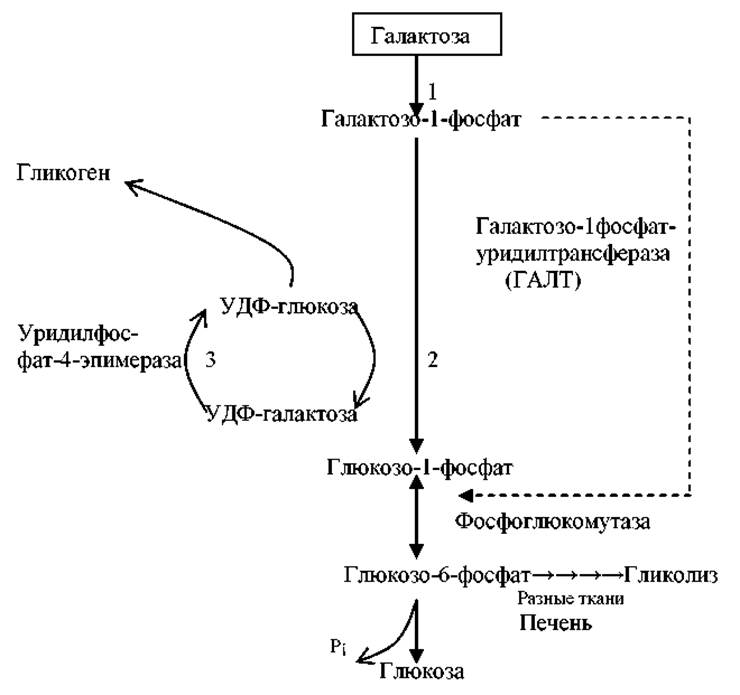
Galactose is formed in the intestine as a result of lactose Hydrolysis. To convert galactose into glucose, it is necessary to alter the optical configuration of the H and OH groups at the C4 atom in galactose, i.e., to undergo an epimerization reaction. This reaction within The Cell is possible only with the UDP-derivative of galactose.
Last update: 06/08/2026
Editorial and Educational Adaptation: This material has been compiled based on the primary/original source text. The project team performed an editorial review, corrected technical inaccuracies, structured sections, and adapted the content for an educational format.
What was processed:
- elimination of formatting defects (OCR errors, structural breaks, corrupted characters);
- editorial organization of content;
- standardization of terminology in accordance with academic sources;
- verification of factual statements against the original source text.
All mentions of the author, publication year, and origin of the primary text have been preserved in accordance with the source.