BIOCHEMISTRY - L. Stryer - 1984
VOLUME 1
PART I. CONFORMATION AND DYNAMICS
CHAPTER 9. CONNECTIVE TISSUE PROTEINS: COLLAGEN, ELASTIN, AND PROTEOGLYCANS
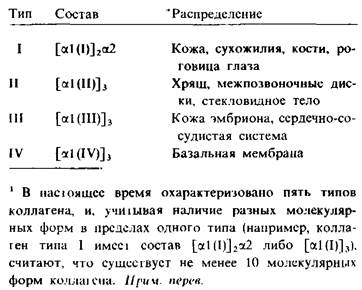
All Multicellular Organisms contain Collagen, which is a family of Fibrous Proteins. Collagen is especially abundant in mammals, where it constitutes a quarter of the total protein. Collagen is the primary fibrous element of Skin, bone, tendon, Cartilage, Blood Vessels, and Teeth. It is present in varying amounts in almost all Organs, serving to bind Cells together into distinct structural units. In addition to this "structural" role in mature Tissues, collagen plays an organizing role in developing tissues. A distinctive property of collagen is its ability to form insoluble fibrils of high tensile strength (Fig. 9.1). Moreover, The Structure of collagen fibers depends on the tissue type and corresponds to its specialization. Four types of collagen have been characterized (Table 9.1).
The word collagen is derived from the Greek expression meaning "to produce glue."
Class="center">Fig. 9.1. Electron micrograph of intact collagen fibers from skin. Chromium-shadowed preparation. The axial periodicity of the fiber structure is 640 Å
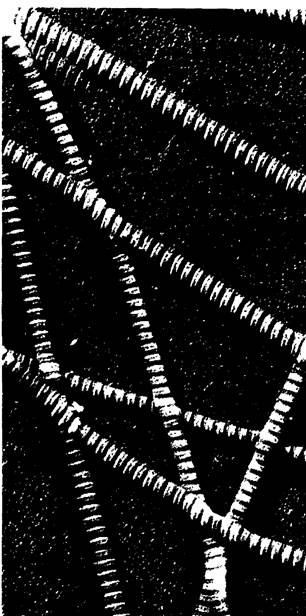
Table 9.1. Types of collagen
9.1. Tropocollagen is the basic structural unit of collagen
For many years, the insolubility of collagen was a major obstacle to studying its chemical properties. This situation changed only when it was discovered that collagen from the tissues of young animals could be extracted in a soluble form, because at this stage it contains relatively few cross-links. The absence of covalent cross-links in immature collagen allows the isolation of its basic structural unit, called tropocollagen.
The Molecular Weight of tropocollagen is about 285 kDa; it consists of three polypeptide chains of equal size. The chain composition depends on the type of collagen (Table 9.1). Type I collagen, which is the most abundant in the body, consists of two chains of one type, designated α1(I), and a third chain, designated α2. Other types of collagen consist of three identical chains. Each of the three collagen strands contains about 1000 amino acid residues. Thus, the basic structural unit of collagen is very large, being more than 10 times larger than Chymotrypsin.
9.2. Collagen has an unusual amino acid composition and sequence
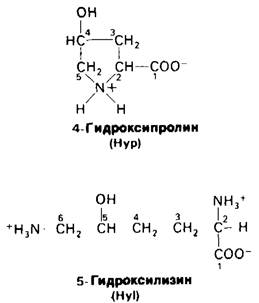
In the collagen molecule, about one-third of The amino acid residues are Glycine, which is extraordinarily high for a protein. In Hemoglobin, for example, glycine accounts for only 5% of the total amino acid content. The Proline content in collagen is also significantly higher than in most other proteins. Finally, collagen contains Two Amino Acids that are extremely rare in other proteins, namely hydroxyproline and hydroxylysine:
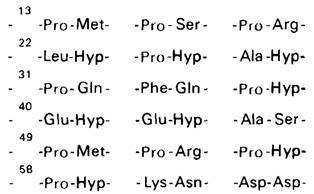
The Amino Acid Sequence of collagen exhibits a high degree of regularity: nearly every third residue is glycine; regions of glycine-proline-hydroxyproline are frequently repeated (Fig. 9.2). In this respect, collagen differs from Globular proteins, which lack a regular amino acid sequence; besides collagen, this property is shared by Silk Fibroin and Elastin.
Fig. 9.2. Amino acid sequence of a portion of the α1(I) chain of collagen. Over a span of more than 1000 residues, every third residue is glycine
Last update: 06/08/2026
Editorial and Educational Adaptation: This material has been compiled based on the primary/original source text. The project team performed an editorial review, corrected technical inaccuracies, structured sections, and adapted the content for an educational format.
What was processed:
- elimination of formatting defects (OCR errors, structural breaks, corrupted characters);
- editorial organization of content;
- standardization of terminology in accordance with academic sources;
- verification of factual statements against the original source text.
All mentions of the author, publication year, and origin of the primary text have been preserved in accordance with the source.