Principles of Biochemistry Volume 1 - A. Lehninger 1985
Biomolecules
Fibrillar Proteins
Collagen is the most abundant protein in higher animals
Collagen accounts for nearly one-third of total vertebrate protein mass, quantitatively outperforming all other Proteins. The larger the animal, the greater the proportion of its total protein is collagen. The body of a 400 kg cow is bound and supported primarily by a system of tough collagen fibers located in its Skin, tendons, Cartilage, and bones.
Collagen Connective Tissue consists of fibers, which in turn are made up of collagen fibrils characterized by a striated Structure (Fig. 7-12). These fibrils are organized in various ways depending on the biological function of the connective tissue. In tendons, collagen fibrils are arranged as cross-linked parallel bundles that possess exceptionally high tensile strength and are virtually inextensible. Collagen fibrils can withstand loads at least 10,000 times their own weight, meaning they surpass steel wire of equal cross-section in strength. In cow skin, collagen fibrils form an irregularly interlaced, highly dense network; It is worth noting that tanned leather consists of nearly pure collagen. In the Cytology/practical/76.html">Cornea of the eye, collagen fibrils are laid out in cross-ply layers. Regardless of their arrangement in different Connective Tissues, electron micrographs consistently reveal a characteristic regularly repeating transverse banding pattern with a periodicity of 60 to 70 nm (depending on the collagen source). The exact period may vary slightly because collagen is not a single individual protein, but a family of very similar proteins with structural differences tailored to their anatomical function and Organism species. Most commonly, collagen exhibits a periodicity of 64 nm.
Class="center">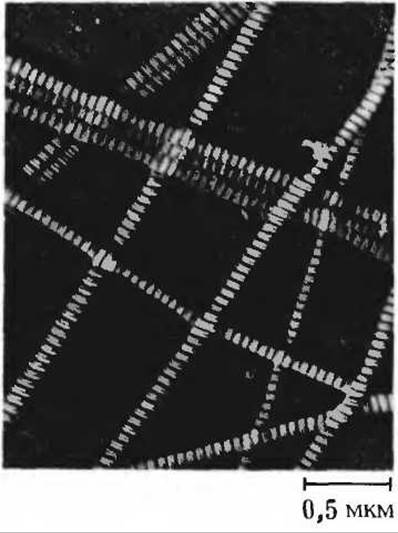
Fig. 7-12. Electron micrograph of connective tissue collagen fibrils. Note the periodicity of the transverse bands within the fibrils. In the collagens of many tissues, these bands repeat approximately every 64 nm.
Last update: 06/08/2026
Editorial and Educational Adaptation: This material has been compiled based on the primary/original source text. The project team performed an editorial review, corrected technical inaccuracies, structured sections, and adapted the content for an educational format.
What was processed:
- elimination of formatting defects (OCR errors, structural breaks, corrupted characters);
- editorial organization of content;
- standardization of terminology in accordance with academic sources;
- verification of factual statements against the original source text.
All mentions of the author, publication year, and origin of the primary text have been preserved in accordance with the source.