Pharmacognosy with the Fundamentals of Plant Biochemistry - Kovalyov V. M. 2004
Special Part
Alkaloids
Medicinal plants and raw materials containing tropane alkaloids
BELLADONNA LEAF — FOLIA BELLADONNAE
BELLADONNA HERB — HERBA BELLADONNAE
BELLADONNA ROOT — RADICES BELLADONNAE
Deadly nightshade — Atropa belladonna L., Caucasian belladonna — Atropa caucasica Kreyer., fam. Nightshade family — Solanaceae
Deadly nightshade (common belladonna, sleeping nightshade); the generic name Atropa comes from Atropos, one of the three Moirae (Fates in Greek mythology); the Latin belladonna derives from Italian bella (beautiful) and donna (lady/woman).
A perennial herbaceous plant featuring a multi-headed rhizome and a branching cylindrical root, light brown on the outside and yellow when freshly cut. The stems reach a height of 1-2 m, branching into three parts near the top.
Leaves are alternate, yet arranged in pairs close to each other, with one leaf of the pair always significantly larger than the other. The large leaves are elliptic, while their smaller counterparts are ovate; the leaves are entire, acuminate, thin, glabrous, 10-20 cm long, and 5-12 cm wide. Flowers are solitary, drooping, and emerge from the leaf axils. The calyx is five-toothed; the corolla is tubular with five reflexed lobes and a brownish-purple hue. The fruit is a bilocular, shiny black, juicy, many-seeded berry about the size of a cherry, complemented by a green calyx and deep purple juice.
Caucasian belladonna differs from common belladonna by its stem, which is glabrous and covered with a bluish-gray waxy bloom.
Distribution. Common belladonna is found in the forests of Crimea, the Carpathians, and the Pre-Carpathian region. It is listed in the Red Data Book of Ukraine. It is cultivated in Ukraine (Lubny, Crimea) and most European countries.
Class="center">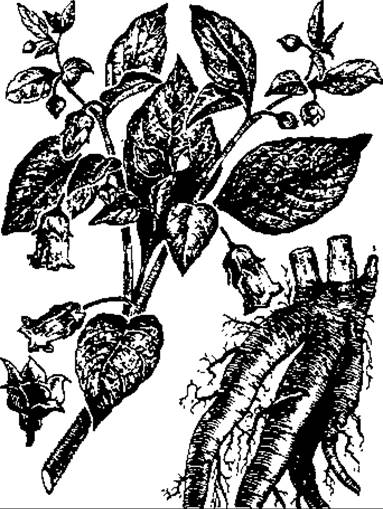
Wild belladonna is not harvested commercially. Agricultural enterprises harvest Three types of raw material. The leaves are gathered at the onset of flowering, several times throughout the summer. Later, during the seed-formation stage, the entire aerial part of the plant is mown at a height of 10 cm above the ground. Plantations are utilized for 3-5 years. Following the final harvest of the herb, prior to clearing the plantation, the roots are dug up, shaken free of soil, washed, and large specimens are split lengthwise. Drying is carried out rapidly at 40-45 °C. Safety regulations must be strictly observed during harvesting, Processing, and handling.
Chemical composition. The entire plant contains tropane Alkaloids. Total alkaloid content: up to 1.3% in the roots, up to 1.2% in the leaves, up to 0.65% in the stems, up to 0.6% in the flowers, and up to 0.7% in the ripe fruits.
The principal alkaloid is levorotatory hyoscyamine, which converts into the racemate atropine upon extraction from the raw material. Smaller quantities of apoatropine, belladonnine, cuscohygrine, and scopolamine are also present. Associated constituents include Flavonoids, Coumarins, and sterols.
Biological activity and application. Belladonna preparations act as anticholinergic agents, exhibiting spasmolytic, bronchodilator, and analgesic activities; they reduce the secretion of salivary, sweat, and gastric glands, dilate the pupils, and induce tachycardia.
Dry extract, belladonna tincture, Bellastezin, Besalol, Bellalgin, Becarbon, Bellataminal are spasmolytic agents used for gastrointestinal disorders; Zelenin drops are prescribed for cardiac neuroses; Belloid is used for functional Disorders of the Autonomic Nervous system; Aclimann is utilized for autonomic dystonia and menopausal disorders; Bellaspon is indicated for insomnia, menopausal neuroses, and vegetative neuroses; Anuzol and Betiol suppositories possess analgesic properties and are employed in the Treatment of hemorrhoids.
In homeopathy, the entire plant harvested at the beginning of flowering is used for arterial Hypertension. Belladonna induces capillary spasm, which leads to the cessation of inflammatory processes; consequently, it is prescribed for all acute inflammations and at the Cytology/cytology/16.html">Early stages of numerous infectious diseases (Influenza, scarlet fever, etc.).
HENBANE LEAF — FOLIA HYOSCYAMI
HENBANE HERB — HERBA HYOSCYAMI
Black henbane — Hyoscyamus niger L., fam. Nightshade family — Solanaceae
Black henbane, stinking nightshade; the name originates from Greek hyoskyamos: hys (hog) and kyamos (bean); niger refers to the black color, as the throat of the flower is blackish-purple.
A biennial, pubescent, herbaceous plant. The stem is erect, branched, and 20-60 cm high. Leaves are 5-20 cm long and 3-10 cm wide; alternate, simple; the lower ones are long-petiolate, oblong-ovate, sinuate-pinnatifid; the upper ones are sessile, semi-amplexicaul, ovate, sinuate-dentate, covered with soft hairs primarily along the Veins and leaf margins; the midrib is whitish and significantly widens near the base; leaf color is grayish-green. Flowers are dingy yellow with purple veins, clustered in a scorpioid cyme. The fruit is a bilocular, dry, many-seeded, urn-shaped capsule that opens with a lid.
Distribution. Found throughout the CIS territory as a weed in wasteland, meadows, fields, and near dwellings. It does not form dense thickets. It is cultivated in the southern regions of Ukraine and in Russia.
Harvesting. Stem leaves are gathered at the beginning of flowering, and the herb is harvested during the fruit-ripening period. All large leaves are plucked, while the smaller rosette leaves are collected again in autumn if they have managed to regrow. The harvested raw material is loosely packed to prevent Fermentation and blackening during drying. It is dried rapidly in well-ventilated attics by spreading it in a thin layer (1-2 cm) and stirring periodically. Drying in mechanical dryers at 40-45 °C is also permitted. The plant is poisonous and has an unpleasant odor.
Chemical composition. Contains tropane alkaloids: hyoscyamine, scopolamine, etc. (0.05-0.1%). The leaves are rich in flavonoids, predominantly rutin. Glycosides such as hyoscypicrin, hyoscylresin, and methylesculin have also been identified.

Biological activity and application. The leaves were a component of 'Asthmatin' cigarettes for asthma patients. Externally, henbane oil is used as a remedy for neuralgia and rheumatism.
In homeopathy, the entire fresh plant (harvested in its second year of growth during flowering) is used for both Central Nervous System excitation and depression. It is prescribed for delirium tremens, hallucinations, mental disorders, and infectious diseases, as well as an antispasmodic for spasms of the ocular Muscles and Diaphragm, and spasmodic cough.
THORNAPPLE LEAVES — FOLIA DATURAE
Jimsonweed — Datura stramonium L., fam. nightshade — Solanaceae
Common thornapple; the name datura comes from the latinized Sanskrit name dhattura or Arabic tatura from tat meaning to prick; stramonium is a latinized French stramoine meaning stinking weed.
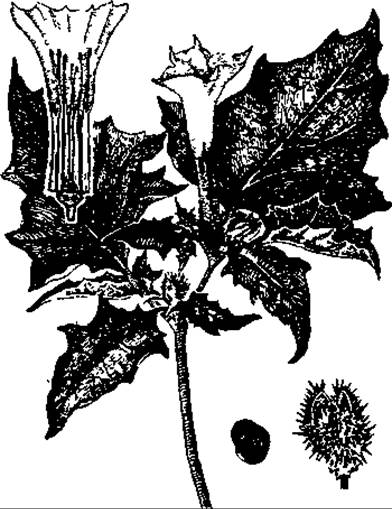
An annual herbaceous plant with an unpleasant odor, growing up to 1 m tall. The stem is hollow and branched. Leaves are short-petiolate, alternate, ovate, sinuate-dentate, nearly lobed, acute at the apex, and cuneate at the base; venation is pinnate. Slight pubescence is noticeable along the yellowish-white veins protruding on the underside; the odor is specific and unpleasant. Flowers are white, funnel-shaped, located in the leaf axils; the calyx is tubular and pentagonal. The fruit is a multi-seeded, four-valved, ovate capsule covered with rigid prickles.
Distribution. It grows throughout Ukraine, in the Caucasus, the Baltic states, Central Asia, on wasteland, along roadsides, near human settlements, and in fields. It is also cultivated.
Harvesting. Developed leaves are harvested with caution during the plant's flowering phase in dry weather. In autumn, the entire plant is pulled up, the leaves are plucked, the stems are burned, and the ash is used as fertilizer. Drying is carried out in the same manner as for henbane raw material.
The leaves are hygroscopic; therefore, they should be stored in well-sealed containers in a dry, ventilated room. The plant is poisonous.
Chemical composition of the raw material. The total alkaloid content ranges from 0.25-0.4%, primarily represented by hyoscyamine and scopolamine, along with volatile oils (0.04%), carotenoids, and Tannins.
Biological activity and application. The leaves were part of anti-asthmatic herbal mixtures, as well as 'Asthmatin' and 'Asthmatol' cigarettes. Thornapple oil is used as a liniment for rubbing in cases of neuralgia and rheumatism, and is included in various liniment formulations.
In homeopathy, the fresh flowering plant and fruits are used for infectious diseases or intoxications accompanied by hallucinations and manic psychosis, as well as for severe convulsions.
INDIAN THORNAPPLE FRUITS — FRUCTUS DATURAE INNOXIAE
INDIAN THORNAPPLE SEEDS — SEMINA DATURAE INNOXIAE
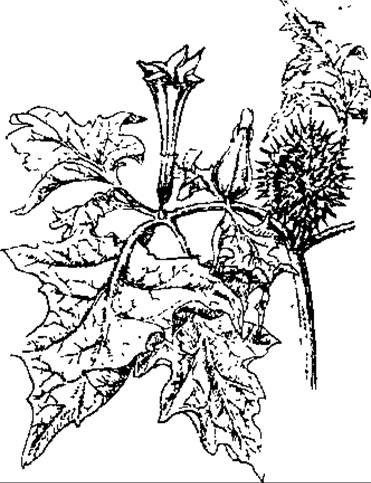
Indian thornapple — Datura innoxia Mill., fam. nightshade — Solanaceae. A perennial herbaceous plant up to 1.5 m tall.
The stem is erect, hollow, branched, and densely pubescent.
Leaves are alternate, petiolate, ovate, and pubescent. Flowers are white, solitary, up to 15 cm long and 8.5 cm in diameter, located in the stem forks. Fruits are spherical, multi-seeded capsules up to 5 cm in diameter, covered with prickles up to 1 cm long. Seeds are globose-reniform, flattened, 4-5 mm long and 5-4 mm wide, with a finely pitted surface, varying in color from grayish-brown to ochre-yellow.
Distribution. Native to Central and Southern Africa. Considered an adventive and weed plant. Cultivated as an annual crop in Russia, Southern Kazakhstan, and Central Asia. The crop has also been tested and approved in Crimea.
Harvesting. Harvesting is carried out 2-3 times during the summer, during the browning period of the lower capsules. Ripe fruits contain fewer alkaloids. Immediately after harvest, they are shredded using a straw cutter and sorted into seeds and capsule parts; they are dried separately in dryers at a Temperature of 40-45 °C or outdoors in the sun under canopies.
Chemical COMPOSITION OF THE raw material. The raw material contains alkaloids (0.2-0.4%), the main one being scopolamine; hyoscyamine, tropine, pseudotropine, nicotine, etc., are also present. The alkaloid content depends on the vegetation phase and the degree of seed ripeness.
Biological activity and application. The fruits serve as industrial raw material for obtaining scopolamine hydrobromide, as well as scopolamine camphorate and hyoscyamine camphorate used in Aeron tablets, which are prescribed for motion sickness (seasickness and airsickness).
CARNIOLIAN SCOPOLIA RHIZOMES — RHIZOMATA SCOPOLIAE CARNIOLICAE
Carniolan scopolia — Scopolia carniolica Jacq., fam. nightshade — Solanaceae
Scopolia carniolica; the generic name originates from the Italian botanist and physician J. Scopoli; the Latin specific epithet carniolicus means Carniolan.
A perennial herbaceous plant standing 30–80 cm tall, featuring a slightly branched rhizome. The roots are curved, heavily knobby and wrinkled, brownish-grey on the outside and light grey when freshly broken, measuring 1–2 cm in thickness. The stems are sometimes purplish at the base, covered with scale-like leaves lower down. The leaves are ovate, with entire margins or 1–2 Teeth near the apex. The petioles are winged, up to 2 cm long. The flowers are solitary, up to 3.5 cm long, borne on long pedicels with a campanulate corolla that is cherry-purple outside and yellowish-brown within. The fruit is a globose capsule opening by a lid (operculum). It blooms in April–May, with fruits ripening in June. By July, the aerial parts completely die back. The entire plant is poisonous.

Distribution. The native range of the species encompasses the mountain regions of Central and Southern Europe; the plant is also distributed in the Caucasus, the Carpathians, and Moldova. It typically grows in broad-leaved forests, along slopes, and in river valleys.
Harvesting is carried out from early spring to late end of summer. The rhizomes are dug up, shaken clean, washed quickly, with thicker ones split lengthwise, wilted for 2–3 days, and then dried in dryers at temperatures not exceeding 60 °C. In clear weather, they may be sun-dried or dried in well-ventilated attics.
Only licensed harvesting is permitted.
The plant is listed in the Red Data Book of Ukraine, and its natural range is shrinking.
Chemical composition of the raw material. All PARTS OF THE plant contain tropane alkaloids, including hyoscyamine, scopolamine, and others. The rhizomes are the richest in alkaloids (0.55%). In addition to alkaloids, coumarins (scopoletin) are also present.
Biological activity and application. The rhizomes are used to extract atropine, hyoscyamine, and scopolamine; however, due to The production of synthetic atropine, the demand for the natural raw material has decreased. Scopolia is harvested in small quantities for export and traditional medicine needs.
Pyrrolizidine alkaloids
The pyrrolizidine Nucleus of these alkaloids is a cyclic Structure consisting of two pyrrolidine rings sharing a common nitrogen atom; it is biosynthesized from Ornithine via an intermediate product, putrescine. This diamine initially undergoes Oxidative Deamination or Transamination to yield 4-aminobutanal. Two molecules of this compound then condense to form a Schiff base.
Certain alkaloids of this class are esters of necine bases with one or two monocarboxylic or dicarboxylic acids (referred to as necic acids). These acids are typically derived from branched-chain Amino Acids (such as isoleucine and valine).
Among the group of pyrrolizidine alkaloids, derivatives of retronecine, heliotridine, platynecine, and otonecine occur most frequently in nature. They are found in plants belonging to the families Fabaceae, Orchidaceae, Santalaceae, and Scrophulariaceae. With the exception of platynecine, all of them contain a double bond in the pyrrolizidine ring and are recognized as hepatotoxic and carcinogenic compounds. The presence of these pyrrolizidine derivatives limits the prolonged THERAPEUTIC USE OF comfrey root (Radices Symphyti), borage herb (Herba Boraginis), and coltsfoot leaves (Folia Farfarae).
Last update: 06/08/2026
Editorial and Educational Adaptation: This material has been compiled based on the primary/original source text. The project team performed an editorial review, corrected technical inaccuracies, structured sections, and adapted the content for an educational format.
What was processed:
- elimination of formatting defects (OCR errors, structural breaks, corrupted characters);
- editorial organization of content;
- standardization of terminology in accordance with academic sources;
- verification of factual statements against the original source text.
All mentions of the author, publication year, and origin of the primary text have been preserved in accordance with the source.