Pharmacognosy with the Basics of Plant Biochemistry - Kovalyov V. M. 2004
Special Part
Alkaloids
Pyrrolidine, tropane, and pyrrolizidine alkaloids (ornithine group)
The precursor of pyrrolidine, pyrrolizidine, and tropane Alkaloids is The amino acid Ornithine, which in the first step of Biosynthesis undergoes decarboxylation to yield the corresponding amine, putrescine.
This is followed by the methylation of one of the amino groups of putrescine, and subsequently by the Oxidative Deamination of methylputrescine, resulting in The formation of N-methylaminobutanal. Cyclization of this aldehyde yields the N-methyl-∆-pyrrolinium cation, which serves as the direct precursor of the pyrrolidine ring.
Biosynthesis of pyrrolidine and tropane alkaloids
Class="center">
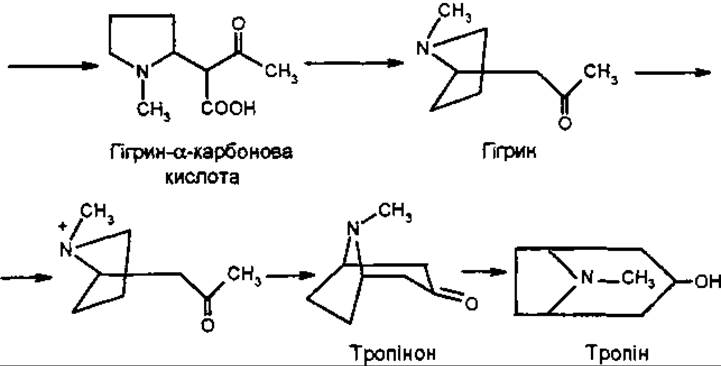
The biosynthesis of the bicyclic core of tropane alkaloids can be regarded as a continuation of the pyrrolidine ring biosynthesis. The N-methyl-∆-pyrrolinium cation condenses with acetoacetic acid to form hygrine-α-carboxylic acid. Decarboxylation of this acid yields hygrine, which through intermediate steps is converted into tropine—a bicyclic compound formed by the Condensation of pyrrolidine and piperidine rings sharing a common nitrogen atom. Alkaloids of the tropane series are derived from tropine (tropan-3-ol).
Tropane alkaloids
Tropane derivatives can be divided into two groups: the tropine group (hyoscyamine, scopolamine, apoatropine, belladanine) and the ecgonine group (cocaine, α- and β-truxillines).
Most tropane alkaloids are characterized by an ester linkage with an acid via the OH group of tropine. The acid component (particularly in the Solanaceae family) is tropic acid, whose initial biosynthetic precursor is the amino acid phenylalanine.
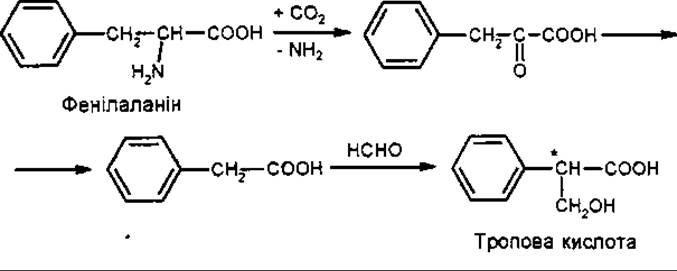
Tropine and scopine, which possesses an epoxide bridge, react with tropic acid to form hyoscyamine and scopolamine, respectively. Tropic acid readily undergoes racemization, converting l-hyoscyamine into l,d-hyoscyamine, known as "atropine".
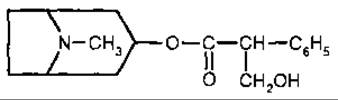
Hyoscyamine
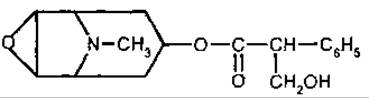
Scopolamine
In terms of biological activity, hyoscyamine is twice as potent as atropine; however, medical practice more frequently employs atropine, which blocks the body's muscarinic cholinergic receptor systems and cholinesterase. Its activity manifests as a reduction in the tone of various Organs (eyes, Bronchi, Blood Vessels, abdominal organs) and a decrease in glandular secretion (salivary, sweat, gastric, and pancreatic). Atropine is used as an antispasmodic and antiulcer agent; it dilates the pupils and increases intraocular pressure.
Scopolamine also exhibits a muscarinic antagonist effect, but unlike atropine, it depresses rather than stimulates the Central Nervous system, inducing drowsiness; therefore, it is used as a sedative and in the Treatment of parkinsonism.
Cocaine is an alkaloid obtained from the coca bush Erythroxylum coca (Erythroxylaceae). The plant is native to Peru and Bolivia and is widely cultivated.
The leaves contain 0.7–1.5% alkaloids, including cocaine, cinnamoylcocaine, and truxilline. The ratio of these major alkaloids varies depending on the bush cultivar. Other identified alkaloids include ecgonine and minor alkaloids such as hygrine, hygrine, cuscohygrine, dihydrocuscohygrine, and tropacocaine.
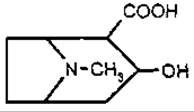
Ecgonine
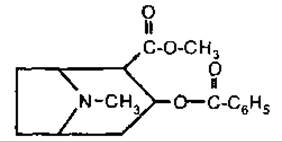
Cocaine
The leaves exert a tonic effect during fatigue, sustain muscular energy, and suppress the sensation of hunger. Cocaine and its salts (cocaine hydrochloride) were the first local anesthetics, but today they are used exclusively as local anesthetics in ophthalmology, as well as in ear, Nose, throat, and oral surgery.
Chronic excessive use of cocaine leads to drug addiction; in chronic users, The Nervous System is severely damaged, ultimately resulting in rapid death.
Last update: 06/08/2026
Editorial and Educational Adaptation: This material has been compiled based on the primary/original source text. The project team performed an editorial review, corrected technical inaccuracies, structured sections, and adapted the content for an educational format.
What was processed:
- elimination of formatting defects (OCR errors, structural breaks, corrupted characters);
- editorial organization of content;
- standardization of terminology in accordance with academic sources;
- verification of factual statements against the original source text.
All mentions of the author, publication year, and origin of the primary text have been preserved in accordance with the source.