Pharmacognosy with the Basics of Plant Biochemistry - Kovalyov, V. M. 2004
Special Section
Alkaloids
Medicinal plants and raw materials containing protoalkaloids
FRUCTUS CAPSICI — CAPSICUM FRUIT
Annual pepper — Capsicum annuum L., fam. Solanaceae
Capsicum annuum (red pepper); the generic name capsicum is possibly derived from the Greek kapto (to burn), due to the pungent taste of the fruits, or from the Latin capsa (bag or box), referring to the shape of the fruit.
Plant. Cultivated as an annual plant in two main forms — sweet pepper and hot pepper, which encompass numerous cultivars.
The stem is branched, erect, woody at the base, 30-125 cm in height. Leaves are alternate, sometimes paired at the upper nodes, ovate, entire or sinuate along the margin, on long petioles. Flowers are solitary or paired, located in the stem forks. The corolla is rotate, white, yellowish, or violet. Fruits are conic, slightly flattened, somewhat curved, with a five-toothed calyx persisting into the pedicel, hollow inside, with numerous seeds, 5-12 cm long and 2-4 cm wide. The color of the fruit ranges from orange to dark red, the seed color is yellowish. The taste is extremely pungent.
The pericarp in sweet pepper varieties is thicker and more fleshy than in hot varieties; the coloration successively changes from green to yellow, orange, or dark red. Only red pungent varieties are used in medicine.
Distribution. The homeland of Capsicum is Central America (Mexico, Guatemala). The pepper is cultivated in Ukraine, Moldova, the Caucasus, the Volga region, and Central Asia.
Harvesting. The fruits are harvested as they ripen, either manually or mechanically in July-August. They are dried in the sun or in fruit dryers at a Temperature of 40-50 °C. The dust irritates mucous membranes, therefore when grinding the fruits, it is necessary to wear a gauze mask, avoid touching the eyes, and wash hands thoroughly after work.
Class="center">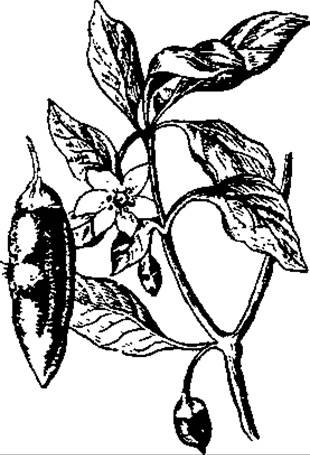
Chemical composition of the raw material. Contains pungent compounds — capsaicinoids (0.1-1.9 %). The main ones are capsaicin, nordihydrocapsaicin, and homodihydrocapsaicin. The fruits are rich in Vitamins — C (0.5 %), P, B1, B2, Folic acid, nicotinic acid, carotenoids; steroid saponins, the glycoalkaloid solanine, Flavonoids (apigenin, luteolin); the coumarin scopoletin, as well as salts of potassium, sodium, calcium, mercury, manganese, aluminum, and iron have been detected.
Biological activity and application. Capsicum preparations are used externally as a counter-irritant for neuralgia and radiculitis. Products include capsicum tincture and capsicum plaster. Capsicum tincture is a component of anti-frostbite ointment, pepper-ammonia and pepper-camphor liniments, as well as preparations such as capsin (a non-narcotic analgesic acting on the Central Nervous system), capsitrin, and espol.
The tincture is used to stimulate appetite and improve Digestion. It should be borne in mind that internal consumption of an excessive dose can cause acute gastrointestinal upset.
In homeopathy, the mature pod with seeds is used for acute and chronic otitis, rhinitis, sinusitis, hyperacid gastritis, acute hemorrhoids, Bronchitis, and Bronchial Asthma.
EPHEDRA HERB — HERBA EPHEDRAE
Ephedra (joint-pine) — Ephedra equisetina Bunge, fam. Ephedraceae
Ephedra equisetina (mountain ephedra); the generic name originates from the Greek epi (upon) and hedra (sitting), because the strobili are sessile on the branchlets; the Latin specific epithet equisetina refers to its resemblance to Equisetum (horsetail).
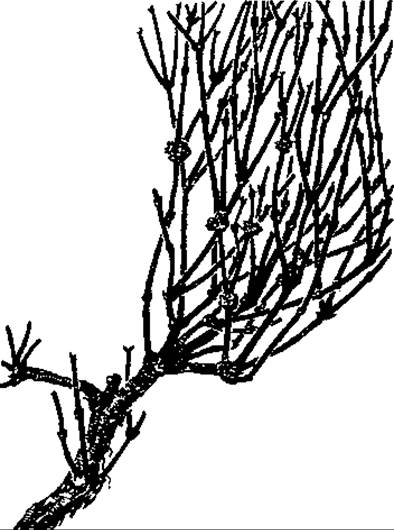
Plant. A perennial dioecious densely branched shrub up to 1.5 m tall. Branches are woody, directed upwards, with opposite, non-woody, jointed green annual branchlets up to 3 mm thick; internodes are about 2 cm long. The lower branchlets are often whorled, while the upper ones are always opposite. Leaves are opposite, reduced to membranous scales. Flowers are unisexual, small, gathered in small strobili (spikelets). The fruit is a pseudo-berry.
Distribution. The geographic range spans the mountains of Kazakhstan, Central Asia, the Altai, and the Caucasus. Ephedra forms small patches on sunny slopes at an altitude of 1000–1800 m above sea level.
Harvesting. The raw material is harvested in two periods: early in spring, before the onset of vegetation, or in autumn, when growth ceases and young shoots acquire elasticity. Only green branchlets are cut, avoiding woody parts. About 15% of the green mass is left on the bushes. The interval between harvests should be at least 2 years. The herb is stacked in heaps 80-100 cm wide and 1 m high. For high-quality drying, it must be well ventilated by the wind. Work with the raw material should be carried out wearing gauze masks and protective goggles; hands must be washed thoroughly with soap after work.
Chemical COMPOSITION OF THE raw material. The herb contains Alkaloids (1.5-2%); the main L-ephedrine is mixed with other isomers, half of the mass of which is sometimes represented by dextrorotatory pseudoephedrine. Its pharmacological properties are similar to ephedrine, but its activity is significantly lower. The herb also contains N-methylephedrine and about 10% Tannins.
Biological activity and application. Ephedrine hydrochloride is used as an adrenomimetic agent. It is employed for treating allergic conditions (bronchial asthma, vasomotor rhinitis, urticaria, etc.) and stimulating the central nervous system in cases of poisoning by morphine, scopolamine, and ganglionic blockers. Due to its action on the central nervous system and enhancement of Skeletal Muscle tone, ephedrine is classified as a sports doping agent.
It is a component of tablets such as theofedrin, anthastman, the aerosol efatin, as well as solutan and bronholitin preparations used as bronchodilators.
From the waste products obtained during the extraction of ephedrine from Ephedra equisetina and Ephedra intermedia, the drug defedrin is manufactured, which is used similarly to ephedrine.
In Russia, Ephedra distachya (joint-fir) became known in 1889 as a remedy for all types of rheumatism and dysentery; however, this species has a poorer chemical composition, and extracting ephedrine from it is economically unviable.
FRESH COLCHICUM CORMS — BULBOTUBERA COLCHICI RECENTIA
Showy meadow saffron — Cólchicum speciósum Stew, autumn crocus — Colchicum autumnale L., fam. Melanthiaceae
Showy autumn crocus; the name originates from Greek Kolchis — Colchis, whence, according to Dioscorides, this plant was brought; Latin speciosus, -um — handsome, beautiful.
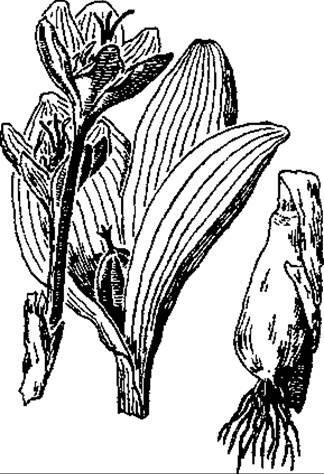
A perennial herbaceous plant with a specific developmental cycle. It blooms in autumn (September–October), and fruits appear in June–July. The corms are whole, oblong, nearly Kidney-shaped, up to 7 cm long and up to 6 cm wide, covered with a brownish-brown membranous tunic. On cross-section, they are white with pale yellow dots. The flowers are large, bisexual, ranging from nearly white to pinkish-purple. The leaves are lanceolate or elliptical, fused by their sheaths, forming a false stem 20–50 cm high. During seed ripening, the leaves wither away. In summer, during June–August, the plants are entirely hidden in the soil, and their corms are in a state of dormancy. The corms are replaced annually in the spring. Propagation occurs both by seeds and vegetatively. The plant is poisonous.
Distribution. Showy meadow saffron is widespread in the subalpine belt of the Main Caucasian Ridge and Western Transcaucasia at an altitude of 1200–3300 m above sea level.
Autumn crocus grows in isolated groups in the Carpathians. The main reserves are concentrated in Western Europe. The species is listed in the Red Data Book of Ukraine. Autumn crocus is also cultivated as an ornamental plant.
Harvesting. Large corms (at least 4 cm long and 3 cm wide) along with their roots are dug up in late summer and autumn during flowering. It is strictly forbidden to harvest the raw material before the plant flowers. Undamaged corms are cleaned of soil, and the renewal SHOOT located on the side is broken off, taking care not to damage the lower part of the mother plant. Cut, damaged, and corms less than 4 cm in diameter are reburied in the soil. To preserve the population in the forest belt, it is recommended to leave 10–20 plants per 100 m2 of thickets. The harvesting rotation is 4–5 years. Caution should be exercised during harvesting.
For preliminary wilting, the raw material is spread in a 10–15 cm layer in the sun or indoors. Washing the corms or wetting them with Water is strictly prohibited. The raw material is used fresh.
Chemical composition of the raw material. More than 10 colchicine alkaloids have been isolated: colchamine, colchicine, colchiceine, colchicoside, glycoalkaloids, a series of colchicine alkaloids H, C, E, B, etc. The colchicine content is 0.25%. In addition to alkaloids, the corms contain flavonoids, phytosterols, CARBOHYDRATES, and aromatic acids.
Biological activity and application. Colchamine is used for malignant tumors in cases that are not amenable to surgical intervention. A 0.5% colchamine ointment is used to treat Skin Cancer.
In homeopathy, the corms of the autumn crocus dug up in spring are used. They are prescribed for stiffness of the neck and occipital Muscles, Joint Diseases of a rheumatic and gouty nature, dysentery, and gastroenteritis. It is considered a capillary poison.
Last update: 06/08/2026
Editorial and Educational Adaptation: This material has been compiled based on the primary/original source text. The project team performed an editorial review, corrected technical inaccuracies, structured sections, and adapted the content for an educational format.
What was processed:
- elimination of formatting defects (OCR errors, structural breaks, corrupted characters);
- editorial organization of content;
- standardization of terminology in accordance with academic sources;
- verification of factual statements against the original source text.
All mentions of the author, publication year, and origin of the primary text have been preserved in accordance with the source.