Pharmacognosy with the Basics of Plant Biochemistry - Kovalyov V. M. 2004
Special Section
Alkaloids
Medicinal plants and raw materials containing pyrrolizidine alkaloids
BROAD-LEAVED RAGWORT RHIZOMES AND ROOTS — RHIZOMATA CUM RADICIBUS SENECIONIS PLATYPHYLLOIDES
BROAD-LEAVED RAGWORT HERB — HERBA SENECIONIS PLATYPHYLLOIDES
Broad-leaved ragwort — Senecio platyphylloides, syn. Adenostyles platyphylloides (Willd) M. Pimen., fam. Asteraceae. The generic name comes from the Latin senex meaning "old man"; the specific epithet platyphylloides is derived from the Greek platys (broad), phyllon (leaf), and oides (resembling).
A perennial herbaceous plant with a thick, horizontal, often hollow, greyish-brown rhizome up to 20 cm long, from which numerous slender roots 2–15 cm long and 0.1–0.2 cm wide emerge. The stem is slender, erect, ribbed, pubescent, branched in the upper part, and 75–150 cm tall. The basal and lower stem leaves are up to 50 cm wide, long-petiolate, reniform-cordate, acuminate, deeply emarginate at the base, and unevenly dentate along the margin. The middle stem leaves are triangular or sagittate-triangular in shape and short-petiolate, with broadly winged petioles and large stem-clasping auricles. The upper leaves are sessile, lanceolate, and nearly entire. The flowers are tubular, bright yellow, arranged in 10–15-flowered cylindrical corymbs. The fruit is an achene.
Distribution. A Caucasian endemic. It grows in meadows and mountain forest edges.
Harvesting. The herb is harvested using a sickle or pruners during the budding and early flowering stages. The underground parts are dug up after fruit maturation, exposed to the air for 1–2 days, then washed and dried in dryers at a Temperature of 50 °C. The herb is dried outdoors in clear weather. The plant is poisonous.
Class="center">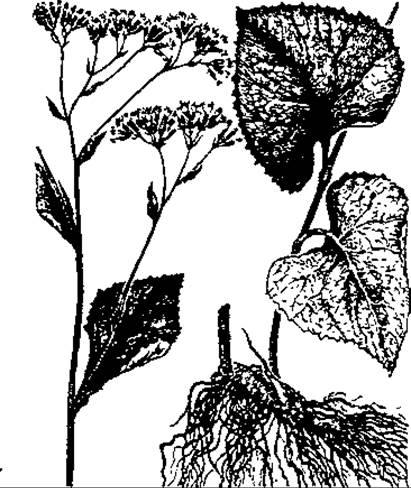
Chemical composition of the raw material. All PARTS OF THE plant contain the Alkaloids platyphylline, seneciphylline, saracine, neoplatyphylline, and senecionine, predominantly in the N-oxide form. The total alkaloid content is: in leaves — 0.49–3.5%, in stems — 0.2–1.2%, in rhizomes with roots — 2.2–4%, and in seeds — up to 5%. The platyphylline content in the herb ranges from 0.5 to 0.9%.
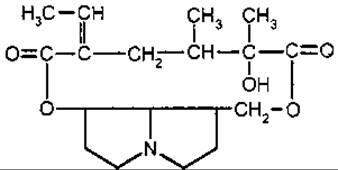
Platyphylline
Biological activity and application. Platyphylline hydrotartrate exhibits spasmolytic effects. Its activity is weaker than that of atropine, but its toxicity is also significantly lower. It is prescribed in ampoules, tablets, and combination formulas for Bronchial Asthma, angina pectoris, cholecystitis, and other conditions. Due to its sedative effect on the Central Nervous system, it is used to treat motion sickness.
Last update: 06/08/2026
Editorial and Educational Adaptation: This material has been compiled based on the primary/original source text. The project team performed an editorial review, corrected technical inaccuracies, structured sections, and adapted the content for an educational format.
What was processed:
- elimination of formatting defects (OCR errors, structural breaks, corrupted characters);
- editorial organization of content;
- standardization of terminology in accordance with academic sources;
- verification of factual statements against the original source text.
All mentions of the author, publication year, and origin of the primary text have been preserved in accordance with the source.