Pharmacognosy with the Basics of Plant Biochemistry - Kovalyov V. M. 2004
Special Part
Alkaloids
Pyridine Alkaloids
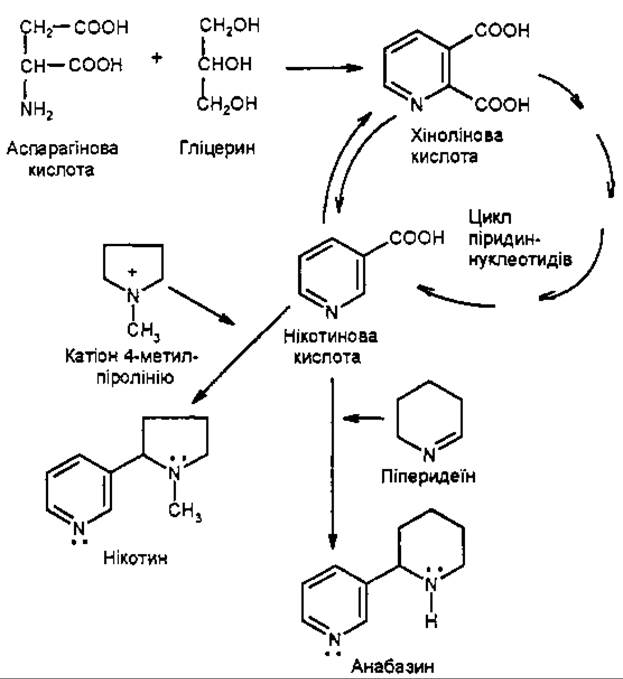
The pyridine ring is relatively rare in The Structure of Alkaloids (such as nicotine and anabasine); however, it is widely distributed in natural compounds, being a structural component of pyridine NUCLEOTIDES (NAD, NADP), nicotinamide Coenzymes, and others. Nicotinic acid always serves as the precursor of pyridine. Unlike humans, animals, and most microorganisms, plants synthesize it not from Tryptophan, but through the transformation of simpler aliphatic compounds (aspartic acid and glycerol or its phosphorylated derivative, phosphoglyceraldehyde).
Following Condensation and a series of intermediate reactions at the cyclic product stage, these compounds yield quinolinic acid. Subsequently, it undergoes the Reactions of the so-called pyridine nucleotide cycle, resulting in the elimination of CO and The formation of nicotinic acid. The latter acts as the direct precursor of pyridine alkaloids. In The Biosynthesis of nicotine, this acid condenses with the N-methyl-Δ-pyrrolinium cation, whereas in the biosynthesis of anabasine, it condenses with Δ-piperideine.
Class="center">Biosynthesis of pyridine alkaloids derived from L-aspartate via the formation of nicotinic acid
Nicotine is the most well-known representative of this group. It is found in the leaves and seeds of tobacco and wild tobacco (Nicotiana spp., Solanaceae), which are used for smoking. Wild tobacco is native to Mexico and Texas. Tobacco is an ancient crop cultivated by Native Americans, which had spread throughout the Americas before the arrival of Europeans.
It is cultivated in Crimea, the Caucasus, and Central Asia. The leaves contain from 0.3% to 6% nicotine, depending on the variety, climate, and other factors. Nicotine is a colorless, odorless liquid with a pungent taste. Upon exposure to air, it oxidizes and acquires a tobacco-like odor, and it is volatile with steam. It is a potent poison that inhibits The Nervous system; in its potency, it approaches hydrocyanic acid (the toxic dose for humans is 50-100 mg).
An aqueous solution of nicotine sulfate is used to control harmful insects. Nicotine can be used to produce nicotinic acid and nicotinamide (Vitamin PP). In medicine, tobacco has no direct application. Nicotine is a component of chewing gum used as an aid to smoking cessation. The preparation Nicorette is available abroad.
In homeopathy, dried leaves of current-year tobacco are used for Disorders of the Autonomic nervous system, primarily the parasympathetic system: dizziness with cold sweat, vomiting, motion sickness, Muscle cramps; optic neuritis, laryngitis with dry cough, Hypertension, collapse, obliterating endarteritis, and Pregnancy toxicoses.
Anabasine (α-piperidyl-β-pyridine) is an alkaloid found in leafless rat-tail (Anabasis aphylla, Chenopodiaceae) and in tobacco along with nicotine. It is a ganglionic poison, with physiological effects similar to those of nicotine. In therapeutic doses, it stimulates the Central Nervous System, enhances Respiration, and increases Blood pressure. Previously, a mixture of alkaloids from Anabasis aphylla known as anabasine sulfate was used as an insecticide to treat pediculosis and ringworm in animals, but it is no longer used due to its high toxicity.
Last update: 06/08/2026
Editorial and Educational Adaptation: This material has been compiled based on the primary/original source text. The project team performed an editorial review, corrected technical inaccuracies, structured sections, and adapted the content for an educational format.
What was processed:
- elimination of formatting defects (OCR errors, structural breaks, corrupted characters);
- editorial organization of content;
- standardization of terminology in accordance with academic sources;
- verification of factual statements against the original source text.
All mentions of the author, publication year, and origin of the primary text have been preserved in accordance with the source.