Pharmacognosy with Basics of Plant Biochemistry - Kovalyov V. M. 2004
Special Part
Essential Oils
Medicinal plants and raw materials containing sesquiterpenoids
HOPS STROBILE — STROBILI LUPULI
Common hop — Humulus lupulus L., fam. Cannabaceae
Common hop; the name comes from humulus, a medieval Latinized name for hops, and Latin lupulus, derived from Italian lupullo, the name for hops.
Plant description. A perennial herbaceous liana. Stem twining, angular, 3-6 m long. Leaves petiolate, opposite, rounded or ovate, dark green above, rough, with yellow glands; lower leaves three- to five-lobed. Flowers unisexual, dioecious, in dichasial cymes, gathered into spike-like inflorescences. Female flowers solitary or in cone-like catkins that develop into infrutescences. Cones oblong-elliptic, single or a few together on a slender pedicel, with open scales attached to a hard axis, with or without fruits. The scales contain small glands on the inner side.
Distribution. Grows throughout Ukraine. Found in Europe, the Caucasus, partly in Siberia and Central Asia in damp places, shrublands, and along riverbanks. Cultivated.
Harvesting. Female inflorescences, or "cones", are picked together with their pedicels in late summer, before full maturity, when they acquire a greenish-yellow color, to prevent the glandular scales from falling off during collection, and are quickly dried in the shade.
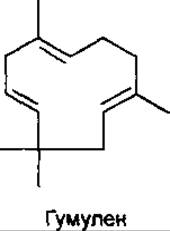
Chemical composition of the raw material. The cones contain essential oil (1.0-3.0 %), which includes humulene (up to 50 %), myrcene (up to 25 %), farnesene, and ß-caryophyllene. The Components of the bitter resin (11-20 %) are a- and ß-hop acids, which are phloroglucinol derivatives: humulon, cohumulon, allupulon, lupulon, colupulon, etc. Other Phenolic Compounds include Coumarins, Flavonoids, catechins, and Tannins. Additionally, it contains B Vitamins, ascorbic acid, tocopherols, and estrogenic hormone-like substances. The sedative effect is attributed to the recently discovered compound 2-methyl-3-buten-2-ol.
Class="center">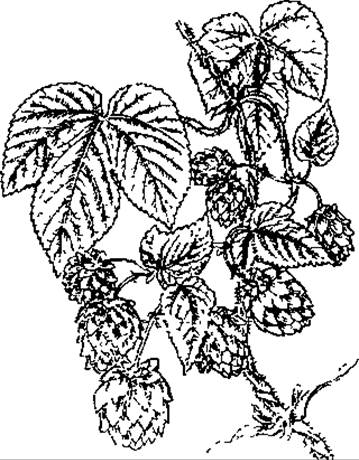
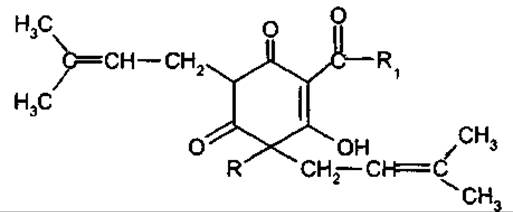
R = ОН; R1 = СН2СН(СН3)2 — Humulon
R = СН2СН = С(СН3)2; R1 = СН2СН (СН3)2 — Lupulon
R = ОН; R1 = СН(СН3)2 — Cohumulon
R = СН2СН = С(СН3)2; R1 = СН (СН3)2 — Colupulon
Biological activity and application. The raw material is a component of sedative herbal mixtures. The extract is an ingredient of the complex preparation Urolesan, which is used as a spasmolytic and diuretic agent in urolithiasis. The essential oil is part of the sedative medications Valocordin and Corvaldin.
In homeopathy, hop inflorescences are used under the name Lupulinum as a sedative, especially for gastrointestinal disorders of nervous origin. They are frequently used in combination with other plants (e.g., barley).
BIRCH BUDS — GEMMAE BETULAE
BIRCH LEAVES — FOLIA BETULAE
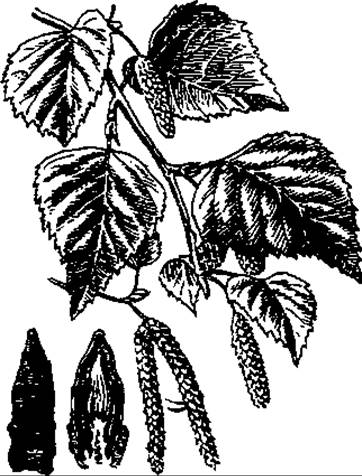
Silver birch — Betula pendula Roth. (downy birch — Betula verrucosa Ehrh.), downy birch — Betula pubescens Ehrh., fam. Betulaceae
Silver birch (warty birch), downy birch; the Latinized generic name comes from Celtic betu — birch, and Latin pendulus, -a — pendulous, verrucosa — warty.
Plant description. A monoecious tree, 10-20 m tall. Crown open, with weeping branches. Young shoots glabrous, glossy, reddish-brown, densely covered with resinous warts. Buds elongated-conical, acute, up to 7 mm long and 3 mm wide, glabrous, covered at the edges with imbricate scales. Color brownish to dark brown. Balsamic odor, becoming stronger when rubbed. Leaves alternate, long-petiolate, triangular-rhombic, doubly serrate, with a cuneate base, glabrous. Flowers in unisexual catkins.
Distribution. Grows in forest and forest-steppe regions, along river valleys. Cultivated in gardens and parks.
Harvesting. Buds are harvested in early spring during the Swelling period. Leaves are collected in April-May while they are fragrant and sticky. Opened buds and old leaves lose their medicinal properties. Buds and leaves are dried outdoors under a shed or in attics.
Chemical COMPOSITION OF THE raw material. Buds and leaves contain essential oil, saponins, tannins, resins, ascorbic acid, and nicotinic acid. The essential oil includes betulene, caryophyllene, a- and ß-betulenol, and their acetic acid esters. Dammarane-type triterpenoids and pentacyclic lupane-type triterpenoids (betulinic acid derivatives), flavonoids, and carotene have also been found.
Birch sap contains up to 2 % sugars, tannins and aromatic substances, malic acid, as well as iron, calcium, and magnesium salts.
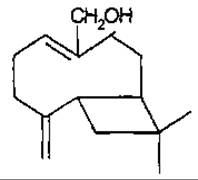
alpha-Betulenol
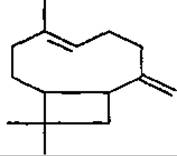
Caryophyllene
Biological activity and application. Birch-based preparations exhibit diuretic, choleretic, spasmolytic, anti-inflammatory, wound-healing, antiviral, anthelmintic, and antiparasitic properties. The crude drug is used in the form of infusions and tinctures, and is a component of the combined preparation Propobesan.
POPLAR BUDS — GEMMAE POPULI
Black poplar — Populus nigra L., fam. Willow family — Salicaceae
Black poplar (populus is the Latinized name of the poplar derived from popullaris meaning common or useful to the people; Latin niger means black).
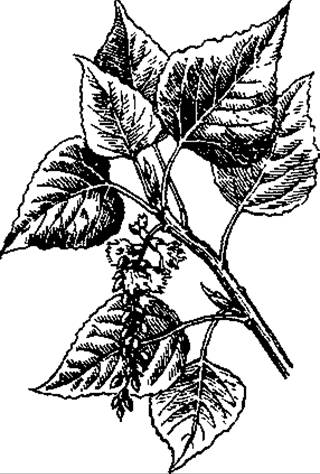
Plant description. A deciduous dioecious tree up to 30 m in height, with a spreading crown. The trunk bark is thick and dark gray, while the bark of the branches is ash-gray. Buds are oblong-ovate, pointed, scaly, resinous-sticky, aromatic, glabrous, and glutinous; they possess a distinct resinous-balsamic odor. Leaves are long-petiolate, nearly triangular, pointed, smooth, glossy, and green. Flowers are small, bracteate, unisexual, and gathered into long cylindrical catkins.
Distribution. Found throughout Ukraine, except for the Carpathians, along river valleys and banks, in floodplains, and along the banks of oxbow lakes and ponds. Cultivated as an ornamental plant.
Harvesting. The leaf buds are collected as soon as they swell but before they open, by snapping them off the branches. They are dried in the shade in a draft or in a warm, well-ventilated room, spread in a 2–3 cm layer on fabric or paper, and turned over periodically.
Chemical composition of the raw material. Essential oil (0.7 %), which includes humulene, alpha-caryophyllene, and cineole. Black poplar buds contain sesquiterpenoids, phenol glucosides (salicin and populin), 8 % flavonoids (apigenin, galangin, genkwanin, galangin 3-methyl ether, isalpinin, quercetin, kaempferol, rhamnetin, isorhamnetin), organic acids (benzoic, cinnamic, gallic, caffeic, ferulic, and malic), Vitamin C, resins, fatty oil, etc.
Biological activity and application. Poplar preparations possess diuretic, antiseptic, and diaphoretic properties. When applied topically, they exhibit anti-inflammatory, antimicrobial, hemostatic, and mild anesthetic effects. Preparations derived from poplar buds (ointments, oil infusions, and less frequently, tinctures) are used to treat wounds, ulcers, Burns, cuts, dermatitis, and trichomonal colpitis. It is a component of the combined preparation Propobesan.
CALAMUS RHIZOMES — RHIZOMATA CALAMI
Sweet flag (calamus) — Acorus calamus L., fam. Arum family — Araceae
Sweet flag (sweet sedge, calamus); the Latinized name originates from the Greek akóros, the name of a plant with a fragrant ROOT, and kalamos, meaning reed.
A perennial herbaceous plant. The rhizome is thick, cylindrical, tortuous, yellowish-green, covered on top with spiral dark wide leaf scars, and bearing numerous thin rootlets on the underside; it grows horizontally, lying almost On the surface.
The stem is erect, unbranched, flattened, grooved on one side and sharply ribbed on the other, up to 120 cm in height. Leaves are ensiform (sword-shaped), flowers are small, greenish-yellow, collected into a spadix. The fruit is a leathery red berry.
Distribution. Grows across almost the entire territory of Ukraine along the banks of rivers and Water bodies, in swamps, marshy meadows, and gullies.
Harvesting. Calamus rhizomes are harvested in autumn (September–October), when the water level in ponds and lakes drops, and continuing until the first frosts.
They are pulled ashore using pitchforks, shovels, or rakes, then washed, air-withered, cut into pieces 15–20 cm long, and dried in dryers at a Temperature of 25–30 °C. At higher temperatures, the Essential Oils, which are abundant in the raw material, evaporate, thereby reducing its value.
Chemical composition of the raw material. Rhizomes contain essential oil (up to 5 %). The composition of the essential oils is highly variable and depends on the origin and chemotype of the sweet flag. The essential oil of calamus harvested in Ukraine includes mono- and sesquiterpenoids: alpha-pinene, alpha-camphene, camphor, borneol alcohols, eugenol, methyl eugenol, cyclic sesquiterpenes: elemol, beta-elemene, alpha-camphene, acorone. The bitter glycoside acorin, phenolic compounds (asarone), ascorbic acid, and tannins also contribute to its biological activity.
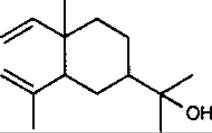
Elemol
Biological activity and application. Calamus exhibits tonic, anti-inflammatory, analgesic, expectorant, choleretic, antibacterial, and disinfectant properties. Internally, its preparations are prescribed for non-specific digestive disorders as a general tonic, while externally they are used for stomatitis, rinsing purulent wounds and ulcers, douching in vaginitis, and promoting Hair growth.
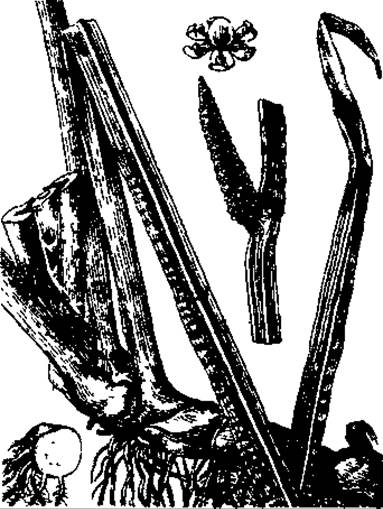
Dosage forms: infusion of dried rhizomes, tincture, olimetin, polyphitol—having spasmolytic, choleretic, diuretic, and anti-inflammatory effects; vikalin, vikaïr, and herbogastrin—preparations for the Treatment of PEPTIC ULCER DISEASE.
Last update: 06/08/2026
Editorial and Educational Adaptation: This material has been compiled based on the primary/original source text. The project team performed an editorial review, corrected technical inaccuracies, structured sections, and adapted the content for an educational format.
What was processed:
- elimination of formatting defects (OCR errors, structural breaks, corrupted characters);
- editorial organization of content;
- standardization of terminology in accordance with academic sources;
- verification of factual statements against the original source text.
All mentions of the author, publication year, and origin of the primary text have been preserved in accordance with the source.