Biochemistry - The Chemical Reactions of Living Cells, Volume 3 - D. Metzler 1980
Cell Growth, Differentiation, and Chemical Communication
Environmental Issues (Author's Personal Note)
The concluding section of this chapter, dedicated to communication issues, naturally leads to the topic of interspecies communication. People face so many hurdles in communicating with one another that environmental issues might seem secondary by comparison. However, a closer look at what can be more broadly defined as metabolic cycles in the biosphere quickly reveals the vital importance of this biochemical dimension. We need only consider that The Emergence of eukaryotes is likely linked to the establishment of symbiotic relationships between Two Types of prokaryotes. Similarly, the evolution of higher plants may have been driven by Symbiosis between an alga and a non-photosynthetic Organism.
Interspecies alliances continue to play a crucial role today. For instance, meat production depends heavily on the Bacteria that make up the microflora of the ruminant digestive tract. The Human Body serves as a host to numerous bacteria, Fungi, and other organisms, and we must maintain a harmonious coexistence with them. To combat bacterial infections, we rely on Antibiotics produced by bacteria or fungi. Even more fundamental is our dependence on plants, which supply oxygen and essential nutrients. Our surrounding environment is largely the product of various organisms living in a state of dynamic ecological equilibrium. Clearly, we can anticipate a rapid expansion of our knowledge in chemical ecology—not only regarding how one group of organisms influences another, but also how human activity impacts plants and animals across all Levels of Organization. Issues such as the consequences of environmental pollution, atmospheric ozone depletion, and other shifts affecting The amount of radiant energy reaching Earth must be thoroughly investigated, alongside the potential implications of excessive human energy consumption. Just as maintaining Homeostasis within a Cell is often critical for the survival of an organism, preserving the steady state of chemical cycles appears equally essential for The Biosphere as a whole.
Undoubtedly, The Role of biochemists in medicine, agriculture, and industry will continue to grow in the future. Biochemists must be prepared to help shape critical decisions that will influence the future of all life on Earth. Biochemical approaches will be required to solve many major problems. Special attention must be given to mutation-related issues (Ch. 15, Sec. 3, 3) and the environmental fallout from the ever-growing number of synthetic chemical substances. This will inevitably raise not only scientific but also ethical questions. For example, humanity cannot avoid a gradual decline in the Gene pool without resorting either to effective Selection measures—which do not yet exist—or to "Introduction/32.html">Genetic Engineering." If we gain The ability to alter genetic traits, theoretically nothing would prevent us from making humans healthier, more capable, and more intelligent than they are today. However, we must not forget that our knowledge remains highly incomplete and our actions are fraught with potential errors.
Despite attempts to ignore the threat of a new war, we cannot afford to overlook this issue. The near-total annihilation of complex life forms through The impact of radiation on the genetic apparatus is a very real possibility. Of course, it is reassuring that humanity has lived with atomic weapons for many years without deploying them, but persistent threats to use them as a last resort could easily trigger a global catastrophe.
Perhaps it is biochemists—those who fully grasp the problems caused by Mutations and other consequences of radiation exposure—who must warn society of the looming danger.
An even greater threat than radiation exposure is biochemical warfare, such as The Use of engineered Viruses. To date, biochemical warfare has been rarely used because of the universal realization that such weapons do not spare friend or foe alike. However, advancing knowledge in molecular biology could make insidious attacks on unvaccinated populations feasible. Because biochemical research does not require bulky technical equipment, The Development of biological weapons could be carried out by a small group of scientists in strict secrecy.
Should we worry? If biochemistry cannot uncover the meaning of life, perhaps we scientists should simply stick to science? After all, science in itself has no morals, does it? And ultimately, won't society do whatever it pleases regardless of our opinions? Such questions are inevitable, yet the work of the world's leading scientists is driven by a profound sense of responsibility. They seek not only the joy of discovery and the satisfaction of recognition, but also the preservation of peace for their children and grandchildren. They feel a deep compassion for others. Many of them became biochemists out of a desire to study living systems in order to improve human health, medical care, Nutrition, and more. Most scientists refuse to accept an outcome where Human Evolution ends in catastrophe due to nuclear warfare or the irreversible pollution of land and Water.
Returning to the subject of biological weapons, I recall the words of Joshua Lederberg, the pioneer of bacterial recombination, at a 1971 conference in Berkeley. He asked whether justice and objectivity exist outside the walls of the laboratory. In his view, the answer must be yes. Lederberg pointed out that various nations had agreed to halt The production of biological weapons and had already taken steps to mitigate the growing danger. Yet this sensible decision invariably meets with resistance. Some insist on establishing on-site inspections to verify compliance. But can any inspection truly be effective? According to Lederberg, only one form of control is currently viable: control exercised by scientists themselves, who must step beyond the role of "pure scientists" and take on the task of preventing the reckless misuse of cutting-edge biological discoveries. While a community of scientists acting with absolute responsibility at all times may seem unlikely, it is perhaps the only path to ensuring that humanity can continue to thrive on our planet. Lederberg believed this is achievable. (I share this view.)
If this book has helped the reader navigate the complexities of molecular biology and appreciate the potential of this science, I hope these final lines will persuade the reader to heed Professor Lederberg's advice. I sincerely hope that all young people currently studying biochemistry and modern biology will use this fantastic knowledge for the benefit of humanity, and that upon attaining positions of influence in the scientific world, they will act with responsibility and caution.
1. The corticosteroid hormone–receptor complex, formed at low Temperature and low Ionic strength, binds to Chromatin only after "activation." Activation is a first-order reaction yielding a monomolecular product. The reaction rate increases with temperature, and equilibrium is reached when approximately ~60% of the complex molecules are activated. The process is characterized by the following parameters (Atger M., Milgrom E., JBC, 251, 4758–4762, 1976):
Class="center">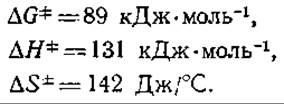
How would you classify the type of this activation reaction?
2. Many Peptide Hormones are synthesized from larger precursor Peptides via proteolysis, which sometimes occurs in two or more stages. What advantages might this pathway of hormone production offer to the organism?
3. During Sleep, an insoluble rat Brain phosphoprotein incorporates more radioactive Pi than during wakefulness. This phosphoprotein was isolated and identified as glucose-6-phosphatase (Anchors M., Karnovsky M. L., JBC, 250, 6408–6416, 1976). How can this phenomenon be explained? Attempt to interpret the state of sleep from a chemical perspective.
4. Alterations in the same behavioral trait of an organism are observed following a mutation in any of the genes encoding the following Proteins:
adenylate cyclase,
phosphodiesterase,
prostaglandin synthesis Enzymes,
monoamine oxidase,
cAMP receptor protein,
a protease acting on lipotropin.
Explain the molecular basis for the commonality of these mutation effects.
5. Certain N-formyl peptides act as chemoattractants for phagocytes (Aswanikumar S., Schiffman E., Corcoran B. A., Wahl S., M., PNAS. 73, 2439–2442, 1976). What might be the Biological Significance of this fact? It has been suggested that the peptidase activity of phagocytes also plays a major role in chemotaxis. Explain why.
Last update: 06/08/2026
Editorial and Educational Adaptation: This material has been compiled based on the primary/original source text. The project team performed an editorial review, corrected technical inaccuracies, structured sections, and adapted the content for an educational format.
What was processed:
- elimination of formatting defects (OCR errors, structural breaks, corrupted characters);
- editorial organization of content;
- standardization of terminology in accordance with academic sources;
- verification of factual statements against the original source text.
All mentions of the author, publication year, and origin of the primary text have been preserved in accordance with the source.