Human Biochemistry, Volume 2 - Murray R. 1993
Biochemistry of Intra- and Intercellular Communication
Membranes: Structure, Assembly, and Functions
Fluid-Mosaic Model of Membranes
Functional membranes are a two-dimensional solution of globular integral Proteins dispersed in a fluid phospholipid matrix. The Fluid Mosaic Model of Membrane Structure was proposed in 1972 by Singer and Nicolson (Fig. 42.9). The first evidence supporting the validity of this model came from artificially induced fusion of two different parental Cells. It was found that when an interspecies hybrid Cell forms, The Plasma Membrane undergoes rapid stochastic redistribution of species-specific proteins. Subsequently, it was demonstrated that Phospholipids are also capable of rapid redistribution within the membrane plane. Such in-plane diffusion, termed lateral diffusion, can occur quite rapidly; a single phospholipid molecule travels a distance of several micrometers in just 1 s.
Class="center">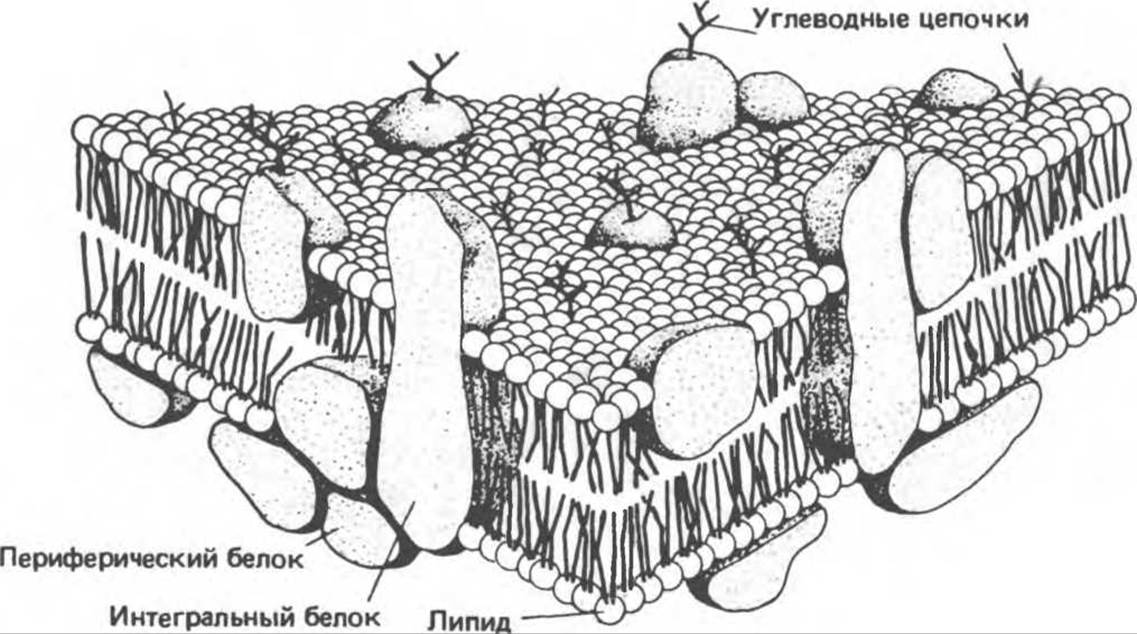
Fig. 42.9. The fluid mosaic model of membrane structure. The core of the membrane is a lipid bilayer associated with proteins that are either embedded in the bilayer or attached to its cytoplasmic surface. Integral Membrane Proteins are firmly anchored within The Lipid Bilayer. Some of these proteins span the bilayer and are termed transmembrane proteins, whereas others are embedded in either the outer or inner leaflet. Proteins that are loosely bound to the inner surface of the membrane are called peripheral proteins. Many proteins and Lipids bear oligosaccharide chains projecting into the extracellular environment. (Reprinted with permission from Junqueira L. C., Carneiro J., Long J. A.: Basic Histology, 5th ed. Appleton and Lange, 1986.)
Phase transitions, and consequently membrane fluidity, depend heavily on the Lipid Composition of membranes. In the lipid bilayer, the hydrophobic fatty acid chains are oriented almost parallel to one another, resulting in a fairly rigid structure. As the Temperature rises, the hydrophobic layer transitions from an ordered to a disordered state, forming a more fluid, pliable system. The temperature at which the entire structure undergoes the transition from ordered to disordered is called the transition temperature. Longer and more saturated fatty acid chains have a higher transition temperature, meaning a higher temperature is required to increase the fluidity of the structures they form. The presence of unsaturated bonds in the cis-configuration increases bilayer fluidity by reducing the tight packing of the chains without altering their Hydrophobicity (Fig. 42.3). Cell membrane phospholipids typically contain at least one unsaturated fatty acid with at least one double bond in the cis-position.
Cholesterol acts as a molecular modulator of membranes, and its incorporation leads to states of intermediate fluidity. When acyl side chains are in a disordered state, cholesterol induces their Condensation; conversely, if they form a crystal-like structure, cholesterol disrupts it into a disordered state. At a high cholesterol-to-lipid ratio, the phase transition does not occur at all.
Membrane fluidity profoundly affects its functioning. As fluidity increases, the membrane becomes more permeable to Water and other small hydrophilic molecules, and The rate of lateral diffusion of integral proteins increases. If the Active Site carrying out a specific function of an integral protein is located exclusively in its hydrophilic region, changes in lipid fluidity will likely not have a major impact on protein activity. However, if the protein performs a transport function and the transport component crosses the membrane, alterations in The properties of the lipid phase can lead to significant Changes in the transport rate. An excellent example is the dependence of Insulin Receptor function on membrane fluidity (Ch. 51). When the concentration of Unsaturated Fatty acids in the membrane increases (upon culturing cells in a medium rich in these compounds), fluidity increases, which leads to the receptor binding more insulin.
Membrane fluidity and, consequently, lateral mobility may vary across different Regions of the membrane. For instance, Protein-Protein Interactions can occur within the membrane plane, leading to The formation of a rigid protein matrix distinct from the usual lipid matrix. Such protein matrix domains can coexist with the conventional lipid matrix within the same membranes. Examples of such close juxtaposition of different matrices include Gap Junctions, tight junctions, and the Bacteriorhodopsin-containing patches of halobacterial purple membranes.
Some lateral protein-protein interactions are mediated by peripheral proteins; for example, cross-linking occurs via Antibodies and Lectins, leading to the formation of so-called cap structures on the membrane surface. Thus, by participating in specific interactions, peripheral proteins can restrict the mobility of integral proteins within the membrane.
Last update: 06/08/2026
Editorial and Educational Adaptation: This material has been compiled based on the primary/original source text. The project team performed an editorial review, corrected technical inaccuracies, structured sections, and adapted the content for an educational format.
What was processed:
- elimination of formatting defects (OCR errors, structural breaks, corrupted characters);
- editorial organization of content;
- standardization of terminology in accordance with academic sources;
- verification of factual statements against the original source text.
All mentions of the author, publication year, and origin of the primary text have been preserved in accordance with the source.