Biological Membranes - A. N. Ogurtsov 2012
Electrogenesis of Biomembranes
Mechanisms of Intercellular Signaling
Gap Junctions
Gap junctions allow small, Water-soluble molecules to pass directly from the Cytoplasm of one Cell to the cytoplasm of another, providing both electrical and metabolic coupling between Cells.
Gap junctions are built from Proteins that protrude from The Plasma Membrane to form structures called connexons (Figure 151). They connect the cytosols of two interacting cells via a continuous aqueous channel. Each connexon is composed of six protein subunits known as connexins. The docking of two connexons forms a complete intercellular channel linking the adjacent cells.
Class="center">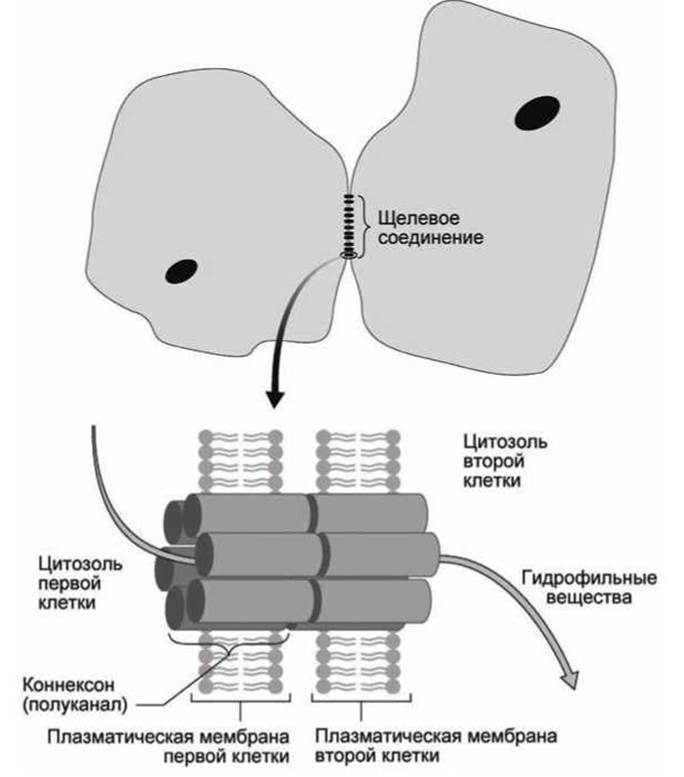
Figure 151 - Diagram of a gap junction
The effective diameter of the aqueous channel is 1.5–2 nm. To determine the internal pore size of gap junctions, researchers microinjected a series of fluorescent probes into individual cells and observed their spread to neighboring cells. The experiments revealed that molecules with a Molecular Weight of up to 1000–1500 Da can pass freely from Cell to Cell.
Inorganic ions, sugars, Amino Acids, and NUCLEOTIDES can all traverse gap junctions to move between cells.
Through electrical coupling, gap junctions ensure the synchronized contraction of cardiac Muscle cells and Cytology/cytology/32.html">Smooth Muscle tissue.
Electrical synapses formed by gap junctions allow action potentials to propagate from cell to cell without the synaptic delay characteristic of chemical synapses.
Cellular coupling via gap junctions plays a crucial role in Embryogenesis. In early embryos, most cells are electrically coupled to one another. It is hypothesized that this metabolic coupling also serves as a vital mechanism for distributing nutrients before the Circulatory system is established.
The permeability of gap junctions is regulated by Calcium Ions. The intercellular channels remain fully open when intracellular Ca2+ concentrations are below 10-7 M, and they close completely when calcium levels exceed 5∙10-5 M.
When a cell is injured or dying, it is essential that it rapidly uncouples from its neighbors. This response is triggered by a sharp rise in intracellular Ca2+, which either enters through the compromised plasma membrane or accumulates because the damaged cell can no longer effectively pump Ca2+ out of its Cytosol. Furthermore, experimental interventions that lower intracellular pH cause a rapid and reversible decrease in gap junction permeability.
Last update: 13/08/2026
Editorial and Educational Adaptation: This material has been compiled based on the primary/original source text. The project team performed an editorial review, corrected technical inaccuracies, structured sections, and adapted the content for an educational format.
What was processed:
- elimination of formatting defects (OCR errors, structural breaks, corrupted characters);
- editorial organization of content;
- standardization of terminology in accordance with academic sources;
- verification of factual statements against the original source text.
All mentions of the author, publication year, and origin of the primary text have been preserved in accordance with the source.