Human Biochemistry, Volume 2 - Murray R. 1993
Biochemistry of Intracellular and Intercellular Communication
Membranes: Structure, Assembly, and Function
Artificial Membranes
Artificial Membranes are produced using specially developed techniques. Such membrane systems typically consist of a single phospholipid (natural or synthetic) or a mixture thereof. Under appropriate conditions (such as mild sonication), these Phospholipids form spherical bilayer vesicles. Vesicles bounded by a lipid bilayer are referred to as Liposomes.
Class="center">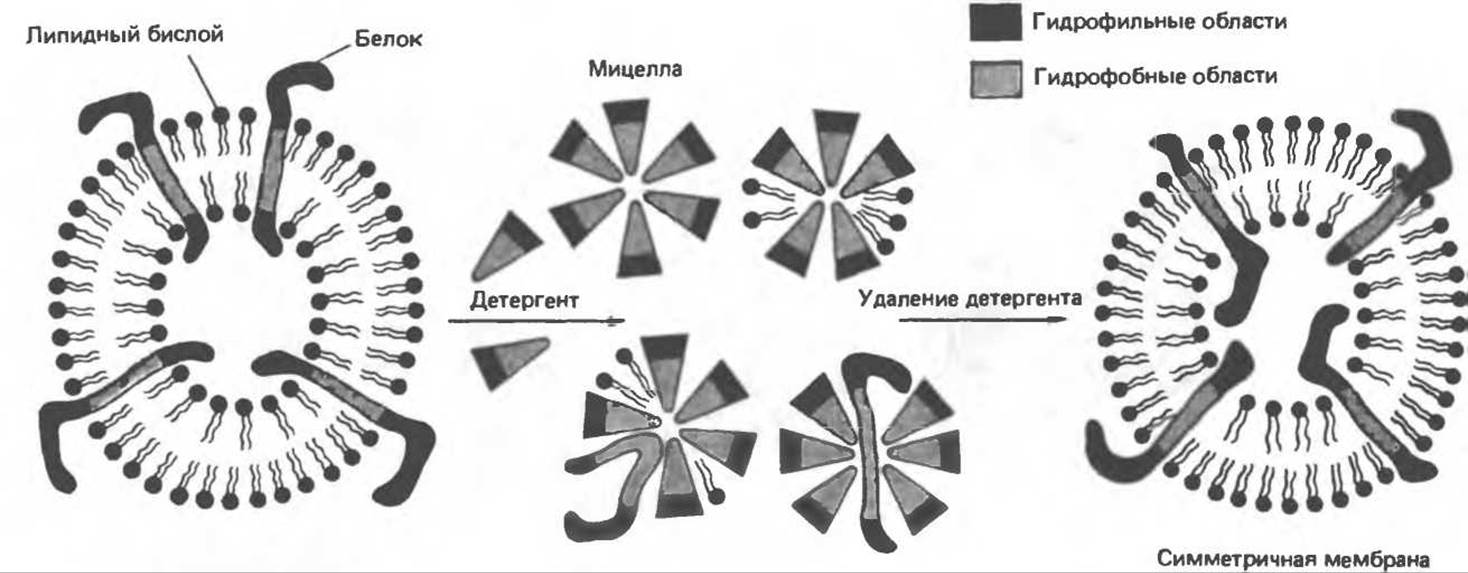
Fig. 42.8. During membrane self-assembly, its fundamental Structure is preserved, but not its Asymmetry. Membranes are disrupted upon Treatment with high concentrations of detergents; amphiphilic detergent molecules form small droplets called micelles. The detergent solubilizes membrane components by surrounding the hydrophobic regions of Lipids and Proteins and enclosing them within micelles, where they are protected from Water. Upon removal of the detergent, lipids spontaneously form a new bilayer with integrated proteins. However, the latter are incorporated largely in a random orientation. Experiments similar to the one described here have demonstrated that all cellular membranes are incapable of correct self-assembly; at least some integral proteins must be inserted into a pre-existing membrane in a specific orientation. (From Lodish H. F., Rothman J. E.: The assembly of Cell membranes. Sci. Am. [Jan] 1979, 240, 43, reproduced with permission.)
Let us consider a few Examples of the application of artificial membrane systems and highlight their advantages over natural membranes.
1. The Lipid Composition of artificial membranes can be varied, allowing for a systematic investigation of how lipid composition affects a particular function. For example, vesicles can be prepared exclusively from phosphatidylcholine or, conversely, from a mixture of phospholipids of known composition incorporating Glycolipids and Cholesterol. Membranes can also be constructed from lipids with different fatty acid residues. This enables systematic studies of The Effect of fatty acid composition on specific Membrane Functions (such as transport).
2. Purified Membrane Proteins or Enzymes can be incorporated into vesicles. This makes it possible to identify which molecules (e.g., specific lipids or accessory proteins) are required to reconstitute the function of purified proteins. Studies of purified proteins, such as the sarcoplasmic reticulum Ca2+-ATPase, show that in some cases a single protein and a single lipid are sufficient to reconstitute an ion pump.
3. The microenvironment of artificial systems can be strictly controlled and purposefully varied (e.g., by changing ion concentrations). They can be exposed to ligands specific for particular protein receptors contained within the liposome.
4. During liposome formation, various components, such as drugs or isolated genes, can be entrapped within them. The Use of liposomes for targeted drug delivery to specific Tissues holds great promise. To achieve this, liposomal membranes must incorporate components (such as Antibodies against specific cell-surface molecules) that allow them to be targeted to specific tissues or tumors. The therapeutic efficacy of such a drug delivery method is expected to be quite significant. DNA encapsulated within liposomes appears to be less sensitive to Nucleases, a factor that should be taken into account in Gene Therapy.
Last update: 06/08/2026
Editorial and Educational Adaptation: This material has been compiled based on the primary/original source text. The project team performed an editorial review, corrected technical inaccuracies, structured sections, and adapted the content for an educational format.
What was processed:
- elimination of formatting defects (OCR errors, structural breaks, corrupted characters);
- editorial organization of content;
- standardization of terminology in accordance with academic sources;
- verification of factual statements against the original source text.
All mentions of the author, publication year, and origin of the primary text have been preserved in accordance with the source.