Principles of Biochemistry, Volume 3 - A. Lehninger 1985
Molecular mechanisms of genetic information transfer
Protein synthesis and its regulation
Polypeptide chains undergo folding and processing
As we saw in Chapters 7 and 8, a protein remains biologically inactive until it folds into its characteristic native conformation, which is determined by its Amino Acid Sequence. At some point—either during Polypeptide chain synthesis or upon its completion—the protein spontaneously adopts its native conformation (Sections 8.6 and 8.7). In other words, the linear or one-dimensional Genetic information contained within the Messenger RNA is translated into the specific three-dimensional Structure OF THE newly synthesized polypeptide. However, the newly formed polypeptide chain frequently cannot assume its final, biologically active conformation until it undergoes Processing or covalent modification. The changes occurring during these processes are known as post-translational modifications.
Class="center">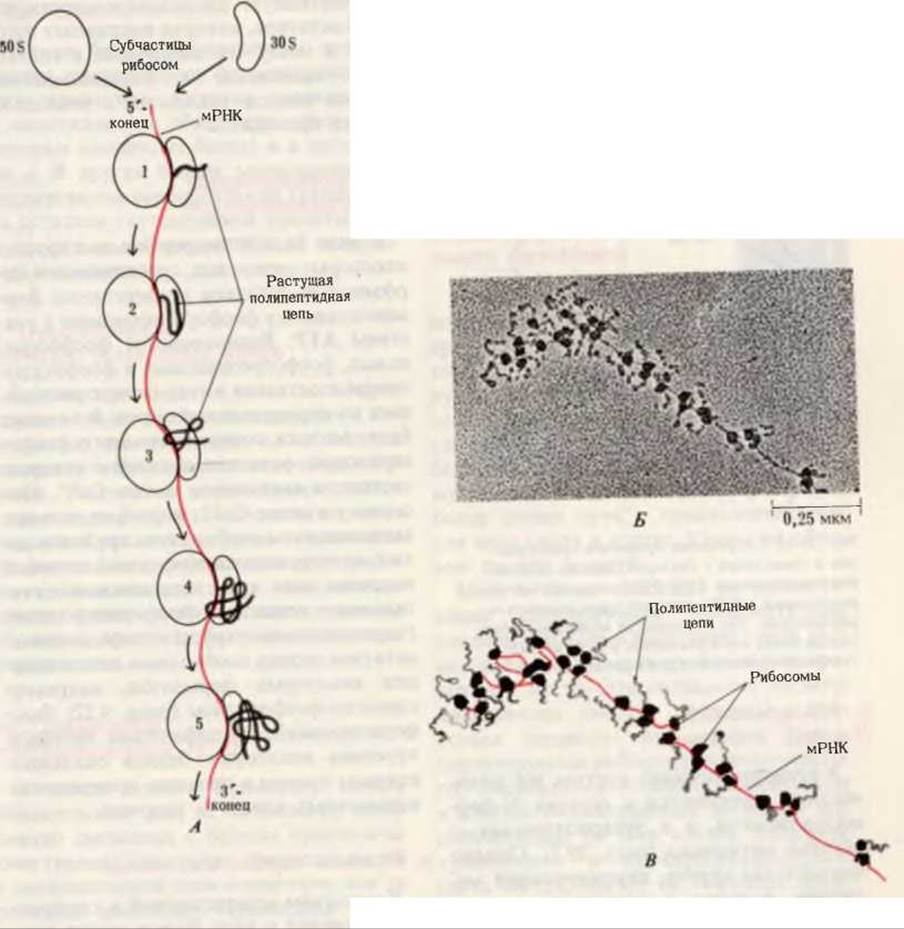
Fig. 29-18. Polyribosome. A. Five Ribosomes simultaneously read the information contained in an mRNA molecule, moving along it from the 5' to the 3' end. B. Electron micrograph of a polyribosome from the silk gland of the silkworm. The mRNA encoding Silk Fibroin is being translated simultaneously by A large number of ribosomes. As the ribosomes move toward the 3' end of the mRNA, The polypeptide chains become progressively longer. C. Diagram explaining the electron micrograph in B.
The processing of various Proteins proceeds in different ways.

Fig. 29-19. Coupling of METABOLISM/31.html">Transcription and Translation in Bacteria. Even before Introduction/24.html">DNA Transcription by RNA polymerase is complete, the resulting mRNA begins to be translated by ribosomes. This is possible because in bacteria, mRNA does not need to be transported from The Nucleus to the Cytoplasm.
a. Modification of the N-terminus and C-terminus
In Prokaryotic Cells, all Polypeptides begin with an N-formylmethionine residue, whereas in Eukaryotic cells, they begin with a Methionine residue (Section 29.7). However, the formyl group, the initiating methionine, and frequently several subsequent amino acid residues are sometimes removed by specific Enzymes and, consequently, are not found in the fully mature protein.
In some proteins, the amino group of the N-terminal residue is acetylated following translation, while in others, the C-terminal residue undergoes modification.
b. Removal of signal sequences
As we will see below, Some proteins contain an additional N-terminal polypeptide sequence of 15–30 residues that directs the protein to its cellular destination. Such signal sequences are eventually removed by specific peptidases.
c. Phosphorylation of hydroxy Amino Acids
In A number of proteins, the hydroxyl groups of certain Serine, Threonine, and Tyrosine residues undergo enzymatic phosphorylation involving ATP. The appearance of phosphoserine, phosphothreonine, and phosphotyrosine residues in these proteins increases their negative charge. Casein, the milk protein, is rich in phosphoserine residues, whose function is to bind Ca2+ ions. Because Ca2+ ions, phosphate, and Amino acids are all essential for infants, milk casein serves as a source of these three indispensable nutrients. The phosphorylation of hydroxyl groups on specific serine residues is necessary for the activation of certain enzymes, such as Glycogen phosphorylase (Section 9.22). Furthermore, the phosphorylation of specific tyrosine residues in certain proteins has proven to be a crucial step in the transformation of normal cells into Cancer cells.
d. Carboxylation reactions
Additional carboxyl groups can be attached to aspartate and glutamate residues in a number of proteins. For example, prothrombin, a protein of the Blood-clotting system, contains several γ-carboxyglutamate residues in its N-terminal region (Chapter 24), which are incorporated into the protein by a vitamin K-dependent enzyme. These carboxyl groups bind the Ca2+ ions required to trigger the Blood Coagulation mechanism.
e. Methylation
In a number of proteins, specific Lysine residues undergo enzymatic methylation. Monomethyl- and dimethyllysine residues are found in certain Muscle Proteins and in cytochrome c. In other proteins, the carboxyl groups of several glutamate residues are methylated, resulting in the neutralization of their negative charges.
f. Attachment of carbohydrate side chains
The carbohydrate side chains of Glycoproteins are covalently attached to the polypeptide during or after its synthesis. In some glycoproteins, the carbohydrate side chain is enzymatically attached to aspartate residues, whereas in others, it is attached to serine or threonine residues. Many extracellular proteins, as well as the lubricating Proteoglycans coating mucous membranes, contain oligosaccharide side chains.
g. Addition of prosthetic groups
Many enzymes require covalently bound prosthetic groups that are essential for their activity; these are also attached to the polypeptide chain after it leaves the ribosome. Examples of such prosthetic groups include a biotin molecule covalently bound to acetyl-CoA carboxylase (Section 21.2) and the heme group of cytochrome c (Section 17.10).
h. Formation of disulfide bridges
In many proteins destined for export from eukaryotic cells, cross-links appear during The formation of their native conformation As a result of the enzymatic formation of disulfide bridges between cystine residues; these bridges link two polypeptide chains or two parts of a single chain together (Section 6.8). Cross-linking disulfide bridges help protect the native conformation of the protein molecule against Denaturation.
Last update: 06/08/2026
Editorial and Educational Adaptation: This material has been compiled based on the primary/original source text. The project team performed an editorial review, corrected technical inaccuracies, structured sections, and adapted the content for an educational format.
What was processed:
- elimination of formatting defects (OCR errors, structural breaks, corrupted characters);
- editorial organization of content;
- standardization of terminology in accordance with academic sources;
- verification of factual statements against the original source text.
All mentions of the author, publication year, and origin of the primary text have been preserved in accordance with the source.