Principles of Biochemistry, Volume 1 - A. Lehninger 1985
Biomolecules
Vitamins and trace elements: their role in enzyme function
Many enzymes require iron for their activity
Iron is among the Trace Elements whose biological Functions have been studied most thoroughly. It is a constituent of the heme groups in the Oxygen-transporting Proteins Hemoglobin and Myoglobin, as well as the mitochondrial electron-transport protein cytochrome c (Chapter 8). Heme prosthetic groups are also found in a variety of essential Enzymes (Fig. 10-26). A prime example is cytochrome c oxidase, which catalyzes the reduction of molecular oxygen to Water using electrons derived from nutrient molecules. Within the cytochrome c oxidase molecule, A change in iron valency drives the reversible transition between the ferric [Fe (III)] and ferrous [Fe (II)] forms, thereby mediating The transfer of electrons from cytochrome c to molecular oxygen. Cytochrome P450, which participates in enzymatic hydroxylation reactions, is likewise capable of transferring electrons to oxygen.
Other heme-containing enzymes include catalase, which decomposes hydrogen peroxide, and peroxidase, which catalyzes The oxidation of various Organic compounds by peroxides. The iron ion in the catalase molecule plays an active role in the catalytic cycle. Even simple iron salts, such as FeSO4, exhibit a degree of catalytic activity by accelerating The breakdown of hydrogen peroxide into Н2О and О2. It is likely that The Role of the porphyrin ring and the protein moiety in catalase is simply to dramatically enhance this baseline catalytic activity of iron.
Class="center">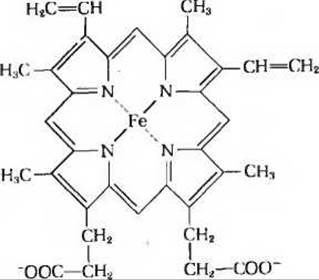
Fig. 10-26. The iron-porphyrin group, or heme. Heme serves as the prosthetic group for heme-containing enzymes such as cytochrome oxidase, catalase, and peroxidase. (See also Fig. 8-5.)
Iron-sulfur proteins represent another major class of iron-containing enzymes involved in cellular electron transport across animals, plants, and Bacteria. These proteins lack heme groups; instead, they are characterized by an equal number of iron and sulfur atoms in a unique labile form that is acid-cleavable. A prominent example is chloroplast ferredoxin, which transfers electrons from light-excited chlorophyll to various electron acceptors (Chapter 23). As we will see later (Section 17.8), other iron-sulfur proteins participate in mitochondrial Electron transfer reactions.
Certain Flavoproteins contain iron In addition to their flavin nucleotide.
Last update: 06/08/2026
Editorial and Educational Adaptation: This material has been compiled based on the primary/original source text. The project team performed an editorial review, corrected technical inaccuracies, structured sections, and adapted the content for an educational format.
What was processed:
- elimination of formatting defects (OCR errors, structural breaks, corrupted characters);
- editorial organization of content;
- standardization of terminology in accordance with academic sources;
- verification of factual statements against the original source text.
All mentions of the author, publication year, and origin of the primary text have been preserved in accordance with the source.