Principles of Biochemistry Volume 2 - A. Lehninger 1985
Bioenergetics and Metabolism
Biosynthesis of Amino Acids and Nucleotides
Glycine is a precursor of porphyrins
Amino Acids are not merely the Building Blocks of Proteins. They also serve as precursors to A wide variety of specialized Biomolecules, including Hormones, Vitamins, Coenzymes, Alkaloids, Cell wall polymers, Porphyrins, Antibiotics, pigments, and Neurotransmitters—each of which plays a vital biological role. Space constraints prevent us from detailing the many secondary biosynthetic pathways leading to these products here. However, we consider it essential to examine two Examples. One of these concerns the synthesis of creatine, a compound that, in the form of phosphocreatine (Sec. 14.15), plays a crucial role in the Bioenergetics of Muscle and nerve Tissues. Three amino acids are involved in its formation: Glycine, Arginine, and Methionine (Fig. 22-11).
Class="center">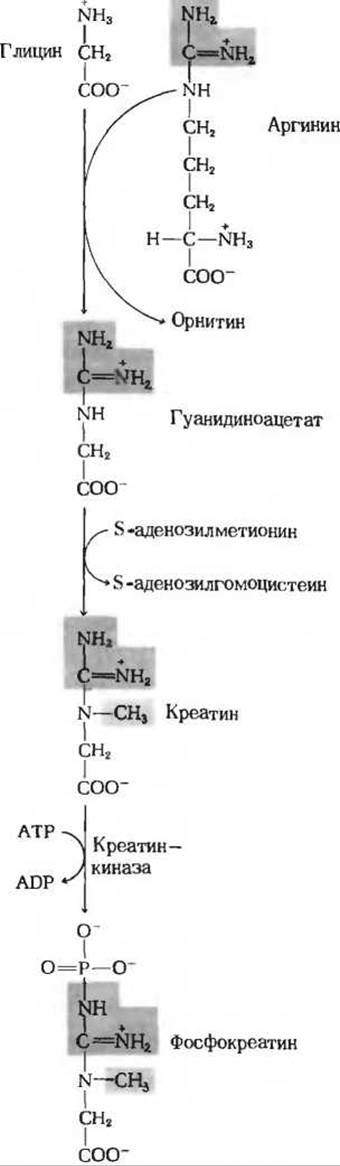
Fig. 22-11. Biosynthesis of creatine and phosphocreatine. Creatine is synthesized from three amino acids: glycine, arginine, and methionine. Arginine serves as the donor of the guanidino group (highlighted in red), and methionine as the donor of the methyl group (gray Background). This metabolic pathway illustrates the diverse role of Amino acids as precursors for other nitrogen-containing biomolecules.

Fig. 22-12. Biosynthesis of protoporphyrin IX (the porphyrin found in Hemoglobin and Myoglobin). Carbon and nitrogen atoms derived from glycine are highlighted in red. The remaining carbon atoms originate from the succinyl group of succinyl-CoA.
The second example is The biosynthesis of porphyrins, for which glycine is also the primary precursor. This process deserves special attention given the critical role the porphyrin ring plays in Hemoproteins—such as hemoglobin and Cytochromes—as well as in chlorophyll, a Mg2+-containing porphyrin derivative. Porphyrins are constructed from four molecules of a monopyrrole derivative, porphobilinogen; the pathway for porphobilinogen synthesis is illustrated in Fig. 22-12. This pathway was elucidated primarily through radioisotope tracer studies conducted by David Shemin. In The First stage, glycine condenses with succinyl-CoA to yield α-amino-β-ketoadipic acid, which is subsequently decarboxylated to form δ-aminolevulinic acid and carbon dioxide. Two molecules of δ-aminolevulinic acid then condense to form porphobilinogen. Through a series of complex enzymatic reactions, four molecules of porphobilinogen are converted into protoporphyrin. Iron is inserted into the preformed protoporphyrin Structure. Figure 22-12 indicates which carbon and nitrogen atoms in the protoporphyrin IX molecule originate from glycine. Porphyrin biosynthesis is regulated by the concentration of its end-product hemoprotein, such as hemoglobin; this end-product exerts feedback inhibition on one of the initial reactions in the pathway.
Last update: 06/08/2026
Editorial and Educational Adaptation: This material has been compiled based on the primary/original source text. The project team performed an editorial review, corrected technical inaccuracies, structured sections, and adapted the content for an educational format.
What was processed:
- elimination of formatting defects (OCR errors, structural breaks, corrupted characters);
- editorial organization of content;
- standardization of terminology in accordance with academic sources;
- verification of factual statements against the original source text.
All mentions of the author, publication year, and origin of the primary text have been preserved in accordance with the source.