Biological Chemistry - Berezov, T. T., Korovkin, B. F. 1998
Hormones
Adrenal Hormones
Hormones of the Adrenal Medulla
The Adrenal Glands consist of two morphologically and functionally distinct parts: the medulla and the cortex. The adrenal medulla belongs to the chromaffin, or adrenergic, system and secretes Hormones that, According to the Classification mentioned earlier, are Amino Acid Derivatives. The adrenal cortex consists of Epithelial Tissue and secretes Steroid Hormones.
The ability of adrenal extracts to raise Blood pressure was known as early as the 19th century; however, it was not until 1901 that J. Takamine and co-workers isolated the active principle from the adrenal medulla, which was identified as adrenaline. This was the first hormone ever obtained in a pure crystalline state. More than 40 years later, in 1946, another hormone—noradrenaline—was isolated from the medullary tissue, having been previously synthesized chemically. In addition to these two principal hormones, trace amounts of another hormone, isopropyladrenaline, are synthesized in the adrenal glands. All these hormones share a remarkably similar chemical Structure.
Class="center">
Structurally, these hormones resemble The amino acid Tyrosine, from which they differ by the presence of additional OH groups in the benzene ring and at the ß-carbon atom of the side chain, as well as the absence of a carboxyl group. Indeed, experimental evidence has confirmed that tyrosine serves as the precursor for Adrenal Medullary Hormones, undergoing hydroxylation, decarboxylation, and methylation reactions via specific Enzymes during METABOLISM (see Chapter 12). The Biosynthesis of Catecholamines (adrenaline and noradrenaline) can be represented by the following simplified scheme:
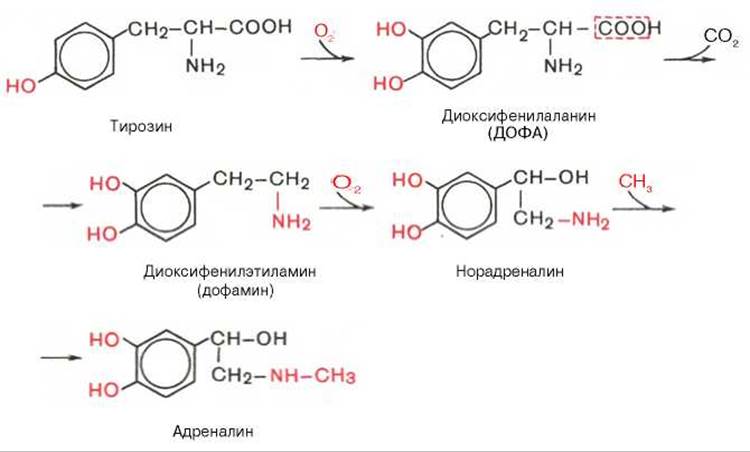
The human adrenal medulla, weighing about 10 g, contains approximately 5 mg of adrenaline and 0.5 mg of noradrenaline. Their blood concentrations are 1.9 and 5.2 nmol/L, respectively. In Blood Plasma, both hormones circulate in both free and bound states, particularly bound to albumins. Small amounts of both hormones are stored as salts with ATP in nerve endings, being released in Response to nerve stimulation. Adrenaline and noradrenaline, along with dopamine (see structure), belong to catecholamines—a class of Organic compounds with potent biological activity. Furthermore, all of them exhibit powerful vasoconstrictive effects, leading to an increase in blood pressure; in this regard, their action mimics that of the sympathetic Nervous system. These hormones are known to exert a powerful regulatory influence on Carbohydrate Metabolism in the body. Specifically, adrenaline causes a sharp surge in blood glucose levels, driven by the acceleration of hepatic Glycogenolysis mediated by the enzyme phosphorylase (see Chapter 10). Like Glucagon, adrenaline activates phosphorylase indirectly via the adenylate cyclase–cAMP–protein kinase cascade (see below). The hyperglycemic effect of noradrenaline is considerably weaker, accounting for roughly 5% of adrenaline's potency. Concurrently, one observes an accumulation of hexose phosphates in Tissues (particularly in Muscles), a decrease in inorganic phosphate concentration, and an elevated level of free Fatty acids in blood plasma. Evidence also indicates that adrenaline inhibits glucose oxidation in peripheral tissues, an effect attributed by some authors to a reduced rate of glucose uptake (transport) across The Cell membrane. The Mechanism of catecholamine action—involving α- and ß-adrenergic receptors, the adenylate cyclase system, and other factors—is discussed at the end of this chapter.
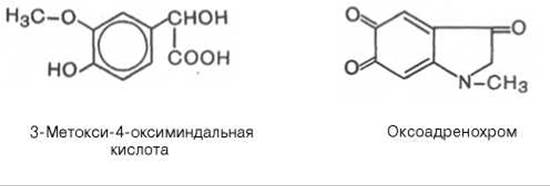
It is well established that both adrenaline and noradrenaline are rapidly degraded in the body; inactive metabolic products are excreted in the urine, primarily as 3-methoxy-4-hydroxymandelic acid, oxoadrenochrome, methoxynoradrenaline, and methoxyadrenaline. These metabolites are present in urine predominantly in forms conjugated with glucuronic acid. The enzymes catalyzing these catecholamine transformations have been isolated from numerous tissues and thoroughly characterized. These include monoamine oxidase (MAO), which dictates The rate of catecholamine turnover, and catechol-O-methyltransferase, which catalyzes the primary pathway of adrenaline inactivation—namely, O-methylation utilizing S-adenosylmethionine. The structures of two final catecholamine degradation products are shown below:
Last update: 06/08/2026
Editorial and Educational Adaptation: This material has been compiled based on the primary/original source text. The project team performed an editorial review, corrected technical inaccuracies, structured sections, and adapted the content for an educational format.
What was processed:
- elimination of formatting defects (OCR errors, structural breaks, corrupted characters);
- editorial organization of content;
- standardization of terminology in accordance with academic sources;
- verification of factual statements against the original source text.
All mentions of the author, publication year, and origin of the primary text have been preserved in accordance with the source.