IMMUNOLOGY - Roitt I. - Mir 2000
Chapter 19. Vaccination
■ Nonspecific immunization, for example via administration of cytokines, can be used when it is appropriate to stimulate general immunoreactivity.
■ Adjuvants, substances that enhance antibody production, are usually required when using killed Vaccines.
■ Recombinant DNA technology is likely to become the basis for developing next-generation vaccines.
■ Vaccination relies on the body's ability to develop acquired Immunity and immunological memory against a pathogen.
■ A wide variety of antigenic preparations are used as vaccines, ranging from whole microbes to simple Peptides and Polysaccharides.
■ Live vaccines differ significantly from killed ones and are generally more effective.
■ Vaccination represents a form of active immunization.
■ Passive immunization through the direct administration of preformed Antibodies still retains its significance as a means of anti-infective protection in certain circumstances, such as in tetanus when the toxin has already entered the bloodstream.
Vaccination is undoubtedly the best-known and most successful application of immunological principles in medicine. The first vaccine was named after a cattle disease, vaccinia (cowpox), which was subsequently found to be caused by a virus. Two centuries ago, it was applied by the English physician and pioneer in this field, Edward Jenner. This marked the first scientifically reasoned attempt to prevent a human infectious disease (smallpox), even though the author of the method knew nothing about Viruses (or any other microbes) or immunity.
Only a century later, Pasteur formulated the fundamental principle of vaccination: to induce robust immunity against highly virulent microorganisms, one can use preparations derived from the same microbes, but with their virulence attenuated through specific treatments. Using dried Spinal Cord from a rabid rabbit and heated cultures of anthrax bacilli in accordance with this principle, Pasteur essentially created the prototypes of modern vaccines. At the same time, Jenner's animal-derived vaccine containing the cowpox virus (heterologous) did not subsequently find any continuation as a method.
Even Pasteur himself knew nothing about the function of lymphocytes or The Nature of immunological memory; their discovery was another half-century in coming. Then, finally, with the advent of Burnet's clonal Selection theory (1957) and data on T/B Cell Differentiation (1965), the key mechanism of vaccination became clear: the antigen contained in the vaccine must trigger the clonal expansion of specific T and/or B Cells, leaving behind a population of immunological memory cells. Upon subsequent encounter with the same antigen, it is these cells that are capable of mounting a secondary response, which is usually faster and more effective than the primary one. Often, the primary response is too weak to contain The Development of a dangerous infection (see Fig. 1.19).
Thus, vaccination leads to the development of acquired immunity, and the art of vaccine design lies in developing antigenic preparations that are
✵ harmless to the Organism,
✵ induce the appropriate form of Immune Response, and, moreover,
✵ are affordable for the population. Thanks to vaccination, great strides have been made in preventing many infectious diseases, yet there remain illnesses for which no vaccines have yet been created. The reasons for this paradox largely constitute the subject of this chapter.
Class="center">
Fig. 19.1. Vaccines can be derived from various microbial antigen preparations.
ANTIGENIC PREPARATIONS USED AS VACCINES
The choice of the type of antigenic preparation to be used as a vaccine depends on many factors. In general, the more Antigens of a given microbe retained in the vaccine, the better, and live microorganisms are usually more effective than killed ones (see below). An exception is made for diseases whose Pathogenesis is determined by the action of a toxin; in this case, the toxin itself can serve as the basis for the vaccine. Another exception is vaccines in which the desired microbial antigens are expressed by cells of other microbes used as vectors.
Fig. 19.1 lists the main antigenic preparations currently used as vaccines.
Both wild-type and attenuated or weakened strains of microbes can be used to prepare live vaccines
Live wild-type microorganisms are rarely used for vaccines. With the exception of the cowpox virus, no fully native (naturally circulating) microorganism has ever been used to prepare vaccines in practical use. However, trials of bovine and simian rotaviruses as vaccines for children have been reported. At one time, immunization with mycobacteria—the causative agents of murine tuberculosis—attracted researchers' attention as a means of anti-tuberculosis protection. In the Middle East and Russia, to induce immunity against cutaneous leishmaniasis, vaccinations are performed using a live culture of Leishmania tropica major isolated from a patient with a mild course of the disease. It is quite possible that another good heterologous vaccine (like Jenner's) will be developed in the future, though this may entail serious Problems associated with safety requirements.
Live Attenuated Vaccines are the most effective. In vaccine development, the most fruitful strategy has been the attenuation of virulence in human pathogens while preserving the necessary antigens. The first success on this path was achieved by Calmette and Guérin with a strain of the bovine tubercle bacillus (Mycobacterium bovis complex), which through 13 years (1908–1921) of passaging was transformed into a much less virulent form, now known as BCG (bacille Calmette–Guérin) and moderately effective as a tuberculosis vaccine. Truly successful were the efforts to attenuate viruses, beginning with the derivation of the attenuated 17D yellow fever virus strain (1937) through passage in mice and chicken embryos. Subsequently, a fundamentally similar approach led to the creation of vaccines against poliomyelitis, measles, mumps, and rubella (Fig. 19.2). The effectiveness of these vaccines is evidenced by a dramatic decline in the incidence of the corresponding infections over the past two to three decades (Fig. 19.3).

Fig. 19.2. Attenuated vaccines have been developed against many, but not all, infectious diseases. As a rule, viruses are easier to attenuate than Bacteria.
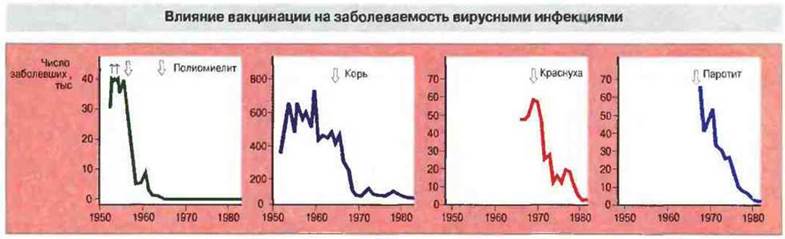
Fig. 19.3. In the USA, The impact of vaccination is evident from the sharp decline in the incidence of several viral diseases following the Introduction of corresponding vaccines (indicated by arrows).
Attenuation can result from Mutations. What is the underlying Nature of the changes leading to attenuation? The first attenuated microbes were obtained through a series of random mutations induced by unfavorable growth conditions; they were successfully isolated through continuous screening and selection for loss of virulence while retaining the original antigenic composition. This long, meticulous work was aptly dubbed "genetic roulette." When viral genome sequencing became feasible, it turned out that the outcomes of traditional attenuation Methods are quite heterogeneous. A striking example of this is the differences among the three poliovirus types included in Sabin's oral polio vaccine. The Genome of the type 1 virus contains 57 mutations and almost never reverts to the wild (virulent) type, whereas this frequently occurs with the vaccine strains of type 2 and 3 polioviruses, as their attenuation depends on just two key mutations. In some cases, reversions lead to outbreaks of vaccine-associated paralytic poliomyelitis. One such outbreak in Sweden provided sufficient grounds for the country's health authorities to discontinue the live vaccine in favor of the inactivated Salk vaccine (see below). However, the argument in favor of the live vaccine is that in many Regions of the USA it has currently displaced wild-type poliovirus from Water sources and undoubtedly provides immune protection to a portion of the never-vaccinated population—a prime example of "herd immunity." With the advent of modern recombinant DNA technology, it became clear that both viral and bacterial attenuated vaccines should be developed using targeted site-directed mutations rather than random ones.
Killed vaccines consist of non-viable microorganisms that retain native antigens
These vaccines are produced following THE PRINCIPLE OF Pasteur's aforementioned killed vaccines. Some killed vaccines are highly effective (the rabies vaccine and the Salk polio vaccine), whereas the efficacy of others is low (typhoid, cholera, and Influenza vaccines) or controversial (plague and endemic typhus vaccines). The Use of certain vaccines is problematic due to their toxicity (whole-cell pertussis vaccine). A list of most currently used killed vaccines is given in Fig. 19.4. It is hoped that some of them will be replaced by more effective pathogen-derived vaccines, and a clear prospect is already emerging for such a rabies vaccine, as well as genetically engineered typhoid and cholera vaccines.

Fig. 19.4. Main whole-cell killed vaccines.
Inactivated toxins and toxoids are the most successful bacterial vaccines
The most effective of all bacterial vaccines are considered to be tetanus and diphtheria vaccines (Fig. 19.5), prepared from inactivated exotoxins (Fig. 19.6). As it turns out, the same principle can be applied to develop vaccines against several other infectious diseases as well.
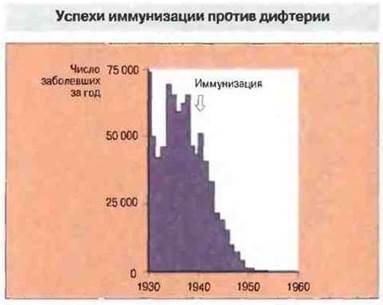
Fig. 19.5. Annual records of diphtheria cases demonstrate the striking success of the toxoid vaccine: the incidence dropped sharply following the introduction of mandatory vaccination in 1940. (Courtesy of J.R. Pattison. In: Brostoff J. et al., eds. Clinical Immunology (Ch. 26). London: Mosby, 1991.)

Fig. 19.6. Toxin-based vaccines. Preparations against numerous staphylococcal and streptococcal exotoxins, as well as bacterial endotoxins such as lipopolysaccharide, are not included in this list.
Tetanus toxoid can serve as a "carrier" in other vaccine formulations. In addition to its use as a tetanus vaccine, tetanus toxoid is employed as a "carrier" in vaccines composed of short peptides that would otherwise lack immunogenicity. This approach is effective because the majority of the population is vaccinated against tetanus and possesses immunological memory T cells that recognize the toxin. However, it is preferable to use a protein from the same microbe against which the designed vaccine is directed (e.g., pneumococcal, malarial vaccines, etc.) as a carrier.
Surface antigens and fragments of microbial cells serve as safe and effective vaccines
The Immune System (primarily B cells and antibodies) predominantly recognizes and responds to the surface antigens of most microorganisms. These antigens serve as safe and effective vaccines whenever secondary antibody production is able to contain the infection (Fig. 19.7). The most successful have been vaccines against encapsulated bacteria—whose capsular polysaccharides can be obtained in preparative amounts—and against the hepatitis B virus, which possesses the unusual property of overproducing its surface antigen (HBs).

Fig. 19.7. Main vaccines consisting of microbial cell fragments.
Low-molecular-weight antigens can be produced via chemical synthesis or molecular cloning
Once it is established that protection is conferred by a small peptide (a rare occurrence), it may be more convenient to produce it by synthesis or by cloning in a suitable expression vector. A successful example of this approach is The production of the HBs antigen cloned in Yeast cells. Vaccines manufactured this way have now replaced first-generation HBs vaccines, which had to be prepared via the laborious method of isolating the HBs antigen from the Blood of virus carriers followed by extensive purification; this new method has also reduced the cost of the vaccine.
The appeal of molecular cloning also lies in the possibility of introducing additional sequences into the product—such as required B- and T-cell epitopes combined in various ways to optimize the immune response. T cells recognize linear Amino acid sequences, whereas B cells respond to the three-dimensional configuration of antigenic epitopes (see Ch. 9). Therefore, peptides function well as T-cell epitopes, but are unable to mimic structured B-cell epitopes. Even when a B-cell determinant has a linear configuration, antibodies elicited against a free flexible peptide do not bind to it as optimally as they do to the identical sequence within the native protein, where it adopts a more rigid Structure.
The vaccines of the future are microbial genes combined with vectors for in situ antigen expression
Further Development of the Gene cloning approach involves inserting the desired gene into a vector capable of Replication and expression following injection into the body, resulting in the production of a large amount of antigen in situ (Fig. 19.8). Vaccinia virus was previously proposed as a vector (despite its occasionally manifested toxicity), but its use is hindered by the fact that many people have already been vaccinated against smallpox, and in such individuals the virus would be cleared from the body too rapidly. Almost all available attenuated viral vaccines have been proposed as alternatives.
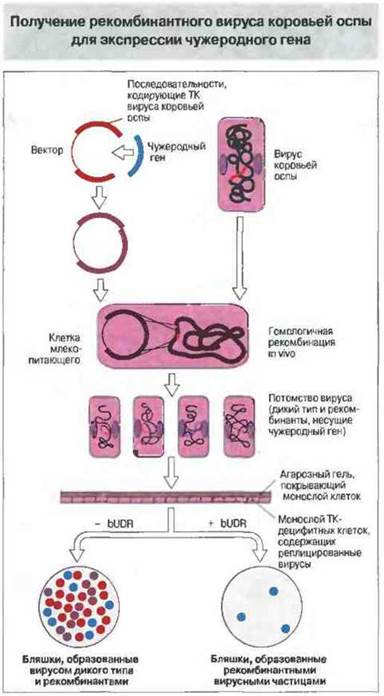
Fig. 19.8. Recombinant vaccinia virus can serve as a vector for foreign Gene Expression. The foreign gene is inserted into the viral thymidine kinase (TK) gene to allow plaque-based selection of recombinant viruses from wild-type ones. The TK enzyme is required for the virus to utilize thymidine from the culture medium or the intracellular pool during METABOLISM/36.html">DNA replication. The recombinant virus lacks TK activity because the gene is disrupted by the insertion, forcing it to rely on the de novo pathway for thymidine synthesis. In the presence of the thymidine analogue bromodeoxyuridine (bUDR), whose incorporation into DNA halts its synthesis, wild-type virus replication is blocked, whereas the recombinant virus continues to replicate via de novo thymidine synthesis. The monolayer Cells must be TK-deficient so that the recombinant virus cannot scavenge cellular TK to incorporate bUDR. (Kind courtesy of Dr. D.J. Rowlands; after Brostoff J. et al., Clinical Immunology (Ch. 26). London: Mosby, 1991.)
Another approach to vaccine development involves using attenuated bacteria as vectors. BCG (bacille Calmette-Guérin) is a natural candidate for this role, as the mycobacterial genome is theoretically large enough to accommodate genes from any other microbial pathogen against which a vaccine is desired. Furthermore, several mutant Salmonella strains have been developed that can colonize and immunize the gut-associated lymphoid tissue upon oral administration before being cleared. These bacteria are ideally suited as vector vaccines to induce mucosal immunity in the intestine—a critical objective, given that diarrheal diseases remain a leading cause of childhood mortality worldwide. A further advantage of attenuated microorganisms as vectors is their uptake by macrophages, which can trigger a systemic immune response as these cells migrate to other PARTS OF THE body.
The most cutting-edge development in this field is the creation of naked DNA vaccination, where the gene of interest is placed under the control of an appropriate promoter. Remarkably, such vaccines elicit robust humoral and cellular immunity without inducing the tolerance that might otherwise be anticipated from a potentially continuous source of foreign antigen. This highly promising approach is advancing rapidly, and clinical trial results for a DNA-based influenza vaccine are expected in the near future.
When the native antigen is unsuitable for immunization, anti-idiotypic vaccines can be used
This is the only class of vaccine designed entirely from theoretical principles. The concept relies on generating large quantities of anti-idiotypic Monoclonal Antibodies (anti-Id) directed against the variable (V) region (idiotype) of an immunoglobulin known to possess protective activity. Appropriately selected anti-Id antibodies will structurally mimic the epitopes of the original immunizing antigen and can therefore be used for active immunization in its place (Fig. 19.9). Although often met with skepticism as a product of 'speculative immunology', this strategy can prove genuinely effective when the native antigen is unsuitable—i.e., poorly immunogenic, such as certain bacterial polysaccharides or lipid A from bacterial endotoxin (lipopolysaccharide, LPS). Moreover, monoclonal antibodies offer the advantage that, being Proteins, they can induce immunological memory, which polysaccharides and Lipids typically fail to do.
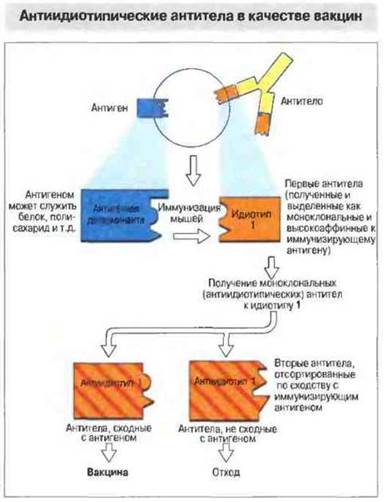
Fig. 19.9. The development of monoclonal antibody technology and the Discovery of the 'idiotypic network' (see Ch. 13) have made it possible to use IMMUNOGLOBULINS as antigen surrogates. This technology enables the generation of a protein replica of a carbohydrate or lipid antigen, offering potential advantages as a vaccine.
Last update: 13/08/2026
Editorial and Educational Adaptation: This material has been compiled based on the primary/original source text. The project team performed an editorial review, corrected technical inaccuracies, structured sections, and adapted the content for an educational format.
What was processed:
- elimination of formatting defects (OCR errors, structural breaks, corrupted characters);
- editorial organization of content;
- standardization of terminology in accordance with academic sources;
- verification of factual statements against the original source text.
All mentions of the author, publication year, and origin of the primary text have been preserved in accordance with the source.