MICROBIOLOGY Study Guide - 2012
CHAPTER 11. THE ROLE OF MICROORGANISMS IN BIOCHEMICAL CYCLES
Depending on their ecological function, Living organisms are traditionally divided into three groups.
1. Plants function as producers because they synthesize Organic compounds utilizing solar energy and carbon dioxide.
2. Animals act as consumers, as they utilize PLANT AND ANIMAL biomass to build their own bodies.
3. Microorganisms serve as decomposers, driving mineralization—The breakdown of organic matter derived from plants and animals.
The Mineral Substances resulting from this process dissolve in Water and are taken up by plants as nutrients. Thus, the global biogeochemical cycling couples two mutually opposing processes: the Synthesis and Breakdown of organic matter, driven by the ecological roles of diverse microbial groups.
The most critical biogeochemical transformations involve the carbon and nitrogen cycles in nature.
11.1. THE NITROGEN CYCLE
The Nitrogen Cycle encompasses the synthesis of complex nitrogenous compounds alongside the Mineralization of organic nitrogen into nitrates, nitrites, or molecular nitrogen (Fig. 34).
Class="center">
Fig. 34. Scheme of the Nitrogen Cycle in nature
Molecular nitrogen is constantly abundant in nature (making up about 80% of the Earth's atmosphere); however, this gas is chemically inert, rendering it inaccessible to the majority of organisms. The Nutrition of all plants, animals, and most microorganisms depends on sources of combined or fixed nitrogen, which is relatively scarce in soil and water. Consequently, a shortage of nitrogen compounds often acts as a limiting factor for the growth of living organisms. Therefore, the cyclic transformation of nitrogenous compounds plays a vital role in supplying various organisms with essential forms of nitrogen.
The nitrogen cycle consists of four main stages:
1) Nitrogen Fixation — the fixation of molecular nitrogen;
2) ammonification — the mineralization of organic nitrogen-containing compounds;
3) nitrification — The oxidation of ammonium nitrogen to nitrates and nitrites;
4) denitrification — the reduction of nitrates to ammonia and molecular nitrogen.
1. Nitrogen fixation is a unique process of capturing atmospheric nitrogen, carried out exclusively by prokaryotic microorganisms. In nature, Biological Nitrogen Fixation is performed by two main groups of microorganisms: free-living Bacteria of the genera Azotobacter and Clostridium, and symbiotic bacteria of the genus Rhizobium (nodule bacteria), which live in Symbiosis with plants.
Bacteria of the genus Azotobacter are Gram-negative, aerobic rods that occur singly or in pairs. As they age, they gradually shorten and transform into cocci surrounded by a thick mucous capsule. Young Cells of Azotobacter possess peritrichous flagella and are motile. Upon Aging, the cells lose their motility. Azotobacter is widely distributed in soils and water bodies with a neutral pH.
Free-living nitrogen fixers also include such bacterial species as Clostridium pasteurianum, C. felsineum, etc. These are Gram-positive, motile, endospore-forming rods. During sporulation, the rods swell and assume a spindle-like shape (clostridium). These obligate anaerobes can multiply within a pH range of 5.5-8.0.
Molecular nitrogen can also be fixed by other microorganisms, including Azotomonas fluorescens, cyanobacteria, and certain actinomycetes.
Biological nitrogen fixation proceeds via a reductive pathway involving a specific Nitrogenase enzyme complex. The electron donor is the iron-containing protein ferredoxin, and the energy source is ATP.

Nodule bacteria are small, Gram-negative, motile, non-spore-forming rods. A symbiotic relationship is established between the bacteria and the host plant: the bacteria feed on carbon-containing compounds produced by the plant, while the plant utilizes the nitrogenous compounds generated by the bacteria through MOLECULAR NITROGEN FIXATION.
2. Ammonification. Plant and animal protein residues enter the soil, where they are decomposed by microorganisms. Protein decomposition releases ammonia, which is why this degradation process is called ammonification (putrefaction).
Putrefaction refers to the enzymatic Breakdown of Proteins driven by microbial activity. In The First stage, proteins are cleaved by extracellular proteases into Polypeptides, oligopeptides, and partially Amino Acids. These Peptides enter The Cell, where intracellular peptidases break them down into free amino acids. The Amino acids are either utilized by the cell for biosynthetic purposes or undergo further transformations (Fig. 35).

Fig. 35. Scheme of protein degradation
The depth of Protein Cleavage depends on the species of microorganisms and their environmental conditions, such as Temperature, humidity, and oxygen availability.
Under aerobic conditions, complete mineralization of proteins takes place, with ammonia, carbon dioxide, hydrogen sulfide, phosphoric acid salts, and Other Compounds as the end products. This process is referred to as decay.
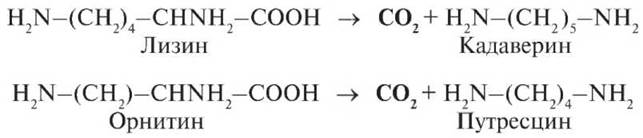
Under anaerobic conditions, the putrefactive decomposition of protein does not lead to the immediate release of all amino nitrogen as ammonia. Driven by anaerobic putrefactive bacteria, Certain amino acids undergo decarboxylation. The products of AMINO ACID DECARBOXYLATION are carbon dioxide and biogenic amines, among which cadaverine and putrescine are the best known (formerly referred to as "cadaveric poisons"):
Deamination is The process of removing an ammonia group from an amino acid. Oxidative and hydrolytic deamination are distinguished, as well as deamination leading to the Formation of Unsaturated Fatty acids.
Oxidative Deamination is the most common type of Amino Acid Breakdown, resulting in The formation of keto acids:

Hydrolytic deamination occurs with the participation of Hydrolases and leads to the formation of hydroxy acids:

An example of deamination resulting in the formation of unsaturated acids is The conversion of aspartic acid to fumaric acid:

Putrefactive bacteria are widespread in nature; they occur in soil, water, air, on plants, in the intestines of humans and animals, and in food products.
The process of putrefaction can be carried out by a variety of microorganisms: bacteria, actinomycetes, and Molds. Among aerobic putrefactive bacteria, the most common are Bacillus mycoides, Bacillus mesentericus, Bacillus subtilis, Bacillus megaterium, Pseudomonas fluorescens, etc. The most typical representatives of facultatively anaerobic bacteria are Proteus vulgaris, Escherichia coli, and Serratia marcescens. Representatives of anaerobic putrefactive bacteria include Clostridium putrificum and Clostridium sporogenes.
Foods with a high protein content—such as meat, fish, and dairy products—are most susceptible to putrefaction. To protect foods from putrefactive spoilage, they are preserved using various Physical and Chemical Methods, including cooling, freezing, pasteurization, sterilization, salting, sugaring, smoking, curing, drying, and The addition of various chemical substances that inhibit Microbial growth, known as preservatives.
3. Nitrification. Ammonia produced during putrefaction is converted by microorganisms into nitrates, which are salts of nitric acid. This process of ammonia oxidation is called nitrification, and it consists of two stages.
In the first stage, ammonia is oxidized to nitrous acid:

The first stage of nitrification is carried out by bacteria of the genera Nitrosomonas, Nitrosococcus, and Nitrosospira. In recent years, two additional genera of nitrifying bacteria have been isolated: Nitrosolobus and Nitrosovibrio.
In the second stage, nitrous acid is oxidized to nitric acid by bacteria of the genus Nitrobacter.
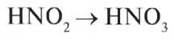
The nitrification process proceeds more intensively in soil in the presence of oxygen. As a result of nitrifying bacterial activity, up to 300 kg/ha of nitrates can accumulate in the soil annually.
4. Denitrification is the process of reducing nitrates to nitrites and molecular nitrogen, which proceeds According to the scheme:

Denitrification is carried out by bacteria of the species Pseudomonas fluorescens, P. aeruginosa, P. stutzeri, Paracoccus denitrificans, Thiobacillus denitrificans, and others. As a result of denitrification, soil fertility decreases because the resulting nitrogen is released into the atmosphere.
Last update: 13/08/2026
Editorial and Educational Adaptation: This material has been compiled based on the primary/original source text. The project team performed an editorial review, corrected technical inaccuracies, structured sections, and adapted the content for an educational format.
What was processed:
- elimination of formatting defects (OCR errors, structural breaks, corrupted characters);
- editorial organization of content;
- standardization of terminology in accordance with academic sources;
- verification of factual statements against the original source text.
All mentions of the author, publication year, and origin of the primary text have been preserved in accordance with the source.