BIOTECHNOLOGY - V. H. Gerasymenko - 2006
Part II. Special Biotechnologies
Chapter 7. BIOTECHNOLOGY OF THE PRODUCTION AND APPLICATION OF IMMOBILIZED PREPARATIONS
7.5. METHODS OF ENZYME IMMOBILIZATION
7.5.2. Chemical methods of immobilization
7.5.2.1. Basic principles of designing covalently immobilized enzyme preparations
Chemical immobilization utilizes a vast diversity of Chemical Reactions, starting Materials, and reaction conditions.
Virtually all Functional groups of Proteins (α- and ε-amino groups, α-, β-, and γ-carboxyl groups, sulfhydryl groups of Cysteine, aromatic rings of Tyrosine and Tryptophan, the imidazole group of Histidine, and amino acid hydroxyl groups) can be utilized to cross-link the enzyme to a carrier. In particular, widely used reactions lead to The formation of peptide bonds between the amino groups of the enzyme and the carboxyl groups of the carrier or, conversely, between the carboxyl groups of the catalyst and the amino groups of the carrier.
The methodologies used for chemical immobilization are based on Reactions Involving the formation of:
a) amide bonds [-C(0)-NH];
b) urea bonds (urea derivatives: -(NH,0)-C(O,S)-NH-);
c) secondary amines [-NH-];
d) azo coupling (formation of azo compounds with an -N=N- bond);
e) thiol-disulfide exchange, among others.
However, regardless of the number and Chemical Nature of the components involved in the immobilization process, or the number and complexity of its individual stages, one of three basic models is formed, comprising no more than three elements: the enzyme (E), the carrier (C), and a bi- or polyfunctional cross-linking reagent (Cr, S), referred to as a "cross-linker", "insert", "spacer", or "tether", which occupies an intermediate position between the cross-linked molecules.
Thus, covalent Enzyme Immobilization involves the creation of constructs linked by chemical bonds comprising three elements: C-Cr-E (maximum), or two elements, C-E and Cr-E (minimum). In turn, the design principles for the corresponding models can be termed: "attachment" (for C-E), "cross-linking" (for C-Cr-E), and "insertion" (for Cr-E).
The formation of chemical bonds between elements is possible only in the presence of specific reactive groups in all interacting Reagents: the enzyme, the carrier, and the cross-linking agent.
If functional groups capable of reacting with the functional groups of the enzyme to form covalent bonds are present on the carrier surface, the chemical immobilization technique is analogous to adsorption. The carrier is introduced into the enzyme solution, where enzyme adsorption takes place; however, this adsorption is irreversible because the enzyme is attached to the carrier by one or more covalent bonds — C-E (Fig. 7.6, a).
Class="center">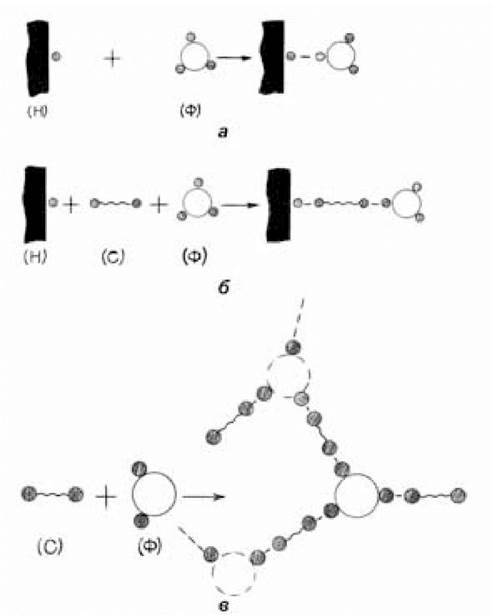
Fig. 7.6. Block diagrams of covalent enzyme immobilization
(according to I. V. Berezin et al., 1987)
When close contact with the carrier proves undesirable—for instance, due to unfavorable Changes in the enzyme's microenvironment, Steric hindrances, or diffusion limitations—it is necessary to distance the enzyme from the carrier. In this case, covalent immobilization is carried out by cross-linking the enzyme to the carrier using a cross-linking reagent of varying length — C-S-E (Fig. 7.6, b).
In terms of methodological approaches, this method is incomparably richer and more flexible than the previous one due to The Use of the cross-linking agent. First, by adjusting the length of the cross-linker (or by selecting an optimal mixture of cross-linkers of different lengths), one can modify the catalytic CHARACTERISTICS OF THE immobilized enzyme.
Second, the cross-linker can be specifically designed to contain a bond that is labile under certain conditions or specifically cleaved by certain reagents (in particular, enzymatically). This provides a key to the Controlled Release of the immobilized enzyme from the carrier, for example, when addressing targeted drug delivery of Enzymes in a living Organism.
Covalent immobilization is also possible in systems that initially contain no pre-formed carrier, consisting only of the enzyme and a cross-linking reagent (S-E). The carrier (as a solid) is formed directly during the immobilization process, or the enzyme itself serves simultaneously as the carrier. Thus, the enzyme molecule is covalently embedded into various types of matrices (Fig. 7.6, c). METABOLISM/2.html">THE CONCEPT OF designing enzyme networks (enzyme reticulation) stems from the polyfunctional Nature of the enzyme molecule itself, which possesses A large number of reactive groups on its surface In addition to the Active Site. Upon introducing a bifunctional cross-linking reagent into the enzyme solution, individual enzyme molecules cross-link with one another to form a network in which the enzyme molecules themselves act as nodes. Depending on The Nature and amount of the cross-linking agent, both Water-soluble and water-insoluble preparations can be obtained.
Another approach to reticulation involves the use of enzymes previously covalently modified with a cross-linking reagent containing a double bond (such as acryloyl chloride). In this case, the copolymerization of the protein macromonomer with low-molecular-weight monomers (e.g., acrylamide) yields cross-linked polymer gels formed by the protein or an additional cross-linking monomer (such as N,N-methylenebisacrylamide). The initial state in this system is a liquid solution, whereas the final state (following polymerization) is a solid (gel), which naturally takes the shape of the vessel (Reactor) in which the polymerization is carried out.
Cross-linking of a protein within a bulk solvent (copolymerization) produces a three-dimensional gel (Fig. 7.7, a) in the form of a large, uniform block, which can be mechanically crushed and utilized as particulate Suspensions.
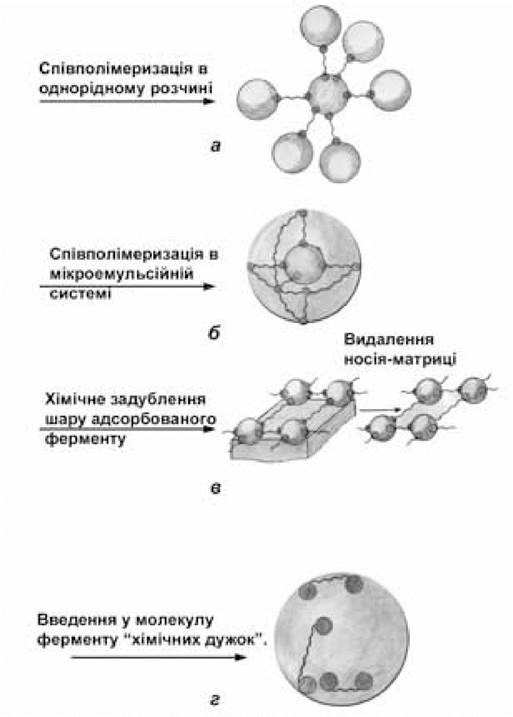
Fig. 7.7. Types of enzyme reticulation
(after Berezin I.V. et al., 1987):
a — intermolecular three-dimensional network; b — reticular shell surrounding the enzyme molecule (molecularly immobilized enzyme); c — intermolecular two-dimensional network; d — intramolecular network formed by protein polypeptide chains and "chemical braces".
A three-dimensional gel can also be prepared directly as fine spherical particles via emulsion polymerization. Emulsions are obtained by dispersing an aqueous solution containing monomers in a water-immiscible organic solvent. Variations of such systems include microemulsions or hydrated reverse (water-in-oil) micelles of Surfactants in organic Solvents. In micellar systems, the size of the "droplets" containing the modified enzyme and monomers can be controlled and even tailored to match the dimensions of the enzyme molecules themselves. This approach makes it possible to coat individual enzyme molecules with a polymer shell of a predetermined thickness, essentially dressing the enzyme in a "tailor-made jacket" (Fig. 7.7, b). This represents a new quality of immobilization—THE MOLECULAR LEVEL.
The reticulation process can take place not only in an enzyme solution but also when utilizing previously immobilized enzyme preparations. For instance, subsequent Treatment of an adsorption-immobilized enzyme on an inert carrier with a cross-linking agent leads to enhanced stability (hardening) of the preparation. Here, the carrier does not participate in the chemical reaction; rather, it acts merely as a template for organizing a monolayer of the adsorbed enzyme, thereby directing the reticulation in two dimensions. Furthermore, the carrier can be completely removed afterward (e.g., nitrocellulose can be dissolved in methanol), yielding a cross-linked enzyme film (Fig. 7.7, c).
Preparations of molecularly immobilized enzymes can also be obtained when both functional groups of a bifunctional cross-linking reagent react with the same single protein–enzyme molecule. In this case, one can speak of applying "chemical braces" that intramolecularly stabilize the Enzyme Structure (Fig. 7.7, d).
Last update: 11/08/2026
Editorial and Educational Adaptation: This material has been compiled based on the primary/original source text. The project team performed an editorial review, corrected technical inaccuracies, structured sections, and adapted the content for an educational format.
What was processed:
- elimination of formatting defects (OCR errors, structural breaks, corrupted characters);
- editorial organization of content;
- standardization of terminology in accordance with academic sources;
- verification of factual statements against the original source text.
All mentions of the author, publication year, and origin of the primary text have been preserved in accordance with the source.