Anatomy and Physiology of Children and Adolescents - M. R. Sapin 2007
Musculoskeletal System
Skeleton
The Skeleton (from the Greek skeletos, meaning "dried up") is an integrated framework of bones connected to one another in a specific arrangement (Fig. 14). In an adult human, the skeleton consists of approximately 206–208 bones. The skeleton is traditionally divided into three main sections: the Axial Skeleton (trunk), the Skull (HEAD), and the Appendicular Skeleton (limbs) (Table 5).
The axial skeleton provides structural support for the head and upper limbs while protecting the Spinal Cord and Internal Organs. It consists of the vertebrae, which form THE Vertebral Column, and the bones of The thoracic cage. Each segment of the human axial skeleton is formed by a vertebra, and in the thoracic region, it also includes a pair of Ribs and a section of the Sternum.
Class="center">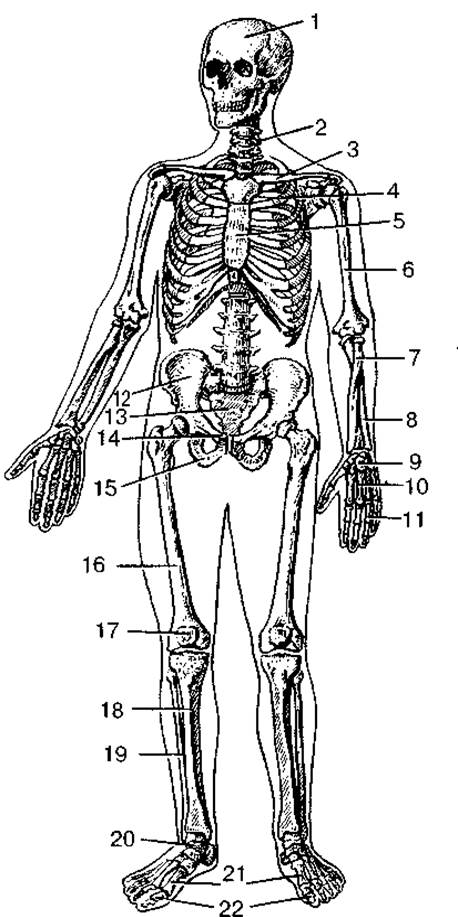
Fig. 14. Human skeleton, anterior view:
1 — skull; 2 — vertebral column; 3 — clavicle; 4 — rib; 5 — sternum; 6 — humerus; 7 — radius; 8 — ulna; 9 — Carpal Bones; 10 — Metacarpal bones; 11 — Phalanges of the hand; 12 — ilium; 13 — sacrum; 14 — pubis; 15 — ischium; 16 — Femur; 17 — Patella; 18 — Tibia; 19 — Fibula; 20 — Tarsal Bones; 21 — Metatarsal Bones; 22 — phalanges of the FOOT
Table 5 Bones of The Human Body
|
Body region |
Bone names and quantities |
|
Trunk |
Vertebrae 31–33 cervical 7 thoracic 12 lumbar 5 sacrum (5 fused sacral vertebrae) coccyx (3–5 coccygeal vertebrae) Ribs 12 pairs Sternum |
|
Skull |
23 bones, including unpaired bones — frontal, occipital, sphenoid, Mandible, Hyoid bone, and paired bones — parietal, temporal, zygomatic, etc. |
|
Upper limb |
32 bones per single upper limb clavicle scapula humerus radius ulna carpal bones 8 metacarpal bones 5 phalanges 14 |
|
Lower limb |
31 bones per single lower limb hip bone femur patella tibia fibula tarsal bones 7 metatarsal bones 5 phalanges 14 |
The skeletal framework of the head—the skull—protects the Brain and Sensory Organs, and provides structural support for the initial segments of the digestive and respiratory systems.
The skeletal framework of the upper and lower limbs is divided into the BONES OF THE free limb and the limb girdle. The Pectoral Girdle (shoulder girdle) consists of two paired bones: the scapula and the clavicle, whereas the free upper limb is divided into three segments: the humerus, the bones of the forearm, and the bones of the hand. The Pelvic Girdle consists of the paired hip bone, while the free lower limb is similarly divided into three segments: the femur, the leg bones, and the foot bones. The Skeleton of the Upper Limb Functions primarily for grasping and manipulating objects in space, whereas the lower limbs provide support and locomotion. Each individual bone functions as an independent organ performing a specific physiological role.
Last update: 10/08/2026
Editorial and Educational Adaptation: This material has been compiled based on the primary/original source text. The project team performed an editorial review, corrected technical inaccuracies, structured sections, and adapted the content for an educational format.
What was processed:
- elimination of formatting defects (OCR errors, structural breaks, corrupted characters);
- editorial organization of content;
- standardization of terminology in accordance with academic sources;
- verification of factual statements against the original source text.
All mentions of the author, publication year, and origin of the primary text have been preserved in accordance with the source.