Review of Medical Physiology - William F. Ganong 2002
Functions of the Digestive System
Regulation Mechanisms of Gastrointestinal Functions
Large Intestine
The main function of the Large Intestine is the absorption of Water, Na+, and other minerals, along with the elimination of nearly 90% of fluid. It converts 1000–2000 mL of isotonic chyme entering daily from the ileum into 200–250 mL of semi-solid feces.
The diameter of the large intestine exceeds that of the Small Intestine. In healthy adults, its length is about 100 cm, extending beyond 150 cm at autopsy. The fibers of its outer muscular layer are gathered into three longitudinal bands known as taeniae coli. However, because these bands are shorter than the rest of the bowel, the wall of the colon forms sacculations (haustra) between the taeniae coli (Fig. 26-30). The colonic mucosa lacks villi. Colonic glands are short, tubular invaginations of the mucosa that secrete mucus. Solitary lymphatic nodules are present here, particularly in the cecum and Appendix.
Class="center">
Fig. 26-30. The human colon.
Motility and Secretion in the Large Intestine
The region of the ileum containing the ileocecal valve protrudes into the cecum such that an increasing intraluminal pressure compresses it, whereas an increase in intraileal pressure opens the valve. Furthermore, this valve effectively prevents the reflux of colonic contents into the ileum. Normally, it remains closed. Each time a peristaltic wave reaches it, the valve opens rapidly, allowing a jet of ileal chyme to enter the cecum. If the valve is surgically transected in experimental animals, chyme enters the large intestine rapidly, reducing small intestinal absorption; however, this phenomenon does not occur in humans. When food masses leave The Stomach, the cecum relaxes and the passage of chyme through the ileocecal valve increases (gastroileal reflex). This is widely considered a vagus-mediated reflex, although some evidence suggests that vagal stimulation does not directly affect the ileocecal valve. Sympathetic stimulation enhances closure of the valve.
Colonic movements include segmental contractions and peristaltic waves, similar to those observed in the small intestine. Segmental contractions mix the chyme within the colon and expose it to the mucosa, facilitating absorption. Peristaltic waves propel the intestinal chyme forward toward the rectum, although weak antiperistalsis is occasionally observed. A third type of contraction is unique to the colon: mass movements, which involve simultaneous contraction of the smooth Muscle over very large, closely spaced areas. These contractions drive the contents into the rectum, and rectal distention triggers the defecation reflex (see below).
Colonic movements are coordinated by the colonic BER (basic electrical rhythm). Unlike the small intestine, the frequency of this wave increases along the length of the colon, from 2/min at the ileocecal valve to 6/min in the sigmoid colon.
Transit Time Through the Small and Large Intestines
During transit testing, the first portion of a marker meal reaches the cecum in 4 hours, and all undigested portions enter the colon by 8–9 hours. On average, the leading food residues reach the hepatic flexure in 6 hours, the splenic flexure in 9 hours, and the pelvic colon in 12 hours. Transport slows down considerably from the pelvic colon to the anus. Indeed, studies show that 25% of the test meal residues are still present in the rectum after 72 hours. When small, colored plastic beads are ingested with food, an average of 70% are recovered in the feces, although complete elimination may take up to 72 hours. Transit time, pressure fluctuations, and pH Changes in the gastrointestinal tract can be monitored by tracking a small capsule containing sensors and miniature radiotransmitters as it passes through.
Absorption in the Large Intestine
The absorptive capacity of the colonic mucosa is remarkable: Na+ is actively transported outward from the colon, and water follows along the resulting osmotic gradient. Normally, a net secretion of K+ and HCO3- into the colon also occurs here (see Chapter 25). The absorptive capabilities of the large intestine make rectal drug administration a routine clinical practice, particularly in pediatrics. Many compounds—including anesthetics, sedatives, tranquilizers, and Steroids—are absorbed more rapidly via this route. During enemas, some water is absorbed; if the enema volume is excessive, absorption can be so rapid that water intoxication ensues. Coma and death resulting from water intoxication, followed by therapeutic fluid withdrawal via puncture, have been reported in children with megacolon (dilation of part or all of the colon) following water enemas.
Feces
Feces consist of inorganic matter, undigested plant fibers, Bacteria, and water. Their composition (Table 26-12) does not directly reflect various dietary intakes because the bulk of fecal matter is of non-dietary origin. This explains why a significant amount of feces is produced even during prolonged fasting.
Intestinal Bacteria
The chyme in the upper small intestine contains relatively few bacterial species. Microorganisms are more numerous in the ileum, but the largest population of bacteria is normally found in the colon. The relative sterility of the upper small intestine is maintained by several factors, although Gastric Acidity and the relatively rapid transit of chyme through this region likely inhibit bacterial growth. The microorganisms present in the colon include not only bacilli such as Escherichia coli and Enterobacter aerogenes, but also pleomorphic organisms such as Bacteroides fragilis, various types of cocci, and gas gangrene bacilli, which can cause severe infections in Tissues outside the colon. Large quantities of bacteria are eliminated with the feces. At birth, the colon is sterile, but the intestinal bacterial flora becomes established early in life.
METABOLISM/18.html">The Influence of intestinal bacteria on their host (the macroorganism) is complex; some bacterial species are extremely beneficial, whereas others are potentially harmful.
Antibiotics improve growth rates across various species, notably in humans. Small quantities of antibiotics are often added to livestock feed. Animals grow faster under good hygienic conditions than in control groups, but this growth enhancement still occurs in the presence of microorganisms. They assimilate food more efficiently and have lower requirements for Certain Amino Acids that are essential for other animals. They are characterized by higher weight gains and lower neonatal mortality rates.
The precise reasons for this growth enhancement remain incompletely understood. Essential nutrients, such as ascorbic acid, cyanocobalamin, and Choline, are utilized by competing intestinal bacteria. On the other hand, certain enteric microorganisms synthesize vitamin K and the B-complex Vitamins. Folic acid produced by bacteria is absorbed in significant amounts. Furthermore, short-chain Fatty acids produced by bacterial action in the colon are of exceptional physiological importance (see Chapter 25).
Feces acquire their brown color from pigments derived from Bile pigments. When bile delivery to the intestine is insufficient, the stools become pale or white (acholic stools). Intestinal bacteria also contribute to the gases produced during flatulence. Organic acids generated from CARBOHYDRATES by bacteria account for the mildly acidic reaction of the stool (pH 5.0–7.0). Intestinal bacteria also play a role in Cholesterol Metabolism; for example, the poorly absorbed antibiotic neomycin modifies the intestinal bacterial flora, thereby lowering plasma LDL and cholesterol levels.
Table 26-12. Approximate composition of feces on a standard diet
Components |
Percentage of total mass |
Water |
75 |
Solid matter |
25 |
Percentage of solid matter |
|
Cellulose and roughage |
Variable |
Bacteria |
30 |
Inorganic matter (primarily calcium and phosphates) |
15 |
Fat and fat derivatives |
5 |
Also desquamated mucosal Cells, mucus, and trace amounts of digestive Enzymes |
|
Certain amines, including potentially toxic compounds such as histamine and tyramine, are produced in the colon by bacterial enzymes that decarboxylate amino acids. While symptoms observed in constipated patients were historically attributed to the absorption of these amines, this "autointoxication" theory has long been discredited. Other amines produced by intestinal bacteria, notably indole and skatole, contribute to the characteristic odor of feces, alongside sulfides.
Ammonia is also formed in the colon and subsequently absorbed. In Liver disease, ammonia is not effectively cleared from the Blood, and hyperammonemia (its excessive accumulation in the body) can lead to neurological symptoms (hepatic encephalopathy). The amount of ammonia produced can be reduced by administering osmotic laxatives, such as lactulose, which flushes some of the ammonia-producing Proteins into the colon and acidifies its contents, thereby favoring the growth of non-ammonia-producing bacteria.
When normal animals with a conventional intestinal bacterial flora are exposed to ionizing radiation, the host defense mechanisms that prevent the spread of enteric bacteria to other PARTS OF THE body are impaired, and the primary cause of death from radiation injury is generalized Sepsis. Germ-free animals exhibit marked lymphoid hypoplasia and poorly developed immune mechanisms, presumably because these mechanisms have never been previously primed. Furthermore, such animals are more resistant to radiation than animals with a normal intestinal flora because they lack the bacteria that initiate sepsis.
Blind Loop Syndrome
Intestinal dysbiosis within the intestinal lumen can cause characteristic adverse effects. For example, dysbiosis occurs when there is stasis of contents in the small intestine, leading to macrocytic anemia, cyanocobalamin (vitamin B12) malabsorption, and steatorrhea. This condition develops in patients with a surgically created blind loop of the small intestine (the presence of closed spaces within the small intestine), and it also occurs in any condition that promotes massive bacterial contamination of the small intestine. The anemia is caused by cyanocobalamin deficiency, and impaired absorption of the vitamin results from the binding of cyanocobalamin by anaerobic bacteria. Steatorrhea results from the excessive Hydrolysis of conjugated bile acids by bacteria. The crucial role of bile acids in fat Digestion is described in Chapter 25.
Dietary Fiber
Adequate Nutrition in herbivores depends on the action of gastrointestinal microorganisms that break down cellulose and related plant carbohydrates. Humans do not undergo significant digestion of these plant products. Cellulose, hemicellulose, and Lignin in foods are important components of dietary fiber, which is present in ingested food because it reaches the colon in an almost unchanged state. Various Gums, marine algal Polysaccharides, and pectic substances are also contained within dietary fiber.
When the amount of fiber in the diet is low, the diet is said to be low-residue. When the bulk of matter in the colon is small, the colon becomes relatively inactive, and bowel motility occurs infrequently. In addition, starvation and parenteral nutrition lead to colonic mucosal atrophy, although the mucosa returns to normal when pectin-like substances are introduced into the colon. Bulking agents—laxatives—provide greater bulk for ingested material in the colon.
In recent years, there has been an increased interest in dietary fiber because epidemiological studies indicate that populations consuming a diet rich in plant fiber have a lower incidence of diverticular disease, colon Cancer, Diabetes Mellitus, and coronary artery disease. However, the exact relationship between dietary fiber and the likelihood of developing these diseases is still not fully understood.
Defecation
Distension of the rectum by fecal masses initiates reflex contractions of the bowel musculature and gives rise to the urge to defecate. In humans, the sympathetic innervation to the internal (involuntary) anal sphincter is excitatory, whereas the parasympathetic innervation is inhibitory. This sphincter relaxes when the rectum is distended. The nerve supply to the external anal sphincter, which is composed of Skeletal Muscle, is provided by the pudendal nerve. The sphincter is maintained in a state of tonic contraction, and moderate distension of the rectum increases the force of its contractions (Fig. 26-31). The initial urge to defecate occurs when rectal pressure increases to 18 mmHg. When this pressure rises to 55 mmHg, both the external and internal sphincters relax, and the rectal contents are expelled. It is precisely due to this reflex that evacuation of the rectum occurs in chronic Spinal Cord injury patients as well as in animals. Before the pressure that relaxes the external anal sphincter propagates, defecation is initiated by the voluntary relaxation of the external sphincter and contraction of the Abdominal Muscles (straining) to assist the reflex evacuation of the distended rectum. Defecation is a spinal reflex; it can be voluntarily inhibited by maintaining the contraction of the external sphincter or facilitated by relaxation of the sphincter and contraction of the abdominal muscles.
Distension of the stomach by food initiates contractions in the rectum and frequently prompts defecation. This response is referred to as the gastrocolic reflex, although in some instances it involves the non-neural release of gastrin acting on the colon. Consequently, in infants, defecation typically occurs following a meal. In adults, habits and cultural traditions play a significant role in determining the timing of defecation.
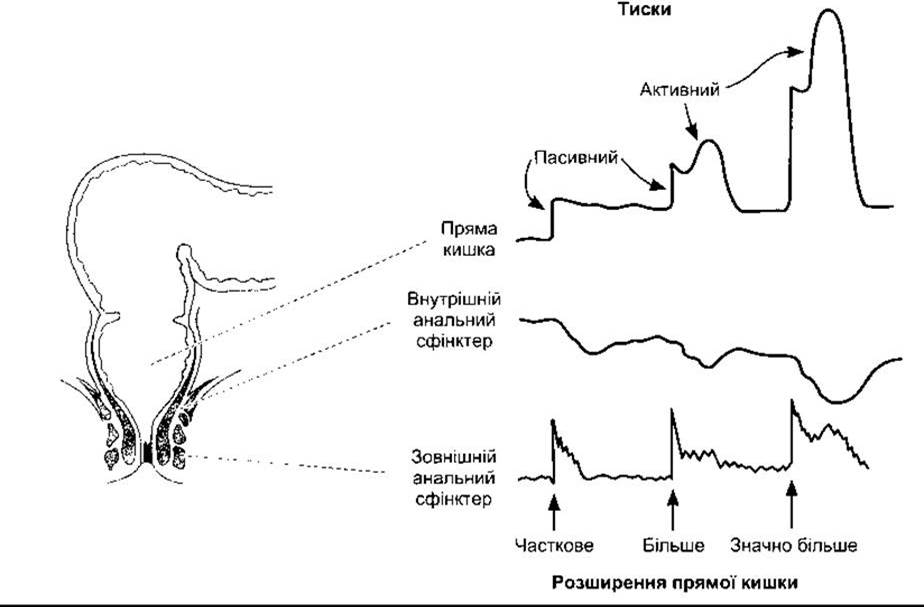
Fig. 26-31. Rectal responses to distension up to a pressure of 55 mmHg. Distension creates passive pressure due to the stretching of the rectal wall and additional active pressure when the smooth muscle of the wall contracts (reproduced by permission from Davenport HW: A Digest of Digestion, 2nd ed. Year Book, 1978).
Effects of Colectomy
Humans can survive total removal of the colon provided that fluid and electrolyte balance is maintained. Following total colectomy, the ileum is brought out through the abdominal wall (ileostomy), and chyme is discharged into a plastic bag attached around the opening. If the diet is well-adjusted, the volume of ileal output decreases, and its consistency increases over time. Caring for an ileostomy is time-consuming and difficult work; however, when an ileostomy is constructed according to modern standards, problems are relatively few, and patients can lead normal, fulfilling lives.
Constipation
In Europe and North America, public information concerning excessive anxiety over constipation surpasses almost all other health lifestyle topics. Patients with chronic constipation, and particularly those with a recent change in bowel habits, are advised to undergo evaluation for organic pathology. However, many healthy individuals have bowel movements only every two or three days, whereas others have them daily or even three times a day.
Occasionally, the only symptoms caused by constipation are mild anorexia, moderate abdominal discomfort, and bloating. These symptoms are not dependent on the absorption of toxic substances, as they are more commonly associated with the motor and evacuatory Properties of the rectum and can be reproduced by distending the rectum with an inert substance. Other symptoms of constipation include anxiety and the like.
Megacolon
The Adverse effects of motor and evacuatory disorders in the colon are accompanied by a relative lack of symptoms, aside from abdominal distension, anorexia, and fatigue in children with aganglionic megacolon (Hirschsprung's disease). This condition results from the Congenital absence of ganglion cells in the myenteric and submucosal plexuses in the distal portion of the colon, likely as a consequence of impaired normal craniocaudal migration of neuroblasts during embryonic development.
The absence of peristalsis causes difficulty in propelling fecal masses through the aganglionic segment, and children with this disease may have a bowel movement only once every three weeks. This condition can be alleviated by resection of the aganglionic segment of the colon and bypassing the remaining portions of the colon to the rectum.
Endothelins activating endothelin B receptors (see Chapter 31) are required for the normal migration of certain neural crest cells. Knockout of endothelin B receptors in mice leads to The Development of megacolon. It is known that another cause of congenital aganglionic megacolon in humans can be a mutation in the endothelin B receptor Gene.
Diarrhea
Numerous factors cause diarrhea. Some of these are partially described in this chapter. Severe diarrhea is debilitating and can be life-threatening, particularly in infants. Large amounts of Na+, K+, and water are lost from the colon and small intestine during diarrheal stools, leading to dehydration, hypovolemia, and consequently Shock and cardiovascular collapse. An even more serious complication of chronic diarrhea, even when water balance is maintained, is hypokalemia. Acute diarrhea is a major problem in developing countries and frequently affects travelers. However, fluid and electrolyte losses can be effectively replaced by the administration of Na+ and glucose, because Na+ is absorbed via the SGLT1 Na+-glucose cotransporter (see Chapter 25). Bismuth subsalicylate has been found effective in reducing diarrheal output, and compounds containing this substance are available for use in many countries.
Last update: 10/08/2026
Editorial and Educational Adaptation: This material has been compiled based on the primary/original source text. The project team performed an editorial review, corrected technical inaccuracies, structured sections, and adapted the content for an educational format.
What was processed:
- elimination of formatting defects (OCR errors, structural breaks, corrupted characters);
- editorial organization of content;
- standardization of terminology in accordance with academic sources;
- verification of factual statements against the original source text.
All mentions of the author, publication year, and origin of the primary text have been preserved in accordance with the source.