Human Anatomy - Kotsan I. Y. 2009
Neural Pathways of the Brain and Spinal Cord
Impulses generated when various factors act upon receptors are transmitted along neuronal processes to their Cell bodies. Through numerous synapses, Neurons interconnect to form chains along which nerve impulses travel in a specific direction only—from receptor neurons through interneurons to effector neurons. This is determined by the morphofunctional characteristics of synapses, which transmit excitation from the presynaptic membrane to the postsynaptic one.
Along some neuronal chains, impulses propagate in an afferent direction, i.e., from their site of origin in the periphery (Skin, mucous membranes, Organs, Blood Vessels) to the Central Nervous system (Spinal Cord or Brain). Along other neuronal chains, impulses are conducted in an efferent direction—from the BRAIN AND SPINAL cord to the periphery, toward the effector organ (Muscle, gland). Neuronal chains within a living Organism form reflex arcs. In the course of evolution and the Progressive development of the central nervous system, The Structure of reflex arcs has grown more complex. This has led to The Emergence of intricate multineuronal reflex arcs, whose Structure and function involve Nerve Cells located in higher segments of the spinal cord, the basal nuclei of the brain, and the Cerebral Cortex (suprasegmental apparatuses). The processes of neurons extending from the spinal cord to various brain structures, and vice versa from the brain back to the spinal cord, form bundles (fasciculi) of nerve fibers.
Neuronal chains and bundles of nerve fibers sharing a common function that interconnect various Divisions of the brain and spinal cord within the central nervous system, ensuring functional bidirectional communication, are designated as Neural Pathways (tracts).
V. V. Turygin (1983) defines the Neural Pathways of the central nervous system as «a system of nerve fibers connecting various PARTS OF THE brain and spinal cord both with one another and within either the brain alone or the spinal cord alone, thereby ensuring functional bidirectional communication among various brain structures.»
Neural pathways ensure the integrative activity of the central nervous system, The Unity of the organism, and its connection with the external environment.
Depending on their structure and function, all neural PATHWAYS OF THE central nervous system are divided into three groups: association, commissural, and Projection Pathways (Table 8).
Class="center">Table 8 SCHEME OF THE Neural Pathways of the brain and spinal cord
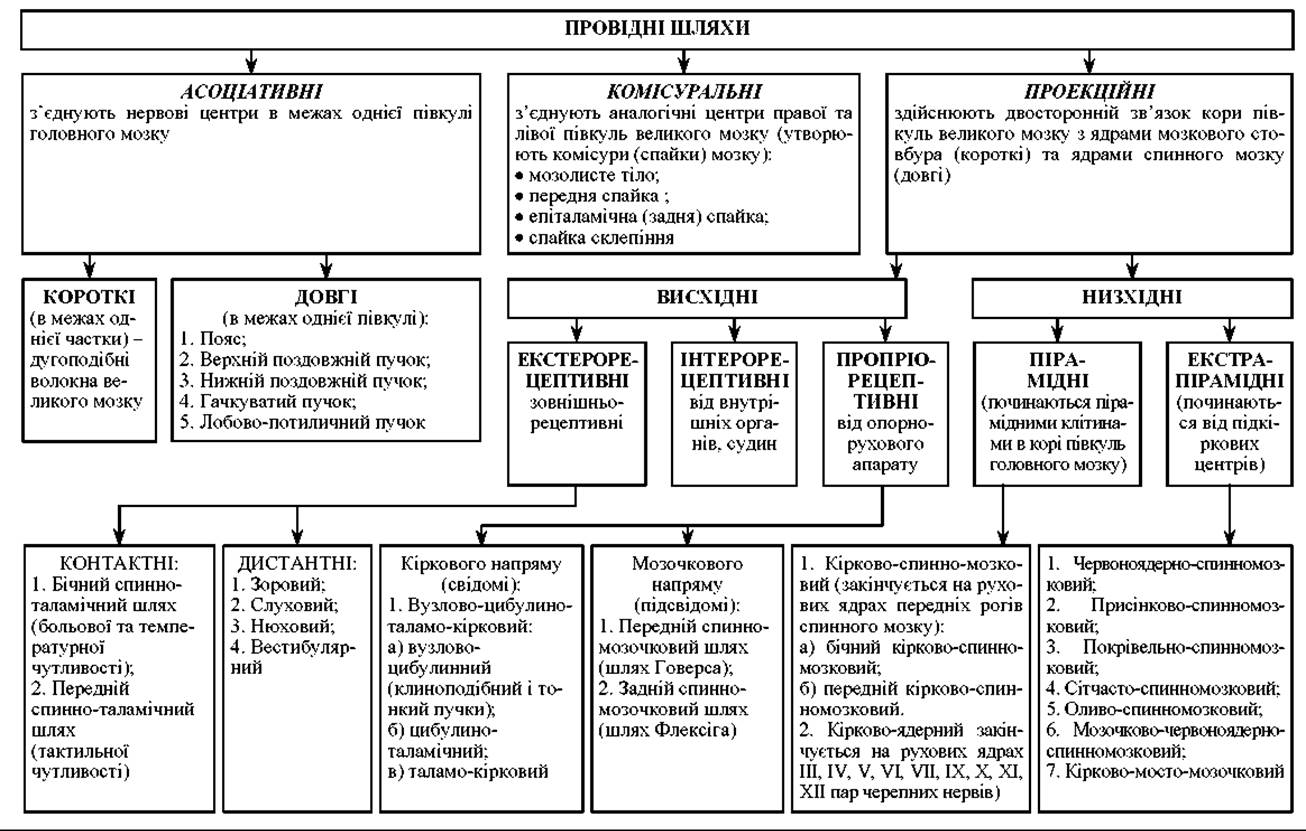
During ontogenetic development, projection pathways are formed first, followed by commissural pathways, and finally Association Pathways.
Last update: 08/08/2026
Editorial and Educational Adaptation: This material has been compiled based on the primary/original source text. The project team performed an editorial review, corrected technical inaccuracies, structured sections, and adapted the content for an educational format.
What was processed:
- elimination of formatting defects (OCR errors, structural breaks, corrupted characters);
- editorial organization of content;
- standardization of terminology in accordance with academic sources;
- verification of factual statements against the original source text.
All mentions of the author, publication year, and origin of the primary text have been preserved in accordance with the source.