Fundamentals of Evolution - Korzh O.P. - 2006
Part III. PATHWAYS OF LIFE EVOLUTION
Chapter 20. Main Stages in the Evolution of Multicellular Animals
20.1. First Representatives and Major Trends in Multicellular Evolution
The most primitive Multicellular animals, which have largely preserved the Structural Features of the first Metazoa, are Representatives of the phylum Placozoa. Currently, only two species of this phylum are known — Trichoplax adhaerens and Treptoplax reptans. Although described as early as the 19th century, their systematic position was established only in the 1970s (Fig. 20.1).
Class="center">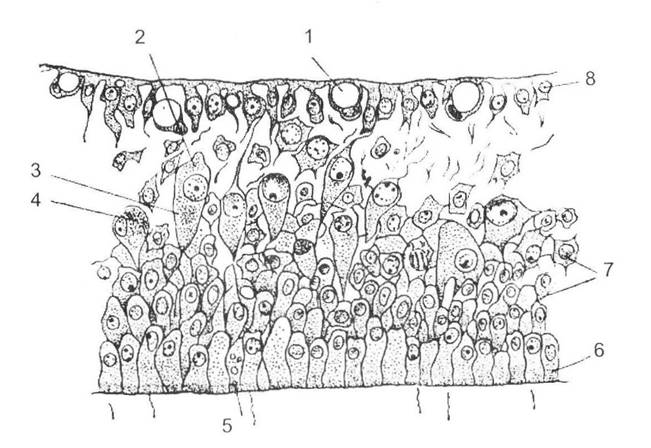
Fig. 20.1. Cross-sectional diagram of Trichoplax (after Yu.I. Polyansky, 1987):
1 - spindle-shaped Cell; 2 - degenerating cell; 3 - amoeboid cell; 4 - "dorsal" epithelium; 5 - "ventral" epithelium; 6 - digestive vacuole; 7 - mitochondrial complex; 8 — fat droplet
It is possible that they are the earliest descendants of the phagocytella, having transitioned from a free-swimming lifestyle to crawling, a specialization that caused them to lose anteroposterior polarity and flatten into a thin plate. It is believed that this group secondarily acquired the capacity for external Digestion, which is also associated with their benthic lifestyle.
Placozoans are quite difficult to classify as true multicellular animals primarily due to the limited differentiation of their Cells. At the same time, the upper and lower layers of flagellated cells can be compared to the precursor of the ectoderm, while the inner amoeboid cells correspond to the entoderm (thus showing the basis for the subsequent development of germ layers). Both asexual and Sexual reproduction in these animals have been recently described. Thus, the discovery of placozoans and The Study of their biology support I.I. Mechnikov's views on THE ORIGIN OF Multicellular Organisms from a common ancestor, the phagocytella.
In terms of their level of Organization, placozoans closely resemble the parenchymula — the larva of Sponges and Cnidarians — which is why they were initially mistaken for it.
At this early stage of evolution, multicellular animals faced several critical challenges. Their feeding became predominantly holozoic (ingesting solid food particles), and generally, the larger the animal, the larger the prey it could consume. Consequently, many groups exhibit an evolutionary trend toward larger body sizes. However, according to General Principles of group evolution, excessively large body sizes can become a factor leading to extinction.
Satisfying increasing nutritional demands drove The Emergence of fundamentally new modes of locomotion, enabling more efficient foraging. These exact circumstances subsequently led to The Development of muscular and skeletal systems, which provide body shape maintenance, protection and support for Internal Organs, and locomotion. To manage such a state, organisms needed to coordinate The activity of individual cells, resulting in The formation of a Nervous system that laid the foundation for the development of animal behavior, and so on. The further evolution of multicellular animals depended directly on the successful resolution of these very issues.
Some animals exhibit an alternation of sexual and asexual generations (sponges, cnidarians, certain parasitic Flatworms, tunicates). However, unlike plants, both the sexual and asexual generations in animals are diploid, featuring a delayed appearance of sexual forms (metagenesis). Metamorphosis typically occurs without an Morphology/12.html">ALTERNATION OF GENERATIONS and is observed in many groups (Annelids, Arthropods, Mollusks, Echinoderms, lampreys, certain fish, and amphibians). In development with metamorphosis, a larva hatches from the egg, which may differ significantly from the adult animal. During subsequent development, larval organs disappear and are replaced by those characteristic of the adult form, completing the transformation of the larva into an imago.
Last update: 07/08/2026
Editorial and Educational Adaptation: This material has been compiled based on the primary/original source text. The project team performed an editorial review, corrected technical inaccuracies, structured sections, and adapted the content for an educational format.
What was processed:
- elimination of formatting defects (OCR errors, structural breaks, corrupted characters);
- editorial organization of content;
- standardization of terminology in accordance with academic sources;
- verification of factual statements against the original source text.
All mentions of the author, publication year, and origin of the primary text have been preserved in accordance with the source.