Botany - B.Ye. Yakubenko 2017
Part One. Plant Anatomy and Morphology
Chapter III. Vegetative Organs of Plants
Laboratory Class Topic 8.16. Morphological Structure of the Shoot
General Remarks. Due to their Functions of support and aerial Nutrition, plants have developed shoots that are extremely diverse in Morphology and Structure. As we examine them, considerable attention is paid to studying their morphology, particularly SHOOT typology based on growth habit, spatial arrangement, and branching patterns. This will help students better grasp the material from a practical perspective, understand their role in plant developmental biology, and explore their potential economic use for the propagation and cultivation of crop plants.
Objects: Shoots of common horse-chestnut (Aesculus hippocаstаnum L.), littleleaf linden (Тіlіа соrdаtа Міll.), common lilac (Syringa vulgaris L.), domesticated apple (Маlus dоmestica Вогkn), European larch (Lаrіх decidua Mill.), tree of heaven (Аіlаnthus altissima (Міll.) Swingle), common lambsquarters (Сhеnороdium аІbum L.), white clover (rifolium rереns L.), hop medick (Меdісаgо рrосumbens Веss.), catchweed bedstraw (Galium aparine L.), one-seed hawthorn (Grataegus monogina Jacg.), common grape vine (Vitis vinifera L.), Pontic butcher's-broom (Ruscus pontica Woronow ex Grossh.), stag's-horn clubmoss (Lycopodium clavatum L.), potato tubers (Sоlаnum tuberosum L.), Solomon's seal rhizomes (Роlуgonatum multiflorum (L.) Аll.), common onion bulbs (Аllium cepa L.)
Tasks:
1. Study and draw shoot morphology.
2. Examine and study shoot types based on growth habit.
3. Study and draw shoot types based on branching pattern.
4. Study and draw shoot types based on internode development.
5. Study and draw subterranean and aerial shoot modifications.
Equipment and Materials: hand lenses, scalpels, forceps, live and fixed herbarium material, charts, and other accessories.
Macroscopic Study of Shoot Morphology. Find horse-chestnut shoots among the herbarium and live material. Select typical specimens and examine them thoroughly. For this, we recommend using a hand lens or binocular Microscope. It is easy to establish that a shoot consists of The Stem as the main supporting axis, leaves, buds, nodes, and internodes. Take the stem and examine it carefully. Using a scalpel, make a cross-section and verify that the bulk of the stem is made up of wood, while the bark and pith occupy only a minor portion of it.
Locate nodes—the sites of leaf attachment—and internodes between two adjacent nodes on the shoot, and indicate them in your drawing. Leaf scars left behind after leaf abscission are clearly visible on the stem. Note that leaf traces appear on these scars as bordered, punctate structures. In addition, elongated lenticels are clearly visible on the stems of two-year-old shoots (Fig. 51).
|
Class="center"> |
Figure 51. Horse-chestnut shoot: 1 — terminal bud; 2 — site of bud scale attachment; 3 — internode; 4 — leaf scar; 5 — leaf trace; 6 — lenticel |

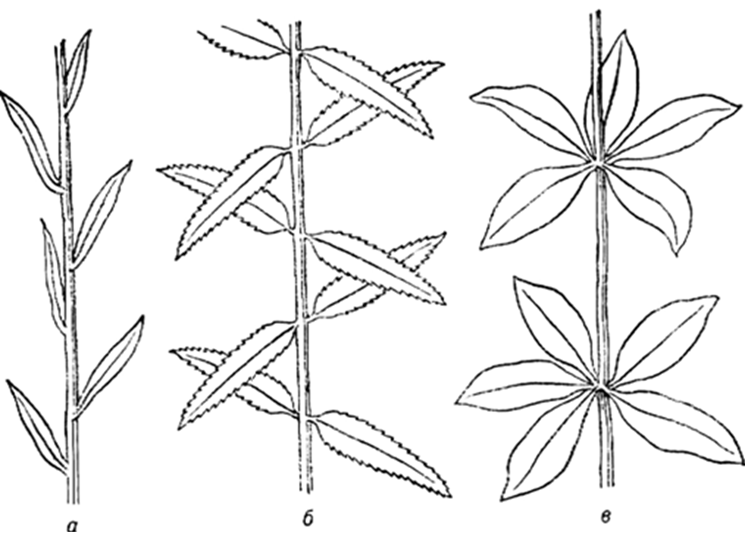
The leaves of the horse-chestnut are opposite in arrangement (Fig. 52). Lateral or axillary buds develop in their axils. The shoot terminates in a apical bud; dissect it and examine it. You can see that it is externally covered by tightly appressed bud scales, whose edges are impregnated with a sticky resinous substance. Use forceps to remove the scales, beneath which you will see embryonic or primordial greenish leaves. If you remove these, the shoot apex (growing cone), which represents the apical meristem, will be exposed.
|
|
Fig. 52. Phyllotaxy: а — alternate; б — opposite; в — whorled |
Macroscopic Study of Shoot Types by Growth Direction. Using live material and herbarium specimens, select the following shoot types according to their growth direction: erect, ascending, prostrate, climbing, twining.
First, examine erect shoots. For this, use common lambsquarters. Its stem is erect, slightly ribbed when mature, woody, and tapering upwards. Nodes and internodes stand out clearly on it. Leaves are arranged alternately, and lateral shoots form in the axils of many of them, though their sizes are always smaller than that of the main axis.
Using yellow alfalfa as an example, examine and study The structure of an ascending shoot. Their characteristic feature is a curved posture: the lower part of the stem lies on the ground surface without rooting, while the upper part rises and assumes a vertical position in space (Fig. 53).
Examine the structure of prostrate shoots using white clover as an example.
Their characteristic feature is the presence of adventitious roots arising from the nodes upon contact with moist soil. Erect stems and inflorescences on long stalks emerge from the prostrate stem. Find the terminal buds on these stems, which enable them to elongate. In prostrate strawberry stems, shoots with short internodes are called runners, while those with elongated internodes are referred to as stolons.
|
|
Fig. 53. Shoot types by growth direction: а — erect; б — ascending; в — twining; г − climbing; д − prostrate |

Examine climbing shoots using catchweed bedstraw as an example. Appendages in the form of small attachment hooks grow along its stems.
Among the distributed material, find woody and herbaceous lianas. You can easily recognize them by their distinct, slender, trailing stems that twine around or cling to other plants. Note that the nodes of the grapevine bear tightly coiled woody tendrils and elongated internodes. Bindweed has twining stems with normal internodes, whereas catchweed bedstraw has elongated stems with retrorse prickles, by means of which climbing and twining plants attach themselves to supporting plants.
Macroscopic Study of Shoot Types by Branching Pattern. Using stag's-horn clubmoss as an example, study dichotomous shoot branching (Fig. 54). In clubmoss, the stem and Branches of the strobili fork into two parts; that is, the growing tip splits into two halves, each of which gives rise to a new shoot.
Using common lilac as an example, study the structure of false-dichotomous (pseudodichotomous) shoot branching. Note that the first-order shoot terminates in a poorly developed bud, and its further growth proceeds through lower-lying buds that give rise to two new second-order shoots.
|
|
Figure 54. Shoot branching types: а, б — dichotomous; в — sympodial; г, д — monopodial |

Take a branch of European larch or Scots pine and examine shoots that exhibit monopodial branching. Here, the terminal bud stands out, driving the continuous growth of the larch or pine stem throughout its life. As a result, their main trunks form first-order shoots, clearly distinct from other lateral branches in both length and thickness.
Using the small-leaved linden and potato as Examples, examine shoots with sympodial branching. In these plants, the first-order sympodium ceases its growth, and the main axis continues to elongate through The activity of the nearest subtending bud positioned just below. The resulting shoot displays a distinct zig-zag or geniculate pattern. Each such segment (sympodium) features a bud, a node, or a leaf scar.
Macroscopic study of shoot types based on internode development. Take a branch of tree of heaven (Ailanthus), linden, apple, and larch to examine shoot variations based on internode length. In the tree of heaven, examine and sketch a stem where the lateral buds are spaced far apart, meaning it possesses excessively elongated internodes (Fig. 55). Such shoots are referred to as elongated shoots. In fruit trees, these are commonly called Water sprouts or epicormic shoots.
In the linden and apple tree, internodes of moderate length feature nodes along with lateral and terminal buds. Such shoots are classified as normal in terms of internode length.
On the branches of larch and apple trees, locate short shoots that possess a terminal bud. These are known as short shoots (or brachyblasts): their leaf scars are densely crowded, and internodes are virtually indiscernible. In fruit-bearing trees, they are called fruiting spurs or fruit branches because flowers and fruits develop on them.
|
|
Figure 55. Shoot types based on internode characteristics: a — shortened; b — normal; c — elongated; 1 — terminal bud; 2 — lateral bud; 3 — bud scale scar; 4 — lenticels; 5 — bud scar; 6 — leaf trace (bundle scar); 7 — leaf scar; 8 — terminal bud scale scar |

Macroscopic study of above-ground shoot modifications. Using hawthorn as an example, examine the shoot modification known as a spine (thorn). Proof of its shoot origin is its heavily developed woody tissue. A cross-section of the spine reveals that the cortical parenchyma and pith are almost entirely absent. One can observe small leaves, flowers, or even fruits growing directly on these spines (Fig. 55).
The tendril of a grapevine is likewise a modified shoot, as evidenced by its lignification, branching pattern, and position in the axil of a leaf.
Using butcher's-broom (Ruscus) as an example, study the Structural Features of a phylloclade, or cladode. This modified shoot mimics the appearance of a leaf blade.
Pay attention to the fact that it arises from the axil of a modified leaf. Furthermore, the cladode, acting as a typical shoot, bears flowers and fruits that develop in the axil of a scale-like leaf.
|
|
Figure 56. Shoot modifications: A — above-ground shoot modifications: a — spines; b — cladodes; c — succulent stems of cactus; B — underground shoot modifications: g — rhizome; d — bulb; e — tuber; 1 — cladode; 2 — flower; 3 — reduced leaf; 4 — scar (leaf attachment point); 5 — reduced leaves; 6 — adventitious roots; 7 — dry protective scales; 8 — fleshy scales; 9 — bud; 10 — basal plate (stem disc); 11 — eyes (buds); 12 — stolons |

Macroscopic study of underground shoot modifications. Using a potato tuber as an example, study the structural features of this modified shoot. Tubers develop through the enlargement of the hypocotyl region of the main axis or via lateral shoots known as stolons. Nutrients accumulate within them, altering their internal structure. On the surface of the tubers, you can identify "eyes" (buds) situated in the axils of modified leaves, which appear as eyebrow-like ridges with scaly appendages. If you take a needle and thread and trace a path from the uppermost bud to each successively lower one, you will uncover a spiral, alternate arrangement of eyes, mirroring the arrangement of leaves or vegetative buds on a stem. Making a Cytology/practical/54.html">Longitudinal section of the tuber reveals vascular conductive elements identical to those of a stem.
Study the STRUCTURE OF THE rhizome in Solomon's seal (Polygonatum multiflorum) as an example of a modified shoot. While it resembles a ROOT, its tip features a terminal bud rather than a root cap, allowing the rhizome to grow and elongate just like a stem. In addition, the rhizome clearly displays leaf scars, internodes, and nodes from which adventitious roots emerge.
Using the bulb of the common onion as an example, examine its structural features. The bulb is an underground shoot modification. Cutting it open reveals a short, robust stem (the basal plate) with shortened internodes and nodes, from which modified fleshy leaves depart, enclosed externally by dry, scale-like leaves. Axillary buds can sometimes be seen in the leaf axils. A cluster of adventitious roots extends from the basal plate.
Conclusion. The efficiency of aerial nutrition is enhanced through the proliferation of homologous, metameric Organs such as shoots and leaves, achieved via their spatial arrangement, branching, growth, internode development, and phyllotaxy.
Adapting to diverse and sometimes extreme environmental habitats, shoots undergo marked modifications, acquiring various shapes, sizes, and specialized anatomical structures.
Self-Check Questions:
1. Define METABOLISM/2.html">THE CONCEPT OF a shoot. Name its constituent parts.
2. What types of shoots do you know based on their spatial orientation?
3. Name the constituent parts of a shoot and describe their functions.
4. WHAT IS A bud, and what types of buds can you name?
5. Name the types of shoots based on their branching pattern. Provide examples of herbaceous plants in which they occur.
6. What underground shoot modifications do you know, and in which plant species do they occur?
7. What evidence can you provide to prove that a potato tuber is a modified shoot?
8. Provide evidence demonstrating that tendrils, spines, and rhizomes are modified shoots.
Last update: 07/08/2026
Editorial and Educational Adaptation: This material has been compiled based on the primary/original source text. The project team performed an editorial review, corrected technical inaccuracies, structured sections, and adapted the content for an educational format.
What was processed:
- elimination of formatting defects (OCR errors, structural breaks, corrupted characters);
- editorial organization of content;
- standardization of terminology in accordance with academic sources;
- verification of factual statements against the original source text.
All mentions of the author, publication year, and origin of the primary text have been preserved in accordance with the source.