BOTANY WITH BASICS OF HYDROBOTANY (AQUATIC PLANTS OF UKRAINE) - B.Ye. Yakubenko - 2011
VII. PLANT TISSUES
Dermal Tissues
Epidermis
The primary dermal tissue of leaves, herbaceous stems, floral parts, and fruits. The epidermis originates from the protoderm, into which the Superficial layer of tunica Cells in the SHOOT apical meristem transforms.
Class="center">Water/water.files/image049.jpg" width="498"/>
A - epidermis (1 - guard cells, 2 - stomatal pore, 3 - subsidiary cells, 4 - ordinary epidermal cells); B — periderm
(1 - remnants of epidermis, 2 - phellem (cork), 3 - phellogen (cork cambium), 4 - phelloderm, 5 - complementary cells of lenticel); C - rhytidome (bark) (1 - cork, 2 - cortical parenchyma, 3 - bast fibers, 4 - sclereids, 5 - cells containing druses).
The epidermis most commonly consists of a single layer of cells and their derivatives. Epidermal cells are living and can be divided into ordinary (pavement), guard, and subsidiary cells.
Ordinary cells are tightly connected to one another. Their anticlinal walls are often sinuous, which enhances cellular adhesion and mechanical strength. The outer walls are thick; in grasses, sedges, and horsetails, they are mineralized, whereas the anticlinal and inner walls are thin and pitted. The protoplast is permanently present, containing a Nucleus and amyloplasts, and only rarely METABOLISM/14.html">Chloroplasts or chromoplasts. The greater part of The Cell is occupied by a vacuole, whose cell sap frequently contains anthocyanins, salts of oxalic, tartaric, and malic acids, Alkaloids, and Glycosides.
Guard cells occur in pairs. They are not fused to each other and form the stomatal pore, which regulates gas exchange and Transpiration by opening and closing. These cells contain chloroplasts. In most plants, guard cells are Kidney-shaped, whereas in grasses and sedges, they are dumbbell-shaped.
Subsidiary cells. Epidermal cells (two or more) that are positioned adjacent to the guard cells and differ in appearance from the ordinary epidermal cells are called subsidiary cells. The guard cells together with the subsidiary cells constitute the stomatal apparatus.
The Mechanism of stomatal opening is based on the uneven thickening of the guard cell walls and changes in their turgor pressure. When turgor pressure in the guard cells increases, the stoma opens; when it decreases, it closes.
Epidermal derivatives include the cuticle, trichomes, and emergences or prickles.
The cuticle is a layer of cutin and wax deposited on the outer surface of epidermal cells. It enhances the Protective Functions of the epidermis by being virtually impermeable to water and gases while allowing light to pass through readily. The thickness of the cuticle depends on the growing conditions of the plant. The cuticle surface may be smooth or form bumps, as well as straight or wavy folds.
Trichomes (hairs) are unicellular or multicellular outgrowths on the epidermal surface (Fig. 49). They may appear as papillae, bumps, hooks, hairs, or scales. Functionally, trichomes are classified as simple (covering) and glandular (capitate).
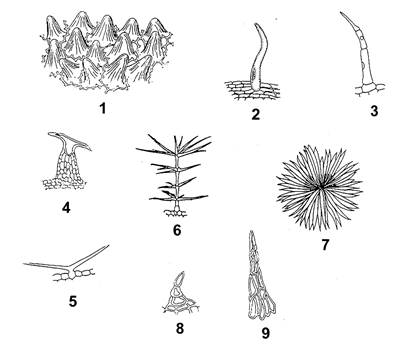
Fig. 49. Epidermal trichomes:
1 - papillae on the petal epidermis of a violet flower, 2 — simple unicellular, 3 — simple multicellular,
4 - hooked Hair of hop, 5 — simple two-horned, 6- branched multicellular of mullein, 7 - stellate of oleaster,
8 - multicellular with a warted surface, 9 - tufted.
Simple hairs can be unicellular or multicellular, unbranched (straight, geniculate, sinuous) or branched (stellate, multiradiate, multi-pointed), and their surface may be smooth or warty, depending on The Nature of the cuticular surface covered by the hair.
Capitate (glandular) hairs consist of a stalk and a HEAD. The stalk may be long or short, unicellular or multicellular. The head of a glandular hair can also be unicellular or multicellular, globular or flattened. Essential Oils primarily accumulate within the head of the hair.
Stinging hairs of nettles represent a specialized type of trichome. At its base, such a hair has a group of cells that produce formic acid. They form a pedestal housing a large syringe-like hair cell with a head at its tip. The wall of the hair stalk is mineralized and brittle. Upon contact with the head, it breaks off, and the sharp edges of the stalk puncture the Skin, injecting an irritating cell sap that causes skin inflammation.
Emergences, or prickles, are pointed or hooked outgrowths formed by epidermal and underlying subepidermal cells. They protect plants from being eaten by animals (such as wild rose and raspberry) and facilitate the dispersal of seeds and fruits by forming hook-like appendages on their surfaces (such as thorn apple, castor bean, and horse chestnut).
The characteristics of epidermal cells and their derivatives are essential for plant identification and serve as an important anatomical and diagnostic feature of Medicinal plant raw Materials. Key diagnostic features include: the size and shape of the ordinary epidermal cells and the nature of their cell walls (straight or sinuous, uniformly or unevenly thickened); the cuticle, its thickness and surface texture (smooth, tuberculate, folded, or wavy); the stomatal apparatus (shape and size of guard and subsidiary cells, and the distribution of Stomata on one or both sides of the leaf); and trichomes (simple or glandular, unicellular or multicellular, straight or branched).
Last update: 07/08/2026
Editorial and Educational Adaptation: This material has been compiled based on the primary/original source text. The project team performed an editorial review, corrected technical inaccuracies, structured sections, and adapted the content for an educational format.
What was processed:
- elimination of formatting defects (OCR errors, structural breaks, corrupted characters);
- editorial organization of content;
- standardization of terminology in accordance with academic sources;
- verification of factual statements against the original source text.
All mentions of the author, publication year, and origin of the primary text have been preserved in accordance with the source.