Plant Physiology - Musiyenko, M. M. 2001
Respiration
Ecology of Respiration
Temperature. Water content
The process of Respiration is based on enzymatic reactions. As known from van 't Hoff's rule, The rate of Chemical Reactions increases by 2–2.5 times with every 10 °C rise in temperature. Respiration follows this rule only within the temperature range of 0° to 35 °C. Upon further warming, this acceleration slows down somewhat, and then respiration intensity drops sharply. Temperatures of 40–50 °C halt the process entirely. The lower temperature threshold for Plant Respiration lies below -10 °C, although in the buds of deciduous trees and the needles of conifers, respiration can be observed even during severe frosts (-20–25 °C).
Accordingly, each plant species and its respective Organs have their own temperature minimum, optimum, and maximum, though overall, these are approximately 5–10 °C higher than those for Photosynthesis. These cardinal points also depend on the exposure time, duration of temperature influence, and the water regime (Fig. 110).
Class="center">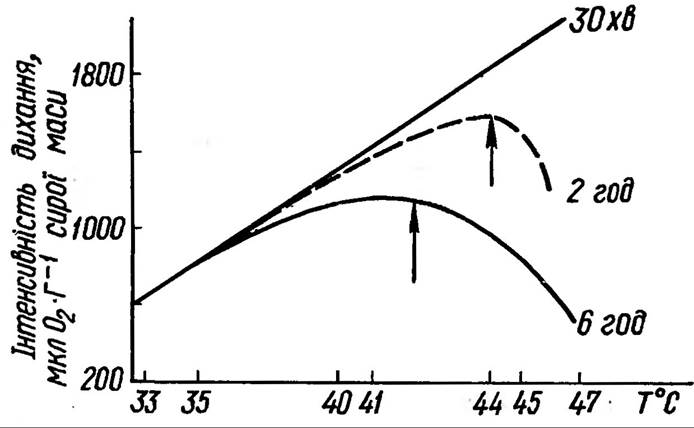
Fig. 110. Dependence of THE POSITION OF temperature respiratory optima (indicated by arrows) on the duration of heating
Respiration intensity directly depends on the water saturation of plant Cells. Dry seeds, containing only 10–12% water, show almost no signs of metabolic activity, including respiration. A slight increase in water content (up to 15%) causes a 3- to 4-fold surge in respiration rate, and upon full imbibition (33%), it increases more than 10,000 times. With the onset of seed germination, respiration increases several times over. The reverse process of gradual respiration decline is observed during seed maturation, which is associated with a decrease in moisture content.
Under natural conditions, this phenomenon is quite important, since seeds germinate in the soil when its temperature is
still quite low. Due to heat generation around the germinating seed, a zone of a specific microclimate is created, where the temperature may rise by several degrees. The low thermal conductivity of the soil ensures the retention of this heat.
An increase in plant temperature resulting from elevated respiration intensity is a rather common phenomenon. Harvesting crops in rainy weather leads to higher grain moisture, causing the grain to respire intensely and release so much heat that the embryo of the grain is killed by the high temperature, while elevators may experience "self-ignition" and even silo explosions.
The rather high temperature required for successful Fertilization during the flowering period of A number of plant species is also provided by an increase in respiration intensity. Often, the temperature of an inflorescence exceeds the ambient temperature by 10–30 °C. For instance, the flowers of Victoria regia have a temperature 12° higher than the air, and in Arum inflorescences, this excess reaches 30 °C. Parasitic plants also frequently maintain a higher temperature than their environment. Plants of northern origin tend to respire more intensively at lower temperatures compared to southern ecotypes, whereas in the high-temperature range, this ratio reverses.
Part of The energy released during respiration can be observed as luminescence; however, this glow is characteristic only of lower plants. Recently, reports have emerged suggesting that respiration intensity depends on atmospheric pressure. Elevated pressure triggers a sharp increase in respiration rate. This is precisely why ecosystems with high biomass (forests) exhibit a higher temperature prior to improving weather conditions compared to ecosystems with lower biomass (agrophytocenoses).
O2 and CO2 concentration. Oxygen is essential for respiration, serving as the terminal electron acceptor transferred by the Components of the Respiratory Chain. An increase in oxygen content up to 5–8% is accompanied by a rise in respiration intensity. Fluctuations in oxygen content within fairly wide limits (from 21 to 9%) do not affect the respiration rate. This can be explained by the fact that one of the most crucial components of the respiratory chain—cytochrome c oxidase—is characterized by a high affinity for O2. However, when O2 concentration drops to 1–2%, the respiratory quotient rises sharply, and respiration is replaced by anaerobic Fermentation. Plant cells seem to recall an ancient mechanism of ENERGY EXTRACTION FROM organic matter that was characteristic of their evolutionary ancestors, which evolved in an anaerobic aquatic environment.
High-altitude plants have also adapted to reduced O2 partial pressure by significantly boosting their respiration intensity. Within the same organ, peripheral Tissues respire most intensively, as they are always better supplied with oxygen. Due to a thick, gas-impermeable cuticle, succulents are characterized by a low respiration rate. It should be borne in mind that the O2 content in the atmosphere does not correspond to its concentration in the gas phase inside the tissues.
Roots suffer most frequently from O2 deficiency. In well-tilled soil, O2 accounts for 7–12%, whereas in waterlogged and structureless soils, its content drops to 2%.
The response of various plant species to O2 deficit varies. Rice is the crop least demanding of O2 content. Marsh plants have adapted well to O2 shortage thanks to the presence of a specialized tissue called aerenchyma. It consists of cells separated from one another by large intercellular spaces. Aquatic plants also feature air passages through which the leaves of higher aquatic plants connect with the rhizome aerenchyma. It has been found that under normal O2 supply, aquatic and marsh plants respire 2–3 times less actively than plants unadapted to oxygen deficiency (such as wheat and peas).
Characteristically, marsh and aquatic plants under anaerobic conditions accumulate not ethanol, but less toxic lactic and malic acids, which are either excreted into the environment or transported from the ROOT to the leaves, where they are incorporated into METABOLISM. Some plants are capable of using nitrate oxygen for respiration—nitrate respiration. Oxygen excess can occur only in certain areas of plant tissues. In an atmosphere of pure oxygen, a plant reduces its respiration rate, and upon prolonged exposure, it dies. This can be explained by the intensification of oxidative processes in cells that damage membranes and negatively affect Metabolism as a whole.
Thus, the plant Organism withstands oxygen deficiency either through biochemical adaptations, i.e., by altering its metabolism, or via anatomical structures. This has allowed them to occupy ecological niches where the life of other organisms is impossible.
Carbon dioxide is the end product of respiration, so an increase in its concentration leads to a decrease in respiration. An elevated CO2 content in the tissues of seeds covered by a dense seed coat promotes their transition into a dormant state. The Effect of high CO2 concentrations depends on the combined Influence of other factors.
In particular, The Nature of CO2 action depends on lighting conditions and the season of the year. In spring, leaves are more sensitive to CO2 concentration. The ability of CO2 to lower respiration intensity is widely utilized in crop storage. After all, under reduced respiration, nutrient reserves are not depleted, and oxidation products do not accumulate; therefore, fruits stored in a CO2-enriched atmosphere retain their flavor and marketability.
Respiration and light. The existence of the so-called compensation point, at which the rate of respiration balances the rate of photosynthesis, indicates that the respiration process of a green
plant continues even in the light. The nature of light's effect on respiration depends on the biological CHARACTERISTICS OF THE species, tissue type, light spectral composition, and other conditions. Respiration in achlorophyllous tissues is activated by short-wave light. The interrelation between photosynthesis and respiration in photosynthetic tissues in the light requires further study. The discovery of Photorespiration has intensified scientific interest in this issue.
Thus, numerous observations have shown that respiration intensity is a constantly changing value. Young, actively growing Plant Tissues and organs respire most actively. Conditions optimal for respiration are likewise dynamic. The position of one optimum depends on the state of all others. A particularly important role is assigned to the ability of tissues to utilize oxygen, which depends primarily on the Specifics of the Catalytic Respiratory Systems.
Effect of endogenous factors on respiration intensity. Respiration intensity also depends on the species and ecological types of plants. For example, sun-loving (heliophytic) plants have a higher respiration rate compared to shade-tolerant (sciophytic) ones. Plants of northern latitudes are also characterized by more intense respiration than southern forms. Differences are also observed at various Stages of Ontogeny, with younger organs and tissues respiring more intensely.
During Aging, especially prior to the death of an organism or organ, a short-term surge in respiration is observed. A similar phenomenon occurs in fruits before ripening, during the so-called Climacteric period. Presumably, complex tissue regeneration processes take place at this time, when complex compounds break down into simpler ones, increasing the quantity and availability of respiratory substrates. As a rule, during this period, respiration is not accompanied by phosphorylation due to The breakdown of ordered oxidation and phosphorylation systems.
Respiration intensity is also influenced by the age of the entire organism. The highest respiration rate is observed just before the onset of flowering. Organs that have completed their growth or are in a dormant state are characterized by a reduced respiration rate. High respiration intensity is characteristic of stamens, pistils, phloem, and cambium cells. It should also be noted that various organs differ not only in their varying respiration intensity, but also in the quality of THE RESPIRATORY PROCESS.
Last update: 07/08/2026
Editorial and Educational Adaptation: This material has been compiled based on the primary/original source text. The project team performed an editorial review, corrected technical inaccuracies, structured sections, and adapted the content for an educational format.
What was processed:
- elimination of formatting defects (OCR errors, structural breaks, corrupted characters);
- editorial organization of content;
- standardization of terminology in accordance with academic sources;
- verification of factual statements against the original source text.
All mentions of the author, publication year, and origin of the primary text have been preserved in accordance with the source.