Plant Physiology - Musienko M.M. 2001
Physiology of Plant Reproduction
Physiology of seed ripening, succulent fruits, and other productive plant parts
Histochemical and biochemical studies indicate that Pollination and Fertilization trigger a significant surge in physiological activity, which accelerates the influx of numerous plastic and physiologically active substances into the reproductive Organs. The ripening process is characterized by both external morphological and deeply internal physiological-biochemical changes and transformations within the plant Organism. During plant ontogeny, various reproductive (e.g., spores, pollen, seeds, fruits) and vegetative (e.g., ROOT crops, bulbs, etc.) organs are formed, which serve for plant dispersal and reproduction. In many cases, they help plants survive under adverse environmental conditions.
Ripening of Cereal Seeds
During cereal ripening, Water content in their seeds gradually decreases while The amount of dry matter increases. The grain ripening process in cereals encompasses the following maturity stages: milk, wax, and full ripeness, with corresponding water contents in the grains of 50-65%, 25-40%, and 13-15%, respectively. Throughout ripening, an outflow of plastic substances from the stems and leaves takes place; the content of CARBOHYDRATES and Proteins increases in the grains, as does the total dry weight of the grain (Fig. 196).
Class="center">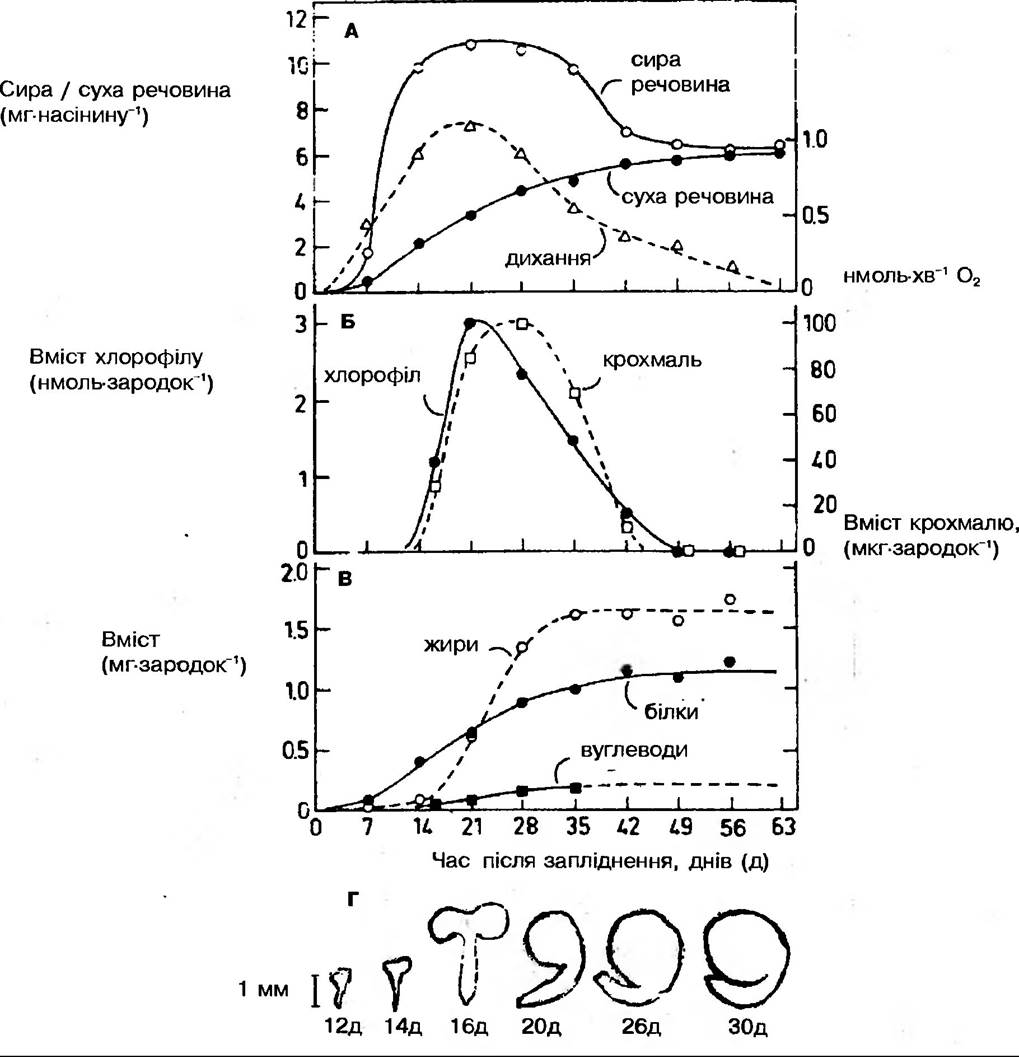
Fig. 196. Dynamics of the fresh/dry matter ratio, Respiration intensity (A), chlorophyll and starch content (B), fats, proteins, and carbohydrates (C) during seed formation, along with seed dimensions (D)
For instance, in winter wheat, starting from the stem elongation stage, There is a continuous decrease in organic nitrogen content in the vegetative parts and its outflow toward the intensively developing ear (Musienko, 1985). During ear ripening, the absolute content of fiber, hemicellulose, and Lignin decreases in the leaves and stems; along with photoassimilates, these compounds are also utilized for the synthesis of grain starch and hemicellulose.
In parallel with the regrouping and reorganization of organic substances among specific PARTS OF THE plant organism, morphological changes are also observed: the green color gradually changes, first acquiring a grayish tint, then turning yellow and eventually transitioning to golden-yellow.
In the seeds of monocotyledonous and dicotyledonous plants, within the endosperm and cotyledons, the absolute and relative content of proteins, Polysaccharides, and storage Lipids continuously increases; water loss leads to a reduction in colloid hydrophilicity, and the absolute weight of the grains increases by 2.5-3 times compared to the wax-ripe stage.
Thus, synthetic processes and the gradual dehydration of seeds predominate during cereal ripening.
As a rule, ripe seeds cannot germinate immediately. Over the course of one to two months, and in some plants 5 to 6 months, seeds undergo post-harvest ripening processes while in a state of physiological dormancy.
It should be noted that seed germination on the parent plant is occasionally observed (Fig. 197).
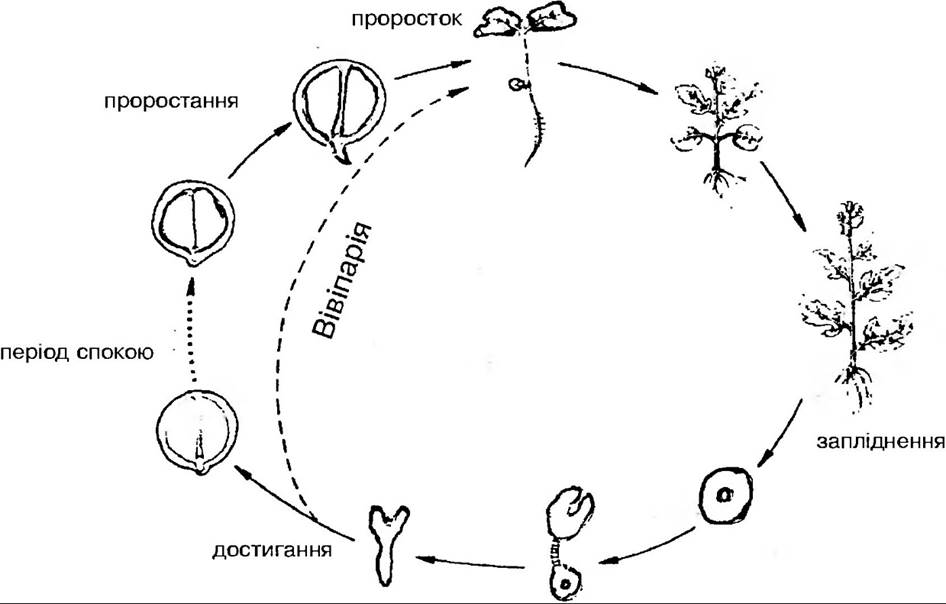
Fig. 197. Formation and germination of seeds in the ontogeny of higher plants
This phenomenon is known as vivipary (from Latin *viviparus* — live-bearing). Generally, this phenomenon is characteristic of mangrove trees (Rhizophora, Avicennia), in which the hypocotyl of the seedling with the embryonic root emerges from the developing fruit. The seedlings reach a length of 50-70 cm, detach, and anchor themselves in the soil. Quite similar to vivipary is "sprouting on the vine" (pre-harvest sprouting) in cereal crops under certain conditions (high humidity, especially during two-phase harvesting of grain crops when they remain in cut swaths for a prolonged period). However, in such cases, mature grains that have already lost their physiological connection with the parent plant germinate.
Ripening of Succulent Fruits
The cessation of fruit growth coincides with their ripening. The ripening of succulent fruits is accompanied by a decrease in the acid-to-sugar ratio, The formation of Aromatic Compounds, The breakdown of chlorophylls and Tannins, the accumulation of anthocyanins, and the softening of their Tissues due to the Hydrolysis of Cell wall pectic substances. During this period, the respiration rate of pericarp tissues rises sharply (Climacteric respiratory rise), accompanied by enhanced Ethylene synthesis. The Effect of exogenous ethylene accelerates ripening processes, confirming its role as a phytohormone that stimulates fruit maturation. Interestingly, the dynamics of sugar accumulation during ripening varies among different plant species. For instance, in tomatoes, the sugar content increases due to Monosaccharides with an almost unchanged sucrose content. In melons, conversely, the sucrose content increases, while the amount of monosaccharides and starch content remains nearly constant. The fruit becomes soft and fragrant. Fruit firmness also depends on the presence of pectic substances and tannins. In green tomatoes, the insoluble fraction of pectic
substances accounts for 2/3 of the total pectin content; in ripe fruits, this content drops to 4%. This indicates that pectin hydrolysis products are utilized in METABOLISM during ripening. As the fruit pericarp ripens, The activity of many Enzymes changes, and alterations in pigment composition are observed. For instance, lycopene appears in tomatoes, and carotene in apricots. During the ripening period, most fruits acquire a characteristic aroma due to the presence of esters, the synthesis of which proceeds with the consumption of a significant amount of oxygen. Vitamin C accumulates, and its Biosynthesis also requires the presence of oxygen.
The completion of ripening processes is accompanied by the formation of an abscission layer in the fruit stalk and fruit drop. The Formation of the abscission layer is induced by a decrease in auxin levels and a high concentration of ethylene.
Ripening of Tubers and Root Crops
The ripening of such productive plant parts as tubers and root crops has its own specific features. Let us examine The process of storage substance accumulation in potato tubers and sugar beet roots.
In most potato varieties, tuberization begins during the budding period, whereas during the ripening period, the synthesis of starch and proteins takes place. The outflow of plastic substances to the tubers continues until the leaves and stems die off completely. In the summer period (July–August), the starch content increases on average by 3-4% every ten days. Ripe potato tubers have a significant vitamin content (in mg% per fresh weight of tubers): vitamin C (10-12), PP (0.4-2.0), B6 (0.9-1.0), B1 (0.05-2.0), and vitamin B2 (0.1-0.2). Glycoalkaloids, particularly solanine, are also synthesized. They accumulate in the tuber peel, and levels exceeding 20 mg% are harmful to humans and animals. Growing conditions significantly influence The chemical composition of tubers.
In sugar beet root crops, the main component of storage substances is sucrose, the content of which averages 16-21%. Sucrose accounts for 80 to 90% of all sugars in the root crops. The disaccharide maltose (1-2%), the trisaccharide raffinose, and monosaccharides such as glucose and fructose (up to 1%) are also present in minor quantities.
Another important component of ripe root crops is pectic substances in the form of water-insoluble protopectin, the content of which is 1.5-2% of the root mass. Physiologically mature root crops also contain nitrogenous compounds (0.15-0.25%), starch (0.006-0.1%), organic acids (3-5%), and Cellulose (about 1%).
Metabolism during the ripening process depends on numerous factors; however, the decisive ones that determine the Qualitative and quantitative Variability of the Chemical composition of plant organisms are humidity, warmth, organic and mineral fertilizers, and agrotechnical practices. Overall, crop quality depends on the soil and climatic conditions of plant cultivation.
Thus, angiosperms are the most highly organized higher plants. They differ from other plants by double fertilization, the formation of a fruit with seeds, a pistil that protects the ovules, and the presence of a flower adapted for cross-pollination. Flowering plants exhibit a further reduction of gametophytes. As a result of double fertilization, they form an endosperm that provides Nutrition to the embryo during its development, which enhances the vitality of the new plant.
Last update: 07/08/2026
Editorial and Educational Adaptation: This material has been compiled based on the primary/original source text. The project team performed an editorial review, corrected technical inaccuracies, structured sections, and adapted the content for an educational format.
What was processed:
- elimination of formatting defects (OCR errors, structural breaks, corrupted characters);
- editorial organization of content;
- standardization of terminology in accordance with academic sources;
- verification of factual statements against the original source text.
All mentions of the author, publication year, and origin of the primary text have been preserved in accordance with the source.