Plant Physiology - Musienko, M. M. 2001
Physiology of Plant Growth and Development
Plant Regeneration
The capacity for regeneration is widespread among plant organisms. When an Organism reaches a certain size, growth does not cease. Instead of Cells and Tissues lost due to Aging or injury, the division and differentiation of new cells are continually stimulated, leading to the restoration of damaged tissues.
Regeneration (from Latin regeneratio — restoration) refers to the process by which an organism restores lost or injured Organs and tissues, or even rebuilds an entire organism from a part of it. For example, an entire plant can be grown from a leaf cutting of Tradescantia. The ability of plants to regenerate forms The basis of vegetative propagation and plant micropropagation technology. Regeneration is quite common among many angiosperm species.
Based on its mechanisms, regeneration is classified into physiological and traumatic (or reparative). An example of physiological repair in higher plants is the continuous turnover of ROOT cap cells, xylem cells in conducting vessels, or epidermal tissues.
When specific parts of a plant are injured, traumatic (or reparative) regeneration is observed. Regeneration occurs via Meristems; if these are absent, cells of specialized tissues in the zone of mechanical damage undergo dedifferentiation and acquire The ability to divide. Cells adjacent to the wound begin to divide periclinally, producing new cells toward the wound. Subsequently, a phellogen forms on the injury surface, which generates a protective tissue called the periderm. Wounds are also healed by the overgrowth of callus tissue. Callus consists of irregularly dividing parenchyma cells. The induction of histogenesis or Organogenesis within it is determined by The ratio of phytohormones. Specific Cell-to-cell interactions are also likely one of the causes of histogenesis and subsequent somatic Embryogenesis.
If an intact organism is broken down along a gradient of increasing disintegration: plant → its part → organ → tissue → cell, the regenerative activity increases correspondingly (Fig. 166), as does the capacity to restore the whole—that is, the totipotency of The plant cell (Kalinin et al., 1992).
The process of protoplast regeneration, for instance, begins just a few hours later with the restoration of The Cell wall. Under appropriate conditions, it is easy to obtain in vitro calli from many specialized differentiated cells: SHOOT apices, the gametophyte of spore-bearing plants and gymnosperms, leaves, Ovaries, endosperm, and pollen. However, obtaining callus tissue from an egg cell and an embryo sac is quite difficult.
Tissues and organs can also regenerate via cell dedifferentiation, but without callus formation. In a damaged stem, conducting tissue is regenerated from parenchymal cells through the activation of specific genetic programs, with polar auxin transport acting as the inducer. The activity of apical and lateral meristems is also one of the pathways for restoring lost plant parts.
Class="center">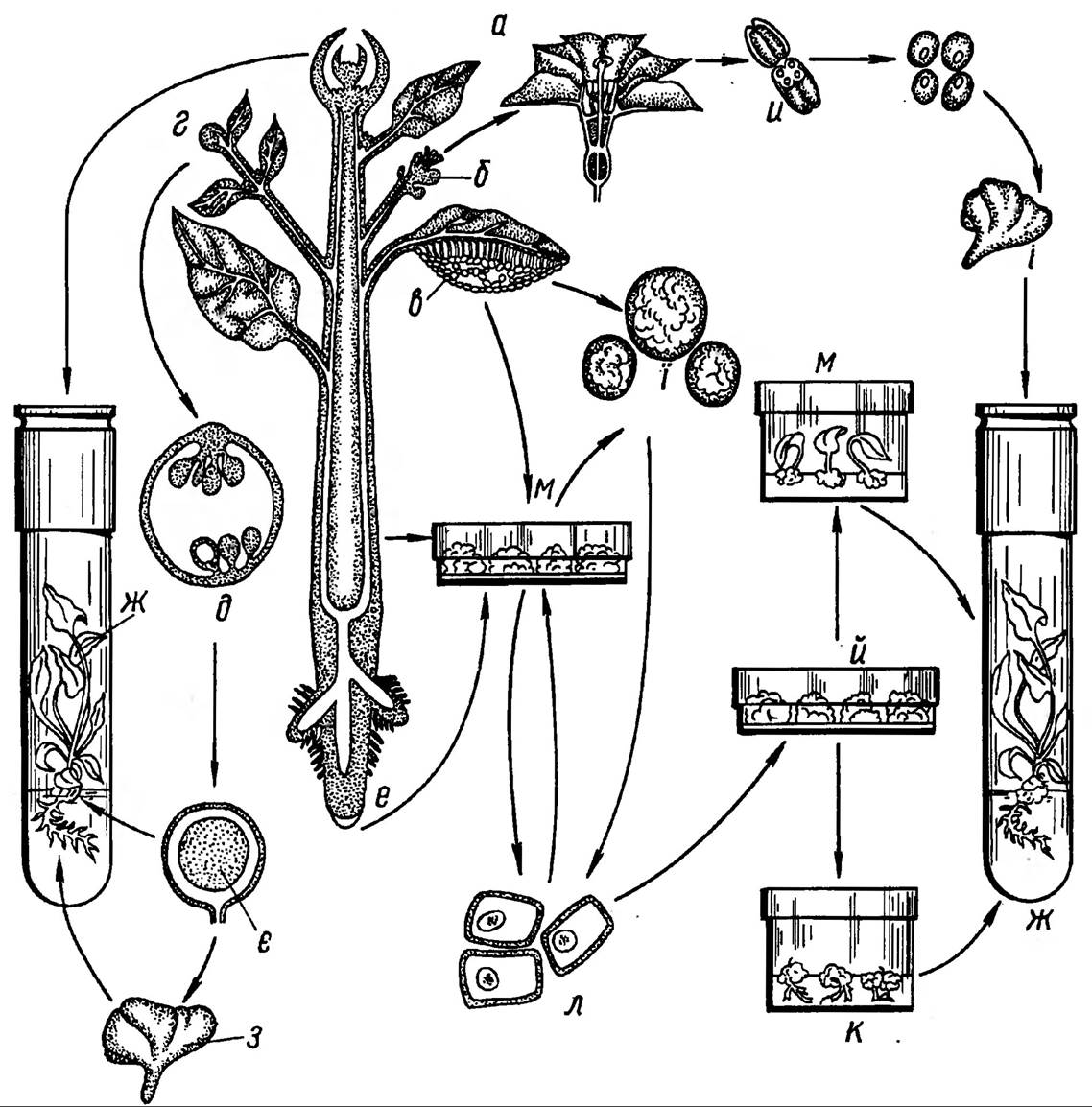
Fig. 166. Pathways of plant organism regeneration: a — shoot apex, б — flower, в — leaf, г — fruit, д — seed, е — root tip, є — embryo, ж — regenerated plant, з — diploid embryoid, и — anther, і — haploid embryoid, і — protoplasts, й — callus, к — regenerated roots, л — individual cells, м — shoots
Organogenesis is also possible from dormant embryos when the dominant role of the apical bud disappears. It can also be observed from newly formed adventitious embryos due to latent meristems. Cuttings of most plants are capable of rooting, with adventitious roots developing from cells of tissues such as the cambium, phellogen, pericycle, and medullary rays.
The capacity of plant somatic cells to regenerate a whole organism forms the basis for applying isolated cell culture to obtain large populations of plants from a single haploid genetic line, isolate cell clones with altered METABOLISM, resistance to adverse conditions, diseases, and pests, and for micropropagation.
The various types of regeneration examined provide the plant organism with a high degree of reliability under changing growth conditions.
The phenomenon of regeneration is of both theoretical and practical interest. Theoretically, regeneration—meaning the redevelopment of tissues, organs, or an entire organism—serves as an excellent model for studying the mechanisms of histogenesis and morphogenesis (Fig. 167). Practically,
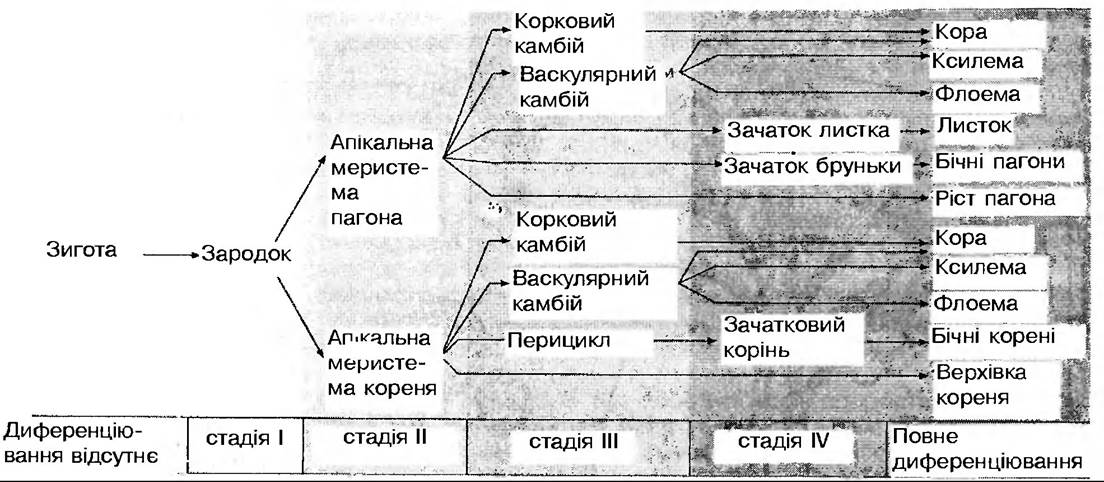
Fig. 167. Stages of plant differentiation
various techniques based on the principles of regeneration have found wide application in crop production, particularly in the propagation of fruit and other crops via cutting rooting, and especially in clonal micropropagation (the multiplication of genetically identical cultures in cell and tissue culture). Micropropagation significantly reduces the land area required for plant cultivation, and tissue cultures can be maintained year-round. Clonal micropropagation accelerates the breeding process, allows for the rejuvenation of valuable varieties by freeing them from pathogens and Viruses, and enables the creation of cryobanks for cultures with valuable genetic traits.
Last update: 07/08/2026
Editorial and Educational Adaptation: This material has been compiled based on the primary/original source text. The project team performed an editorial review, corrected technical inaccuracies, structured sections, and adapted the content for an educational format.
What was processed:
- elimination of formatting defects (OCR errors, structural breaks, corrupted characters);
- editorial organization of content;
- standardization of terminology in accordance with academic sources;
- verification of factual statements against the original source text.
All mentions of the author, publication year, and origin of the primary text have been preserved in accordance with the source.