Plant Physiology - Musiyenko, M. M. 2001
Physiology of Plant Growth and Development
The Phenomenon of Polarity in Plants
Polarity refers to the physiological inequality of opposite poles (apex/base) in a given Cell, organ, or whole plant. It should be viewed as a specific spatial differentiation of processes and structures inherent to plants. In this context, physiological-biochemical and anatomical-morphological differences vary in a definite direction, causing the opposing sides of the plant Organism to differ.
For instance, a meristematic cell is polar simply by virtue of its Location, having a distinct top and bottom. Consequently, if subsequent division occurs perpendicularly to the axis of polarity, the daughter Cells will differ in their physiological and structural features, cytoplasmic hereditary factors, and the distribution of phytohormones regulating genome activity, among other aspects. This occurs despite the equal distribution of genetic material (DNA) between the daughter cells. Organ formation is likewise polar; for example, roots on cuttings invariably develop at the lower end. Polarity is manifested in the directional growth of stems and roots, as well as the directed Transport of substances. It may also be determined by the uneven distribution of electrical charges: the SHOOT apex carries a positive charge relative to the base, and the stem core relative to its surface.
Cellular interactions significantly influence the establishment of polarity. The induction of polarity through METABOLISM/18.html">The Influence of neighboring cells is known as the "field effect." Surrounding cells can direct this formation via asymmetric chemical, mechanical, or electrical signaling.
The polarity of an organism originates from the polarity of the fertilized egg cell from which it develops. During Cell Division, daughter cells inherit the polarity of the mother cell. This phenomenon ensures the precise spatial orientation of processes and structures, establishing morphophysiological gradients. In higher plants, polarity is already evident in the zygote and the developing embryo, where the two primary embryonic Organs—the shoot with its embryonic bud and the ROOT—are formed. Phytohormones play a leading role in driving polarization processes.
Polarity is especially pronounced during regeneration. For example, in stem or root cuttings, regardless of their spatial orientation, shoots develop from the end apical to the stem, while roots develop from the basal end (Fig. 168).
As seen in this figure, this property is also characteristic of single cells. The rhizoid of green Algae forms at the lower end, whereas the thallus forms at the upper end. This is because Auxins undergo polar, basipetal transport, accumulating at the morphologically lower end of the cutting, thereby triggering the genetic program for rhizogenesis.
Cellular polarity is a prerequisite for orderly differentiation, with the cells of a given organ sharing a uniformly oriented polarity. However, certain PARTS OF THE plant organism, such as
Class="center">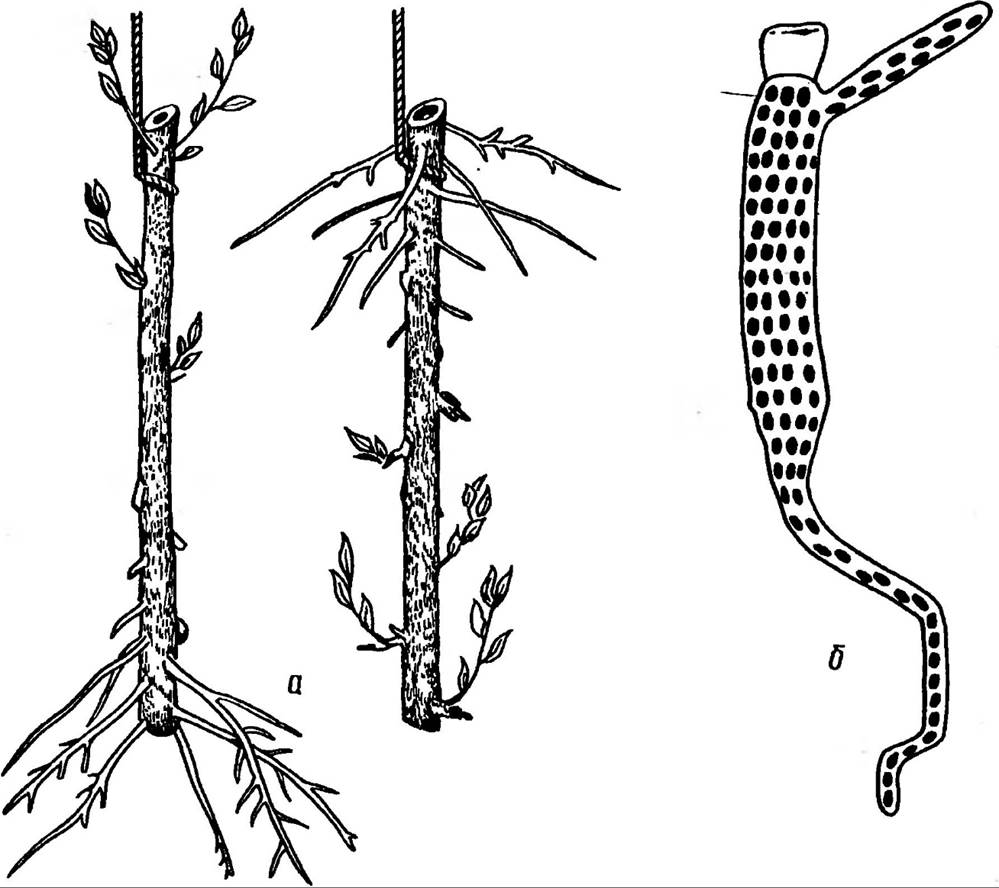
Fig. 168. Polarity of root and bud regeneration in willow stem cuttings (a), and thallus and rhizoid formation in an isolated Cladophora cell (b)
tubers and fruits, lack polarity entirely or exhibit it only weakly. In higher plants, established polarity is stable and irreversible.
Last update: 07/08/2026
Editorial and Educational Adaptation: This material has been compiled based on the primary/original source text. The project team performed an editorial review, corrected technical inaccuracies, structured sections, and adapted the content for an educational format.
What was processed:
- elimination of formatting defects (OCR errors, structural breaks, corrupted characters);
- editorial organization of content;
- standardization of terminology in accordance with academic sources;
- verification of factual statements against the original source text.
All mentions of the author, publication year, and origin of the primary text have been preserved in accordance with the source.