MODERN BOTANY - P. RAVEN - 1990
SECTION III. GENETICS
CHAPTER 8. CHEMISTRY AND HEREDITY
Conclusion
The key to understanding the mechanisms of heredity came from molecular-level research in the early 1950s that uncovered The Role of DNA. A compelling body of evidence pointed directly to DNA as the repository of Genetic information, culminating in the 1953 discovery of its molecular model by James Watson and Francis Crick. This breakthrough catalyzed rapid advancements in Molecular Genetics, allowing the intricate workings of the cellular genetic machinery to be described in considerable detail.
During METABOLISM/36.html">DNA Replication, a complementary daughter strand is synthesized on each template strand. A complex of Enzymes acts in concert to unwind the DNA supercoils, untwist The Double Helix, and incorporate new bases into each of the two forming daughter strands.
Genetic information is conveyed by Messenger RNA (mRNA). Long molecules of mRNA are synthesized via complementary base pairing along a single DNA strand and are subsequently transported to cytoplasmic Ribosomes. This tightly regulated process is known as Transcription. A sequence of three NUCLEOTIDES within the mRNA molecule serves as a codon specifying a particular amino acid.
At the ribosomes, mRNA interacts with smaller molecules known as Transfer RNAs (tRNAs), each attached to a specific amino acid. Every tRNA features a three-base sequence—the anticodon—complementary to an mRNA codon. The tRNA molecule binds to the mRNA via this complementary anticodon, while its cargo amino acid is attached to the terminus of the growing polypeptide chain. Through the action of specialized enzymes, The amino acid is then linked to the protein chain by a peptide bond. This Protein Synthesis process is called Translation. Each of the 20 Amino Acids is encoded by a base triplet (codon) in the mRNA. The Amino Acid Sequence of a protein is determined by The sequence of codons in the mRNA molecule, which directs the synthesis of that specific protein. Ultimately, the sequence of the mRNA codons depends on The base sequence of the DNA from which it was transcribed. Most amino acids are specified by three or four alternative codons, each recognized by its own corresponding tRNA.
Not all genetic material encodes the Amino acid sequences of Proteins. A significant portion of the genetic information in eukaryotic nuclear mRNA is transcribed from DNA segments called introns; these segments are excised from the mRNA transcript prior to its export into the Cytoplasm. The remaining mRNA fragments, transcribed from DNA regions known as exons, are spliced together within The Nucleus before the mRNA enters the cytoplasm.
The Introduction/30.html">Regulation of Gene Expression in certain bacterial systems, such as the lac Operon of Escherichia coli, is straightforward: one system activates transcription in the presence of a potential substrate, or inducer (lactose), whereas another halts transcription when the end-product (glucose) is present in excess. In eukaryotes, developmental pathways are considerably more complex.
In plants, gene transcription is closely coupled with development and proceeds in a phased manner, with each stage corresponding to a distinct pathway of cellular differentiation. These pathways are reversible and influenced by environmental cues. In principle, any differentiated plant Cell that retains a nucleated protoplast can undergo dedifferentiation and be stimulated to regenerate an entire plant.
Appendix 1. Right-Handed and Left-Handed Helices
The continuous DNA double helix described by J. Watson and F. Crick twists to the right (shown on the right). However, in the late 1970s, Alex Rich and his colleagues at the Massachusetts Institute of Technology discovered a second stable DNA configuration, namely a left-handed helix (shown on the left). The discovery of these two DNA forms was made possible by advances in chemical analysis techniques. In the models depicted, the "backbone" of the DNA polynucleotide chains is represented by a black line. In left-handed DNA, the backbone has a zig-zag conformation, which is why this form is designated as Z-DNA. Under certain conditions, Z-DNA and B-DNA (the right-handed form) can interconvert. Research has shown that the presence of Z-DNA correlates with the regulated transcription of specific genes.
Class="center">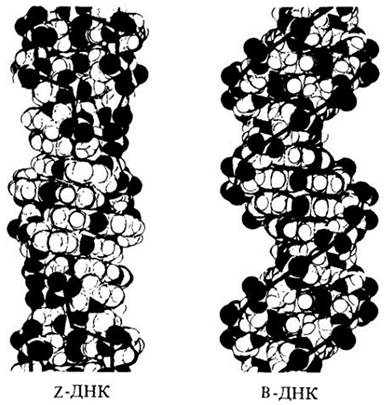
Appendix 2. Control of Multicellular Differentiation
Differentiation is a developmental process during which relatively unspecialized Cells or Tissues undergo gradual changes to become more specialized in Structure and function. A classic, well-studied model system illustrating this process is the cellular slime mold Dictyostelium discoideum. Its life cycle clearly demonstrates how environmental factors acting on developing cells or tissues can ultimately influence the phenotypic traits of the mature Organism.
Cellular slime Molds typically exist as free-living amoeboid cells, or myxamoebae, which feed on Bacteria by surrounding and engulfing them (see Fig. 4-11). They reproduce by fission and exhibit minimal morphological differentiation until their bacterial food supply is exhausted. In response to starvation, the cellular slime mold produces spores. Individual cells first aggregate to form a mobile, slug-like mass called a pseudoplasmodium. Before forming and dispersing spores, the pseudoplasmodium migrates to a new Location. This remarkable stage of The life cycle prevents spores from being stranded in their original site where the bacterial supply has been depleted.
Aggregation of myxamoebae is triggered when one or more starving cells begin to secrete cyclic adenosine monophosphate (cAMP) into the environment. This molecule diffuses and establishes a concentration gradient that prompts surrounding cells to move toward the source of cAMP. In turn, the secreting cells are stimulated to release a fresh pulse of cAMP at roughly five-minute intervals; thus, incoming cells arrive in at least three distinct waves. As the cells converge on the aggregation center, their Plasma Membranes become adhesive and bind to one another, resulting in The formation of a pseudoplasmodium enclosed within a Cellulose sheath.
A. Feeding amoebae. The light-gray areas in the center of each cell are nuclei, and the white areas are contractile vacuoles. B. Amoeboid aggregation. The direction of movement is indicated by the arrow. C. Migrating pseudoplasmodia composed of numerous amoebae. Each slug-like cell mass lays down a thick, dense slime sheath around itself. D. Upon completion of migration, the pseudoplasmodium grows vertically, differentiating into a stalk and numerous spores gathered in a droplet (D)
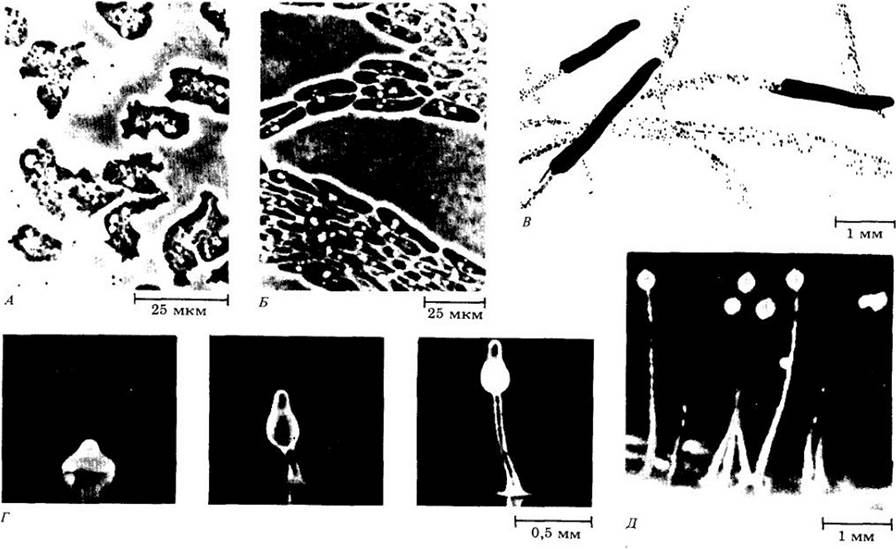
The ultimate fate of an individual cell during development is determined by its position within The Cell aggregate. The cells that aggregate first typically give rise to the anterior region of the pseudoplasmodium, whereas those that join last form its base. When migration ceases, the cells at the apical end form the stalk of the developing "fruiting body." Subsequently, the cells from the posterior region of the pseudoplasmodium move up the stalk and differentiate into spores. Finally, the basal disk and stalk cells die, and the spores are dispersed. Upon encountering a warm, moist substrate, the spores germinate. A single myxamoeba emerges from each spore, and the cycle repeats (see also Chapter 14).
Thus, even in this relatively simple eukaryotic system, we observe directed cell migration, localized cell death, and "tissue" recognition. Far more complex systems with even tighter regulatory control characterize cellular differentiation in plants.
Last update: 07/08/2026
Editorial and Educational Adaptation: This material has been compiled based on the primary/original source text. The project team performed an editorial review, corrected technical inaccuracies, structured sections, and adapted the content for an educational format.
What was processed:
- elimination of formatting defects (OCR errors, structural breaks, corrupted characters);
- editorial organization of content;
- standardization of terminology in accordance with academic sources;
- verification of factual statements against the original source text.
All mentions of the author, publication year, and origin of the primary text have been preserved in accordance with the source.