MODERN BOTANY - P. RAVEN - 1990
SECTION III. GENETICS
CHAPTER 9. EUKARYOTIC GENETICS
While the majority of research into the MOLECULAR MECHANISMS OF heredity has been conducted on Bacteria, in this chapter we focus our attention on eukaryotic genetics (primarily of plants). The field of genetics under Structure/133.html">Discussion deals with relatively discrete traits and their Genetic control; it is commonly referred to as Mendelian genetics in recognition of the pioneering work of Gregor Mendel (Fig. 9-1).
Class="center">Fig. 9-1. Gregor Mendel (1822–1884), standing on the right holding a fuchsia. He conducted his research in the garden of an Austrian monastery. His work in genetics was neither understood nor accepted by his contemporaries, receiving widespread recognition only in 1900.
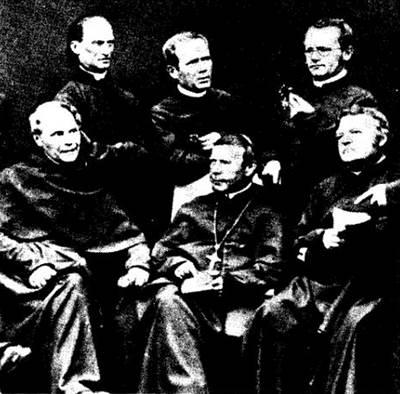
Mendel outlined the fundamental laws of genetics in 1865, yet his discoveries remained largely unappreciated for more than 30 years.
We will also examine how Mendelian genetics relates to evolutionary theory. Charles Darwin wrote his seminal work, On THE ORIGIN OF Species1), without any knowledge of Mendel's research, even though these two extraordinary scientists were contemporaries. Nevertheless, evolutionary studies In the second half of the twentieth century draw almost equally upon the principles established by Mendel and the teachings of Darwin.
1) The full title of Darwin's work is: On the Origin of Species by Means of Natural Selection, or the Preservation of Favoured Races in the Struggle for Life.
Comparison of Eukaryotes and Prokaryotes
One of the primary distinctions between eukaryotes and prokaryotes is that most eukaryotic organisms undergo a sexual cycle, a feature absent in bacteria. Although certain eukaryotes also reproduce asexually, it is evident that most such organisms lost sexual reproduction secondarily over the course of evolution.
Sexual reproduction involves the regular alternation of Meiosis and syngamy. Meiosis is a nuclear division process in which the chromosome number is reduced from diploid (2n) to haploid (n). During meiosis, The Nucleus of a diploid Cell undergoes two successive divisions, one of which is reductional. These divisions result in The formation of four daughter nuclei, each containing half the chromosome number of the original nucleus. In plants, meiosis occurs during spore formation within flowers, cones, and similar structures; most plants, as we know, are diploid, with the exception of mosses and liverworts. Syngamy, or Fertilization, is the process by which two haploid Cells (Gametes) fuse to form a zygote. Syngamy thus restores the diploid chromosome number. All organisms discussed in this chapter are diploid for the major part of their life cycle. Diploid organisms possess two sets of Chromosomes, one inherited from each parent. Corresponding chromosomes that pair up during meiosis are called homologous chromosomes, or homologues. The interaction of products encoded by the genes in each chromosome set determines the genetic traits of diploid plants or animals.
Last update: 07/08/2026
Editorial and Educational Adaptation: This material has been compiled based on the primary/original source text. The project team performed an editorial review, corrected technical inaccuracies, structured sections, and adapted the content for an educational format.
What was processed:
- elimination of formatting defects (OCR errors, structural breaks, corrupted characters);
- editorial organization of content;
- standardization of terminology in accordance with academic sources;
- verification of factual statements against the original source text.
All mentions of the author, publication year, and origin of the primary text have been preserved in accordance with the source.