MODERN BOTANY - P. RAVEN - 1990
SECTION II. ENERGY AND LIVING CELLS
CHAPTER 5. THE FLOW OF ENERGY
Cofactors of Enzymatic Activity
As a rule, the catalytic activity of many Enzymes depends on their Cell/13.html">Protein Structure. However, many enzymes can only exhibit activity in the presence of one or more non-protein components known as Cofactors.
Ions as Cofactors
Ions serve as cofactors for several specific enzymes. For example, magnesium ions are essential for the majority of Enzymatic reactions involving the Transfer of phosphate groups between molecules. The two positive charges of Mg2+ hold the negative phosphate groups in a precise orientation. Other ions (such as Na+ and K+) play a similar role in different reactions. In certain cases, ions assist in binding enzymatic Proteins together.
Non-protein organic cofactors, referred to as coenzymes, frequently play a vital role in enzymatic reactions. For instance, in certain oxidation-reduction processes, electrons are transferred to a molecule that acts as an electron acceptor. Every cell contains several distinct electron acceptors, each specifically tailored to hold an electron at a particular energy level. An example is nicotinamide adenine dinucleotide (NAD), shown in Fig. 5-8.
Class="center">Fig. 5-8. Nicotinamide adenine dinucleotide in its oxidized form (NAD+) and reduced form (NADH)
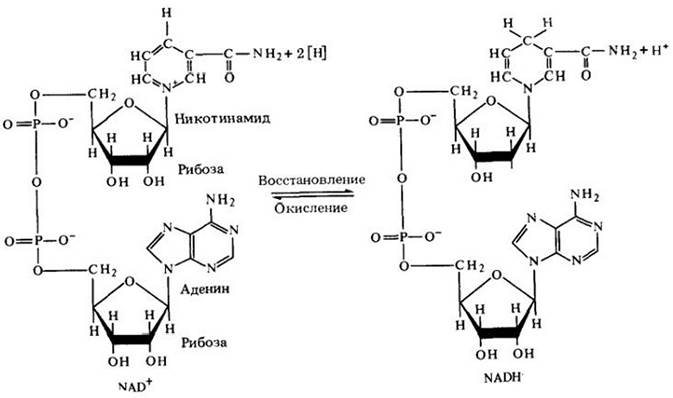
At first glance, NAD appears complex and unusual, yet it is composed of quite familiar components of biological molecules. Two five-carbon sugars (riboses) are joined by two phosphate groups. One of the sugars is linked to adenine (a nitrogenous base), and the other to a different nitrogenous base, nicotinamide. (A nitrogenous base bonded to a sugar and a phosphate group is called a nucleotide, while a molecule combining two NUCLEOTIDES is a dinucleotide.) The nicotinamide ring—the active end of NAD—accepts electrons. Nicotinamide is a vitamin known as niacin. Vitamins are compounds required in small quantities by many living organisms; humans and animals cannot synthesize vitamins and must obtain them through their diet. Human Cells can synthesize NAD provided that nicotinamide is present in the diet. Many vitamins function as coenzymes or parts of coenzymes.
Nicotinamide adenine dinucleotide, much like many coenzymes, undergoes cyclic transformations. Thus, NAD+ is regenerated when NADH + H+ passes its electrons to another acceptor. Consequently, the actual pool of NAD molecules remains relatively small, despite its involvement in numerous cellular reactions.
Some enzymes utilize cofactors tightly bound to the protein. These include so-called prosthetic groups, such as the iron-sulfur cluster in ferredoxins (p. 100) or Pyridoxal phosphate (vitamin B6) in transaminases.
Metabolic Pathways
Enzymatic work proceeds in an orderly, multi-step sequence known as a metabolic pathway. Consequently, chemical processes in living organisms operate with remarkable efficiency. First, very few waste products accumulate, because the product of one reaction is immediately consumed by the next, and so on throughout the pathway. The second advantage of sequential reactions becomes clear when we consider that Chemical Reactions can proceed in either direction—that is, they are reversible. If each individual reaction product is consumed as soon as it is formed, the tendency toward reaction reversal is minimized. Furthermore, if a potential end product is utilized just as rapidly, the entire series of reactions is driven toward completion. Another advantage is that groups of enzymes involved in shared Metabolic pathways can associate within The Cell. Some are found in small cytoplasmic vesicles (membrane-bound bubbles), while others attach to the membranes of specialized Organelles such as Mitochondria or METABOLISM/14.html">Chloroplasts.
Regulation of Enzymatic Activity
A remarkable feature of Cellular metabolism is that every cell regulates the synthesis of products essential for its normal survival, producing them in precise amounts and at appropriate rates. At the same time, the cell avoids overproduction, which would lead to a wasteful expenditure of energy and Materials. The availability of initial substrate molecules or cofactors is a primary limiting factor, and for this reason, most enzymes operate at rates well below their maximum capacity.
Temperature also affects the Rate of Enzymatic reactions. Raising the temperature increases enzymatic reaction rates, but only up to a point. As shown in Fig. 5-9, The rate of most enzymatic reactions doubles for every 10°C rise in temperature, but drops off very sharply around 40°C. The initial increase in reaction rate results from the higher kinetic energy of the reacting components; the subsequent decline is caused by internal molecular vibrations within the enzyme itself, which disrupt Hydrogen Bonds and other relatively weak interactions that maintain the molecule in its active conformation.
Fig. 5-9. Effect of temperature on the rate of an enzyme-catalyzed reaction. Enzyme and substrate concentrations were held constant. The reaction rate doubled with each 10°C rise in temperature up to 40°C, as is typical for most chemical reactions. Beyond this point, as the temperature continued to rise, the rate decreased, and at 60°C the reaction halted primarily due to enzyme Denaturation.

The pH of the surrounding solution also influences enzyme activity. The conformation of an enzyme depends on the attractions and repulsions between negatively charged (acidic) and positively charged (basic) amino acid groups. Altering the pH changes these charges, leading to shifts in the Structural Organization of the enzyme—sometimes drastic enough to render it non-functional. Perhaps the most critical effect is the alteration of charges at the Active Site and on the substrate, which impacts their ability to bind. Occasionally, certain enzymes can function at pH levels far from their optimum. It is suggested that this apparent discrepancy is not an evolutionary "flaw," but rather a mechanism for regulating enzyme activity.
Living systems possess mechanisms for switching enzyme activity on and off. Certain enzymes are synthesized in an inactive form and are activated when needed, typically by another specific enzyme. These specialized regulatory mechanisms will be discussed in Chapter 8.
The Energy Currency: ATP
All biosynthetic processes within the cell require energy (as do many other processes). A large share of this energy is supplied by adenosine triphosphate (ATP), which serves as the primary energy "currency" of the cell. Glucose, Glycogen, and starch can be likened to money sitting in a bank account, whereas ATP is the ready cash in your pocket.
At first glance, ATP is a complex molecule; however, much like NAD, its components are quite straightforward. ATP is composed of adenine, a 5-carbon sugar (ribose), and three phosphate groups. These covalently linked groups carry strongly negative charges, all of which are crucial for the energetic Functions of ATP.
To understand The Role of ATP, we must briefly review THE CONCEPT OF chemical and energetic bonds. Chemical bonds hold the atoms in a molecule together. Because they maintain a constant configuration, energy must be supplied to break them and form new ones; this is activation energy. Enzymes significantly reduce the required activation energy, allowing the metabolic reactions underlying life processes to proceed at appropriate rates. However, There is a major limiting factor for chemical reactions occurring in living systems: the bond energy of the reaction products must be less than that of the initial reactants. Following this logic alone, one might conclude that biosynthetic reactions could not take place at all. In reality, this is not the case. Cells overcome this difficulty by coupling energy-requiring reactions with energy-yielding ones. ATP is most frequently involved in these coupled reactions. Due to its structure, the ATP molecule is well-suited to play this role in living systems. When a single phosphate group is cleaved from an ATP molecule via Hydrolysis, a molecule of ADP (adenosine diphosphate) is formed and energy is released:
АТР + Н2О —> ADP + Рi1.
1Рi denotes inorganic phosphate. — Editor's note.
This reaction releases 7.3 kcal/mol of ATP as chemical energy. The removal of the second phosphate group results in the release of an equivalent amount of energy and The formation of adenosine monophosphate (AMP):
ADP + Н2O —> АМР + Рi.
The high-energy covalent bonds linking the two phosphate groups are termed high-energy bonds (Fig. 5-10). However, this term is somewhat misleading, because The energy released in these reactions does not originate entirely from the bonds themselves. The energy difference between the starting component and the reaction product is only partially due to the bond energy; it also depends on the rearrangement of electron orbitals in the ATP and ADP molecules. The phosphate groups carry a negative charge and therefore repel one another. When a phosphate group is cleaved, the electron arrangement within the molecule shifts, resulting in a lower-energy structure.
Fig. 5-10. Adenosine triphosphate (ATP) is the primary energy "currency" of the cell. The bonds between the three phosphate groups in the ATP molecule play a vital role in its function. The symbol ~ designates a high-energy bond
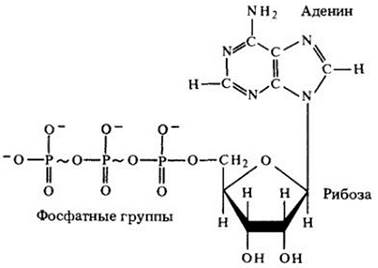
In most cellular reactions, the terminal phosphate group of the ATP molecule is not simply cleaved off, but rather transferred to another molecule. This transfer of a phosphate group is called phosphorylation, and the enzyme that catalyzes it is a kinase. Through phosphorylation, energy stored in high-energy phosphate bonds is transferred to a compound, which in turn becomes energized and can participate in subsequent reactions.
Consider, for example, the synthesis of sucrose in sugarcane, which proceeds with the participation of ATP. Sucrose is formed from the Monosaccharides glucose and fructose; under standard thermodynamic conditions, this is an endergonic reaction, requiring 5.5 kcal to produce a single molecule of sucrose:
Glucose + Fructose Sucrose + Н2О.
However, the synthesis of sucrose in sugarcane is coupled with The breakdown of ATP, making it an exergonic reaction.
Sucrose formation occurs via a specific sequence of reactions: phosphate groups are transferred to a molecule of glucose and a molecule of fructose, energizing each of them, so the overall equation is as follows:
Glucose + Fructose + 2 АТР —> Sucrose + 2 ADP + 2 Рi + Н2O.
In this reaction, 5.5 kcal is utilized for the synthesis of sucrose, but the total energy difference between the initial components and the substrates is 8.5 kcal. Thus, the synthesis of sucrose in sugarcane is coupled with the Cleavage of two ATP molecules, which are necessary to form the covalent bond between glucose and fructose.
Where is ATP produced? The energy released during cellular catabolic reactions, such as the hydrolysis of glucose, is used to "recharge" the ADP molecule. Of course, this energy ultimately originates from The Sun as radiant energy, which is converted into chemical energy during Photosynthesis. Part of this chemical Energy is stored in the high-energy bonds of ATP, which are subsequently used to form chemical bonds in organic molecules. Thus, the ATP/ADP system serves as a universal energy-coupling mechanism between endergonic and exergonic reactions.
Last update: 07/08/2026
Editorial and Educational Adaptation: This material has been compiled based on the primary/original source text. The project team performed an editorial review, corrected technical inaccuracies, structured sections, and adapted the content for an educational format.
What was processed:
- elimination of formatting defects (OCR errors, structural breaks, corrupted characters);
- editorial organization of content;
- standardization of terminology in accordance with academic sources;
- verification of factual statements against the original source text.
All mentions of the author, publication year, and origin of the primary text have been preserved in accordance with the source.