Biochemistry: The Chemical Reactions of Living Cells, Volume 2 - D. Metzler 1980
Coenzymes — specialized natural reagents
Thiamine diphosphate
Enzymatic reactions involving thiamine
All known Thiamine diphosphate-dependent reactions can be broken down into five semireactions (a–e in Fig. 8-3). Each of these is an a-Cleavage leading to The formation of a thiamine-bound "active aldehyde" (the central part of Fig. 8-3), which is identical to the compound shown on the left side of equation (8-14). The decarboxylation of an a-keto acid to an aldehyde is represented by step b, followed by a reaction in the direction reverse of step a. The best-studied enzyme catalyzing this type of reaction is Yeast Pyruvate decarboxylase. This is a Mg2+-requiring dimeric enzyme with a Molecular Weight of ~200,000 [28]. Thiamine diphosphate and Mg2+ dissociate from the enzyme at pH 8, but the active enzyme can be reconstituted at pH values below 7.
Class="center">
FIG. 8-3. Semireactions comprising thiamine-dependent a-cleavage and a-Condensation reactions (reaction type 7 in Table 9-1).
The formation of a-ketols from a-keto acids also begins with step b, followed by condensation with another carbonyl compound via the reversal of step c. A well-known example of such a reaction is the synthesis of a-acetolactate

which combines the decarboxylation of pyruvate with the condensation of the resulting active acetaldehyde with another pyruvate molecule. This reaction is catalyzed by acetolactate synthetase, sometimes referred to as "carboligase." Acetolactate serves as a precursor for valine and leucine (Fig. 14-10). A similar ketol condensation is also required in The Biosynthesis of isoleucine (Fig. 14-10). Acetolactate is a ß-keto acid and readily decarboxylates to acetoin; this reaction is of major importance in certain types of bacterial Fermentation [equation (9-28)]. The ketol condensation of two glyoxylate molecules coupled with decarboxylation is catalyzed by glyoxylate carboligase (Chap. 9, Sec. B, 2).

FIG. 8-4. Cleavage of an a-ketol to an aldehyde and a carboxylic acid; a reaction sequence coupled with ADP phosphorylation (reaction type S7A).
Another pathway for the enzymatic synthesis of ketols involves aldehyde cleavage (step a) followed by condensation with a second aldehyde (step c in reverse). a-Diketones can undergo cleavage (step d) into a carboxylic acid and an active aldehyde, which subsequently participates in a reaction corresponding to step a or step c in reverse. These and other combinations of steps are frequently observed as Side Reactions during the action of Enzymes such as pyruvate decarboxylase. A related thiamine-dependent reaction is the reaction between pyruvate and acetyl-CoA, leading to the Formation of the a-diketone diacetyl, CH3COCOSH3 [29]. This reaction can be viewed as the Displacement of the CoA anion from acetyl-CoA by an attack of the thiamine-bound active aldehyde generated from pyruvate (the reverse of step d in Fig. 8-3, with the release of CoA).
Step e in Fig. 8-3 represents the cleavage reaction of an acyldihydrolipoate derivative. The reaction normally proceeds in the reverse direction and is part of The oxidative decarboxylation process of an a-keto acid, which begins with step b (see Sec. K).
Of considerable importance is the a-ketol cleavage reaction, which utilizes step c (Fig. 8-3) followed by the reversal of this same step, but with a different aldehyde acceptor. This reaction is catalyzed by transketolase [equation (9-15)], an essential enzyme in the Pentose Phosphate Pathways of METABOLISM and in Photosynthesis. A related reaction (Fig. 8-4), which proceeds via a more complex mechanism, is catalyzed by phosphoketolase; this reaction plays a crucial role in the Energy Metabolism of certain Bacteria. The product of the phosphoketolase-catalyzed reaction is acetyl phosphate, the cleavage of which can be coupled to ATP synthesis (Fig. 8-4).
We propose that the required a-cleavage leads to the formation of a thiamine-containing compound (the top Structure in the scheme below):

Protonation of this intermediate (step a) could be accompanied by breakdown into glycolaldehyde (step b). It is generally believed that glycolaldehyde synthesis in Chloroplasts may proceed via this exact pathway as a side reaction catalyzed by transketolase (Chap. 13, Sec. D, 9, b). However, phosphoketolase catalyzes a reaction that is essentially an intramolecular oxido-reduction. The aldehyde group of the glycolaldehyde moiety is oxidized to a carboxylic acid, whereas the —CH2OH group is reduced to —CH3. One possible mechanism involves the formation of 2-acetylthiamine diphosphate as an intermediate, whereas another model is based on The addition of Pi to the double bond.
Supplement 8-G
Thiamine (Vitamin B1)
The history of the discovery and isolation of thiamine is described in Supplement 8-A. In 1937, C. Lohmann and P. Schuster isolated pure "cocarboxylase"—a dialyzable coenzyme required for the decarboxylation of pyruvate by a yeast enzyme. It was shown to be thiamine diphosphate (Fig. 8-2). Mono-, tri-, and tetraphosphates also occur in nature, but in smaller amounts.
Physical Properties. Thiamine and its coenzyme forms are white solids that are readily soluble in Water. Thiamine is commonly commercially available as the dichloride (mol. wt. 337.3), and thiamine diphosphate as the monochloride (mol. wt. 460.8).
Acid-Base Reactions. In alkaline solution, thiamine undergoes a two-step thiazole ring-opening reaction resulting in the formation of a thiol-form anion, which can be crystallized as the sodium salt:
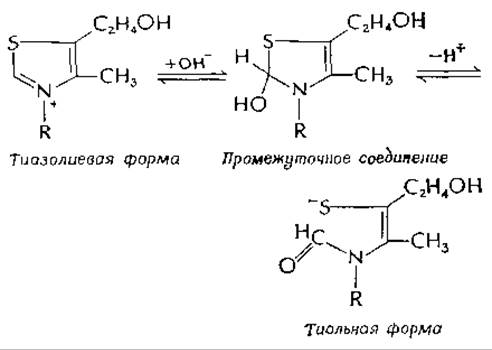
This reaction, much like the parallel reaction described in Chap. 4 [equation (4-31)] which yields a yellow, unstable form of the thiamine anion, is an example of a virtually completely cooperative elimination of two protons accompanied by structural changes. Titration experiments revealed no appreciable concentrations of any intermediate. This property is unusual for small molecules and helped Williams and co-workers correctly determine The structure of the vitamin. Do these reactions have any biological significance? The thiol form presented above, or the "yellow form" [equation (4-31)], could potentially attach to the active sites of Proteins via Disulfide Bonds. However, if such enzyme-thiamine reactions do occur, they have not yet been discovered.
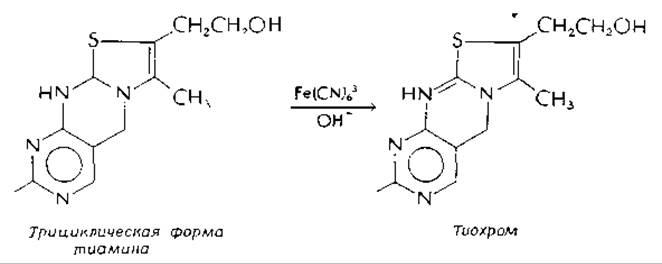
Alkaline conditions also accelerate the degradation of thiamine. Consequently, cooking food under mildly alkaline conditions destroys thiamine. The thiol form undergoes Hydrolysis and oxidation to the disulfide by atmospheric oxygen. The tricyclic form [equation (4-31)] is oxidized to thiochrome, a fluorescent compound whose formation from thiamine upon Treatment with alkaline ferricyanide forms The basis of a widely used fluorimetric assay for thiamine:
Cleavage by Sulfite. In a sodium sulfite solution at pH 5, thiamine undergoes cleavage via a nucleophilic substitution reaction at the methylene group, yielding free thiazole and a sulfonic acid. A similar cleavage is catalyzed by enzymes that degrade thiamine (thiaminases):

Analogues. Substitution of the methyl group in the pyrimidine ring with ethyl, propyl, or isopropyl groups yields compounds exhibiting some vitamin activity, whereas its replacement with hydrogen reduces the activity to 5% of the original. The butyl analogue acts as a competitive inhibitor. Treatment of thiamine with boiling 5 N HCl deaminates it into an oxy analogue, oxythiamine, which is a potent antagonist. Pyrithiamine, another competitive analogue containing a residue instead of the thiazole ring, is highly toxic, particularly to The Nervous system.

Daily requirement: at least 0.23 mg per 1000 kcal of food consumed per day, but not less than 0.8 mg/day.
Last update: 06/08/2026
Editorial and Educational Adaptation: This material has been compiled based on the primary/original source text. The project team performed an editorial review, corrected technical inaccuracies, structured sections, and adapted the content for an educational format.
What was processed:
- elimination of formatting defects (OCR errors, structural breaks, corrupted characters);
- editorial organization of content;
- standardization of terminology in accordance with academic sources;
- verification of factual statements against the original source text.
All mentions of the author, publication year, and origin of the primary text have been preserved in accordance with the source.