MODERN BOTANY - P. RAVEN - 1990
SECTION I. THE PLANT CELL
CHAPTER 4. MOVEMENT OF SUBSTANCES INTO AND OUT OF CELLS
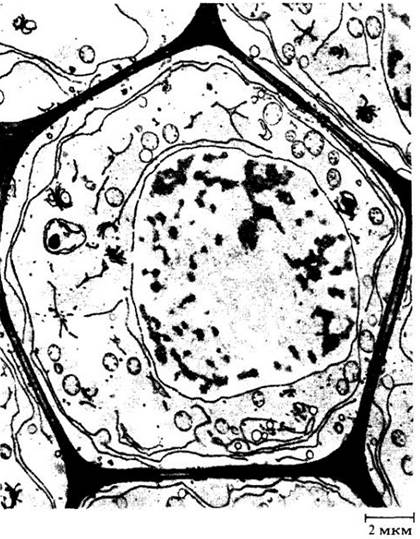
All Cells are separated from their environment by a Cell/33.html">Plasma Membrane. In addition, the interior of Eukaryotic cells is compartmentalized by an extensive system of internal membranes, including The Endoplasmic reticulum, dictyosomes, and the outer membranes of Organelles (Fig. 4-1). Cell membranes are by no means impermeable barriers, as cells can regulate both the quantity and type of substances passing through them, and frequently the direction of movement as well. This property is essential for living cells, since very few metabolic processes would proceed at the required rates if they depended solely on the concentration of substances outside The Cell. Indeed, one of the defining criteria of a living system is the difference in concentration of various substances between the System and Its environment.
Class="center">Fig. 4-1. Transmission electron micrograph of a corn (Zea mays) ROOT-tip cell. The cell was fixed with potassium permanganate, which binds selectively to Introduction/36.html">Biological Membranes, clearly revealing the endoplasmic reticulum, dictyosomes, and organelle outer membranes. These membranes regulate the Metabolic exchange between the cell and its environment and control the movement of substances from one part of the cell to another.
The Regulation of Metabolic exchange across membranes depends on the physical and Chemical properties of the membranes and the ions or molecules passing through them. Water is the primary substance entering and leaving cells.
Laws of Water Movement
The Movement of water, both in living systems and in the inanimate world, is governed by the laws of bulk flow, diffusion, and osmosis.
Bulk Flow
Bulk flow is the overall movement of water (or another liquid) driven by differences in the potential energy of water, commonly referred to as water potential.
A simple everyday example of water possessing potential energy is water behind a dam or at the top of a waterfall. As the water rushes downward, its potential energy can be converted into the mechanical energy of a waterwheel or into mechanical and subsequently electrical energy via a hydroelectric turbine (Fig. 4-2).
Fig. 4-2. Water at the top of a waterfall possesses potential energy. As the water falls, its potential energy is converted into kinetic energy, which can be harnessed to perform mechanical work.

Another source of water potential is pressure. If you enclose water in a rubber bulb and squeeze it, the water—much like the water at the top of a waterfall—will acquire water potential and move toward a region of lower water potential. Can pressure be used to force water to flow upward against gravity? Yes, it can, provided that The water potential generated by the pressure exceeds the water potential due to gravity. Water moves from a region of higher water potential to a region of lower water potential regardless of the factor creating that difference.
METABOLISM/2.html">THE CONCEPT OF water potential enables physiologists to predict the direction of water movement under various conditions. Water potential is defined as the pressure required to stop the movement of water (i.e., hydrostatic pressure) under specific conditions. Pressure is measured in bars1). (A bar is a unit of pressure roughly equal to the average atmospheric pressure at sea level.)
1 In the SI system, the unit of pressure is the pascal (Pa). — Editor's note.
Diffusion
Diffusion is a familiar phenomenon. If a few drops of perfume are sprayed in one corner of a room, the scent will gradually spread throughout the entire room, even if the air is perfectly still. If a few drops of dye are placed in one part of a vessel filled with water, the dye will slowly disperse throughout the container. This process may take a day or longer, depending on the size of the vessel, Temperature, and the size of the dye molecules.
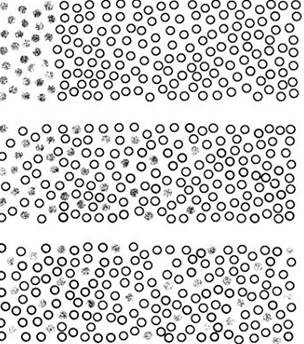
Why do dye molecules move? If you could observe individual dye molecules within the vessel (Fig. 4-3), you would see that their motion is random. Observing the speed or direction of a single molecule gives no indication of how the molecules are arranged relative to one another. So how do molecules travel from one part of the vessel to another? Imagine a thin vertical slice across the vessel. Dye molecules will constantly cross into and out of this slice, some moving in one direction, others in the opposite direction. However, you would notice that more molecules enter from the side where their concentration is higher. Why? Simply because there are more of them there. Since there are more dye molecules on the left in our scenario, more of them will randomly move to the right, even though any individual molecule has an equal probability of moving either left or right. Consequently, the net movement of dye molecules will be from left to right. Similarly, if we could observe the motion of individual water molecules in the vessel, we would record a net movement from right to left.
Fig. 4-3. Schematic representation of the diffusion process. Diffusion is the consequence of the random thermal motion of individual molecules, which ultimately results in their net movement from a region of higher concentration to a region of lower concentration. Note that while some molecules (shown in color) diffuse to the right, others move in the opposite direction. Eventually, both types of molecules will become evenly distributed. Can you explain why the net movement of molecules will diminish as equilibrium (uniform distribution) is approached?
What happens when all the molecules are distributed evenly throughout the vessel? A uniform distribution does not alter The behavior of individual molecules—they continue to move just as randomly. But now there are just as many dye and water molecules on one side of the vessel as on the other, and therefore there is no directional bias. Nevertheless, the individual thermal motion of the molecules, assuming the temperature remains unchanged, will remain the same.
The movement of substances from a region of higher concentration to a region of lower concentration is called movement down a gradient. Diffusion always occurs down a gradient. Movement in the opposite direction—toward a region of higher concentration—is movement against a gradient, which is analogous to walking uphill. The steeper the gradient, the faster the net flux. Furthermore, diffusion occurs more rapidly in gases than in liquids, and faster at high temperatures than at low temperatures. Can you explain why?
Note that in our imaginary vessel There are two gradients. Dye molecules are moving down one gradient, while water molecules are moving down the opposite gradient to meet them. In both cases, movement is down the gradient. Once the molecules are uniformly distributed—that is, once the gradients disappear—the molecules keep moving, but net movement in either direction ceases. In other words, the net Transport of Molecules is zero. We can say that the system is in a state of dynamic equilibrium.
The concept of water potential helps clarify The process of diffusion. A high concentration of a solute in a specific region—for instance, in one corner of a container—indicates a low concentration of water there and, consequently, a low water potential. If the pressure is uniform throughout, water molecules will move down their gradient from a region of higher water potential to one of lower water potential. A section of the container with pure water has a higher water potential than a section containing an aqueous solution of a solute. Once dynamic equilibrium is reached, the water potential equalizes across all PARTS OF THE container.
The essential characteristics of diffusion are: (1) each molecule moves independently of the others, and (2) these movements are random. As a result of diffusion, the diffusing substance ultimately becomes evenly distributed. In short, diffusion can be defined as the dispersal of substances through the movement of their ions or molecules, which tend to equalize their concentration within a system.
Cells and Diffusion
Diffusion is a slow process. It is effective only over very short distances, with steep concentration gradients and in relatively small volumes. For example, the rapid spread of an odor in the air occurs primarily not through diffusion, but due to air Circulation. Similarly, in many cells, the Transport of substances is accelerated by cytoplasmic streaming. Diffusion can also be enhanced by metabolic activity. For instance, in a non-photosynthetic cell, oxygen is typically consumed as soon as it arrives, causing the external concentration of oxygen to be higher. Conversely, Carbon dioxide is produced by the cell, making its internal concentration higher.
Typically, substances are synthesized in one part of the cell and consumed in another. This establishes a concentration gradient, allowing substances to diffuse down the gradient from their site of production to their site of consumption.
Organic molecules are generally polar (hydrophilic) and therefore cannot freely diffuse across the lipid barrier of cell membranes. However, carbon dioxide and oxygen, which are lipid-soluble, pass through membranes unhindered. Water also moves freely in both directions. Since water is insoluble in Lipids, biologists have hypothesized that membranes contain pores through which water and certain small ions travel.
Osmosis
While allowing water to pass, cell membranes simultaneously block most solutes dissolved in it. Such membranes are termed selectively permeable or semipermeable, and the Diffusion of Water across them is known as osmosis. Osmosis drives the movement of water from a solution with a high water potential to one with a low water potential. In the absence of other factors affecting water potential (such as pressure), the movement or diffusion of water during osmosis occurs from an area of low solute concentration (and high water concentration) to an area of high solute concentration (and low water concentration). The presence of a solute lowers the water potential, creating a gradient for water movement.
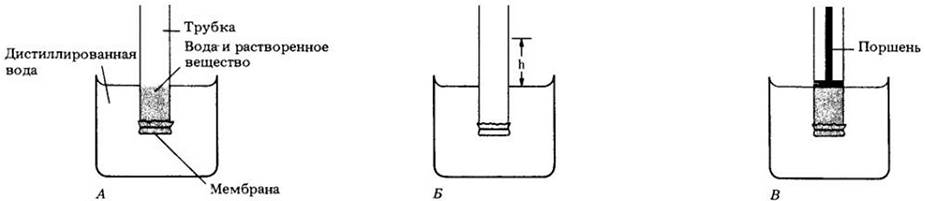
As shown in Fig. 4-4, if water is separated from a solution by a semipermeable membrane, water passes through the membrane and causes the solution in the tube to rise until equilibrium is established—that is, until the water potential on both sides of the membrane equalizes. If sufficient pressure is applied to the upper part of the tube, the influx of water can be prevented. The pressure that must be applied to the solution to stop The entry of water is called osmotic pressure. (Botanists studying plant water relations increasingly use the equivalent term “osmotic potential” instead of “osmotic pressure,” keeping in mind that osmotic potential is negative.) The term “osmotic pressure” is used to emphasize the decrease in water potential caused by the presence of solutes. Increasing the solute concentration raises the osmotic pressure and decreases the WATER POTENTIAL OF the solution.
Fig. 4-4. Osmosis and osmotic pressure. A. The tube contains a solution, and the beaker contains distilled water. B. The semipermeable membrane allows water to pass but blocks the solute. The influx of water into the tube forces the solution to rise until the osmotic pressure, generated by the movement of water toward its lower concentration, is balanced by the height (h) and density of the solution Column. C. The force that must be applied to the piston to prevent the solution from rising in the tube serves as a measure of the osmotic pressure. It is proportional to the height and density of the solution in the tube
The movement of water is determined not by the Chemical Nature of the dissolved substance, but by its quantity—the number of particles (molecules or ions) contained in the water. In short, isotonic solutions are those that contain an equal number of dissolved particles and therefore develop the same osmotic pressure. Water does not cross a membrane separating two isotonic solutions unless, of course, physical pressure is applied to one side of the membrane. When comparing solutions of varying concentrations, the one containing fewer solutes and thus exerting lower osmotic pressure is termed hypotonic, whereas the solution with more solutes and higher osmotic pressure is termed hypertonic. (Note that iso- means “the same”; hyper- means greater, in this case, more solute molecules; and hypo- means less, in this case, fewer solute molecules.)
Because solutes lower the water potential, a hypotonic solution has a higher water potential than a hypertonic one. During osmosis, water molecules cross the semipermeable membrane into the hypertonic solution until the water potential on both sides of the membrane becomes equal.
Osmosis and Living Organisms
The movement of water across The Plasma Membrane from a hypotonic to a hypertonic solution presents significant challenges for living organisms, especially aquatic ones. The complexity of these challenges depends on whether the Organism is hypotonic, isotonic, or hypertonic relative to its environment. Many single-celled organisms living in saltwater tend to be isotonic with their habitat, which solves the problem. (Similarly, the cells of higher animals are isotonic with their surrounding Blood AND Lymph.)
Many cell types are surrounded by a hypotonic environment. In some freshwater unicellular organisms, such as Euglena, the cell contents are hypertonic relative
to the surrounding water. Consequently, water tends to flow into the cell. If an excess of water enters, it can dilute the cellular contents and even rupture the plasma membrane. Excess water is removed by a contractile vacuole, which collects water from all parts of the cell and expels it outward through rhythmic contractions.
Turgor
When a plant cell is placed in a hypotonic solution, the protoplast increases in volume, the plasma membrane stretches, and pressure on The Cell wall rises. However, the cell does not burst because the surrounding cell wall is sufficiently rigid.
Plant cell vacuoles typically contain concentrated solutions of salts, sugars, organic acids, and Amino Acids. As a result, plant cells continuously absorb water via osmosis and generate internal hydrostatic pressure. This pressure, directed against the cell wall, keeps the cell firm, or turgescent. Therefore, hydrostatic pressure in plant cells is commonly referred to as turgor pressure. Turgor pressure can be defined as the pressure developed within a plant cell as a result of osmosis and/or imbibition (see Appendix). Turgor pressure is countered by an equal and opposite mechanical pressure exerted by the cell wall inward, known as wall pressure.
Turgor is especially vital for supporting non-woody plant parts. As shown in Chapter 2, plant cell growth is largely driven by water uptake, since the primary increase in cell size occurs through vacuole expansion. The hormone auxin appears to facilitate water influx by loosening the cell wall, thereby reducing its resistance to turgor pressure.
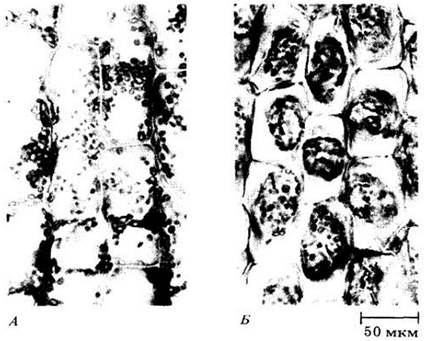
Most turgescent plant cells exist in a hypotonic environment. However, if a turgescent cell is placed in a hypertonic solution, water will leave the cell via osmosis, causing the vacuole and protoplast to shrink, which leads to the Separation of the plasma membrane from the cell wall—a process known as plasmolysis (Fig. 4-5). This process is reversible if the cell is transferred back to pure water. Figure 4-6 shows Elodea leaf cells before and after plasmolysis. Although the plasma membrane and tonoplast (the membrane enclosing the vacuole) are, with few exceptions, permeable only to water, cell walls readily allow both solutes and water to pass through. The loss of turgor in plant cells can lead to wilting as well as drooping of leaves and stems.
Fig. 4-5. Plasmolysis in a leaf epidermal cell. A. Under normal conditions, the protoplasm fills the space enclosed by the cell wall. B. When the cell is placed in a concentrated sucrose solution, water begins to flow out of the cell into the hypertonic environment, causing the plasma membrane to shrink. C. Transferred to an even more concentrated sucrose solution, the cell loses more water, and its protoplast contracts further

Fig. 4-6. Elodea leaf cells. A. Turgescent cells. B. Cells placed in a concentrated sucrose solution, showing plasmolysis
Last update: 07/08/2026
Editorial and Educational Adaptation: This material has been compiled based on the primary/original source text. The project team performed an editorial review, corrected technical inaccuracies, structured sections, and adapted the content for an educational format.
What was processed:
- elimination of formatting defects (OCR errors, structural breaks, corrupted characters);
- editorial organization of content;
- standardization of terminology in accordance with academic sources;
- verification of factual statements against the original source text.
All mentions of the author, publication year, and origin of the primary text have been preserved in accordance with the source.