BIOLOGY Volume 2 - A Guide to General Biology - 2004
16. PLANT COORDINATION AND REGULATION
16.3. Synergism and Antagonism
As research on phytohormones progressed, it became clear that they usually act in concert and that no single aspect of growth is specifically regulated by just one individual hormone. There appear to be Two Types of regulation. In some cases, two or more substances Complement each other's action, and the combined effect is often much stronger than the simple sum of their individual effects. This phenomenon is called synergism, and the substances that act in this way are known as synergists. In other cases, two regulatory substances exert opposite effects on the same process: one stimulates it, while the other inhibits it. This phenomenon is called antagonism, and such substances are called antagonists. The outcome of antagonism depends on The ratio of these opposing influences.
Below we examine several relatively well-understood processes of Plant GROWTH AND DEVELOPMENT to illustrate the roles of phytohormone synergism and antagonism.
Class="center">16.3.1. SHOOT Growth
The Effect of Gibberellins on the elongation of stems, petioles, leaves, and hypocotyls depends on the presence of Auxins.
16.20. How can this be demonstrated experimentally?
16.3.2. Cell Division and Differentiation
Cytokinins stimulate cell division only in the presence of auxins. Gibberellins also play a role in some cases, such as in the cambium, where auxins and gibberellins are supplied by nearby buds and leaves. The interaction between cytokinins and other growth substances was first demonstrated in the classical experiments of Skoog, mentioned earlier. In the 1950s, his research group investigated the effects of various concentrations of kinetin and IAA on callus growth derived from tobacco pith Cells. A high auxin-to-cytokinin ratio led to ROOT formation, whereas a high cytokinin-to-auxin ratio stimulated The formation of lateral buds, which subsequently developed into leafy shoots. Intermediate concentration ratios resulted in the proliferation of an undifferentiated cell mass (Fig. 16.26).
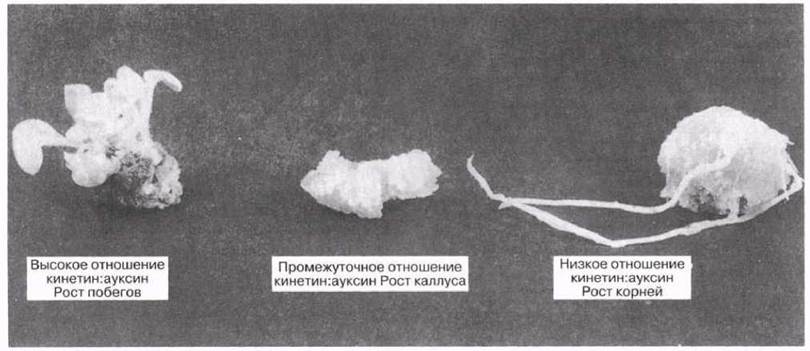
Fig. 16.26. Tobacco callus cultures. In each case, the culture medium contained IAA (2 mg/l) and varying concentrations of kinetin. The culture containing 0.2 mg of kinetin per liter (center) continued to grow as an undifferentiated callus; a lower kinetin concentration (0.02 mg/l) induced root growth, while a higher concentration (0.5 mg/l) promoted shoot development.
16.3.3. Apical Dominance
Apical dominance is the phenomenon whereby the presence of a growing apical (terminal) bud inhibits The Development of lateral buds lower down on the stem. Similarly, the growth of the main root suppresses the formation of lateral roots branching from it. Removal of the apical bud (an operation referred to in horticulture as pruning, heading back, or pinching, depending on the technique) triggers the development of lateral buds, thereby promoting stem branching. This practice is commonly used in cultivating woody shrubs and trees when a dense canopy is desired rather than vertical height.
16.21. (a) Which growth substance is produced in the shoot apex?
(b) Design an experiment to prove that this specific substance is responsible for apical dominance.
Interestingly, the auxin content in lateral buds is often not high enough to inhibit their growth directly. The exact mechanism by which auxins act here remains unclear; they may somehow "attract" nutrients toward the apex. It has been shown that in cocklebur, a drop in stem auxin concentration following pinching allows lateral buds to inactivate the high levels of ABA they contain. Gibberellins often enhance the response to IAA. However, treating lateral buds with kinetin breaks their dormancy in many cases, at least temporarily.
A mixture of kinetin and IAA overcomes this dormancy completely. Cytokinins are typically synthesized in the roots and transported to the shoots via the xylem. It is quite possible that under normal conditions, they are transported to sites of auxin production, where they jointly stimulate bud growth.
Apical dominance is a classic example of how one part of a plant controls another through specific growth substances. This interdependence of plant processes is termed correlation (Fig. 16.27).
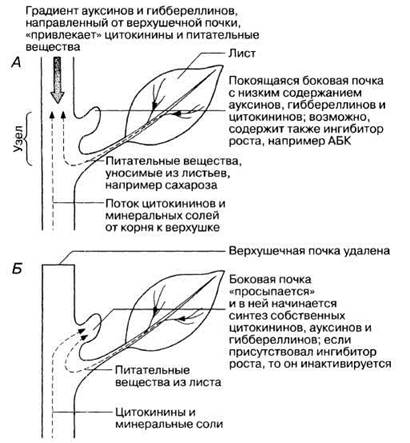
Fig. 16.27. Proposed movement of phytohormones responsible for apical dominance. A. In the presence of the apical bud. B. Following its removal.
16.3.4. Abscission
Abscission is the physiological shedding of specific plant Organs, typically leaves, fruits, and unfertilized flowers. This process involves The breakdown of the intercellular substance (middle lamellae) cementing living cells together at the Base of the organ—in the so-called abscission zone—sometimes accompanied by the concurrent degradation of their cell walls. As a result, an abscission layer is formed (Fig. 16.28). The final shedding of the organ occurs when the vascular bundles are mechanically ruptured, usually by gusts of wind. Beneath the abscission layer, a protective layer develops that prevents tissue desiccation and infection; in other words, it "seals off" the plant's vascular bundles. In woody species, this protective layer becomes suberized, forming part of the tissue produced by the cork cambium (phellogen), i.e., part of the periderm (Section 22.4).
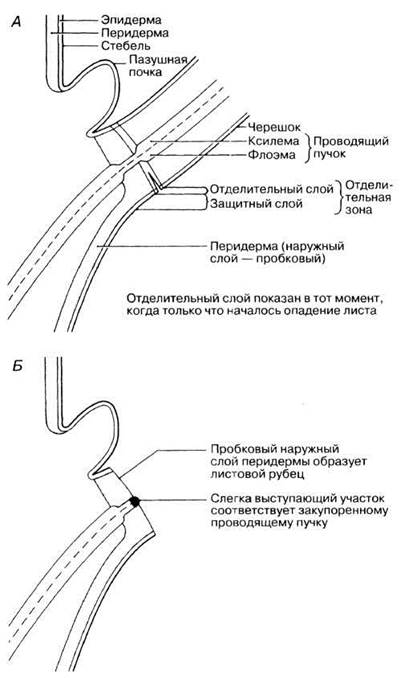
Fig. 16.28. Leaf abscission zone. A. During leaf shedding. B. After shedding.
Leaf fall in deciduous trees and shrubs in temperate zones is typically triggered by the approach of winter, whereas in the tropics it coincides with the onset of the dry season. In both cases, this phenomenon sharply reduces the plant's Water demand, as leaves are the primary organs responsible for water loss through Transpiration. (During a cold winter, soil water becomes largely unavailable because it periodically freezes into ice.) In evergreen plants, leaves are shed and gradually replaced by new ones throughout the year, typically exhibiting structural adaptations to minimize moisture loss.
It has been established that auxin synthesis is suppressed in leaves as abscission approaches. Fig. 16.29 illustrates the effect of these phytohormones on leaf abscission. Notably, once the Formation of the abscission layer has already begun, auxins appear to accelerate the process.
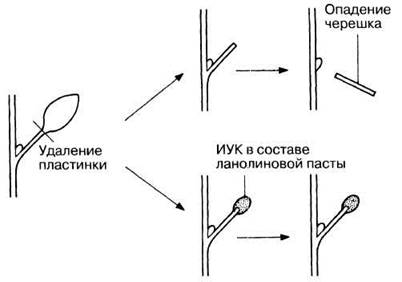
Fig. 16.29. Effect of auxin (IAA) on petiole abscission. Removal of the leaf blade leads to petiole abscission, while IAA application compensates for the absence of the leaf blade.
Abscisic acid (ABA) acts as an auxin antagonist, stimulating the abscission of certain fruits. Immature seeds synthesize auxins, but as they mature, auxin synthesis declines while ABA synthesis may increase. For example, two distinct peaks in ABA concentration have been observed in developing cotton bolls. The first coincides with the 'June drop' of young bolls, which represents natural plant thinning. At this stage, high ABA levels are found exclusively in the shedding green fruitlets. The second peak coincides with seed maturation within the bolls.
It is doubtful whether ABA directly induces leaf fall. Although high concentrations are effective in this regard, they may simply stimulate The production of Ethylene. Ethylene accumulates in senescent leaves and ripening fruits, and Treatment with this gas invariably promotes the abscission of fully developed organs. In the leaves of certain deciduous shrubs and trees, ABA synthesis occurs during the pre-winter period (Section 16.5.1), but this is likely required solely for the induction of bud dormancy.
Organ abscission is of paramount importance in horticulture, as it is closely tied to harvesting. This practical significance is reflected in the agricultural application of auxins and ABA, as discussed at the beginning of this chapter.
Some insights regarding the abscission of unfertilized flowers are discussed in the following section.
16.3.5. Pollen Tube Growth, Fruit Set and Development, Parthenocarpy
Germinating pollen grains are themselves a rich source of auxins and typically stimulate auxin production in the Tissues of the style and Ovary. These phytohormones are essential for 'fruit set', i.e., the retention of Ovaries on the plant following Fertilization. If fertilization does not occur, the flowers generally drop. Following fertilization, auxin synthesis continues in the ovary and developing seeds, driving fruit development.
In nature, the formation of fruits without fertilization—and consequently without seeds (or with 'empty' seed coats lacking an embryo)—is a rare occurrence. This phenomenon, known as parthenocarpy, is more frequently observed in cultivated plants, particularly bananas, pineapples, and seedless varieties of grapes and oranges. Their ovaries accumulate unusually high levels of auxins. Parthenocarpy can sometimes be induced artificially by treating crops such as tomatoes, squash, or peppers with these phytohormones. Producing seedless peas is also easily achieved. In some plants, such as tomatoes, gibberellins produce a similar effect and are even capable of inducing parthenocarpy in A number of species that do not respond to auxin treatments (e.g., cherries, apricots, and peaches). Developing seeds are a rich source not only of auxins and gibberellins, but also of cytokinins (Section 16.2.7). These growth promoters are primarily associated with embryo formation and the accumulation of nutrient reserves within the seed, and occasionally within the pericarp (fruit wall) as well, where they are imported from other PARTS OF THE plant.
Fruit ripening is essentially a senescence process and, in many species, is accompanied by a surge in respiratory activity known as the respiratory Climacteric. This burst in Respiration is driven by ethylene production. The roles of ethylene and ABA in fruit abscission were discussed previously in Section 16.3.4.
Last update: 06/08/2026
Editorial and Educational Adaptation: This material has been compiled based on the primary/original source text. The project team performed an editorial review, corrected technical inaccuracies, structured sections, and adapted the content for an educational format.
What was processed:
- elimination of formatting defects (OCR errors, structural breaks, corrupted characters);
- editorial organization of content;
- standardization of terminology in accordance with academic sources;
- verification of factual statements against the original source text.
All mentions of the author, publication year, and origin of the primary text have been preserved in accordance with the source.