Pharmacognosy with Basics of Plant Biochemistry - Kovalyov V. M. 2004
Special Part
Alkaloids
Medicinal plants and raw materials containing purine alkaloids
COCOA SEEDS — SEMINA CACAO
Cocoa tree — Theobroma cacao L., fam. Sterculiaceae
Chocolate tree
The Description of the plant, its distribution, and harvesting are given in the section «Lipids». The name comes from Greek *theos* meaning god and *bromoides* meaning food; the Latinized *cacao* is a distorted Mexican name for the seeds of this plant, *kakahuate*.
Chemical composition of the raw material. The kernel and seed coat contain 0.9–3% of theobromine. The seeds were also found to contain 0.05–0.36% of caffeine, 43–53% of fat, and 5–10% of Water-soluble polyphenolic compounds (epicatechin, leucoanthocyanins, and anthocyanins).
Biological activity and application. Theobromine has a weaker stimulating effect on the Central Nervous system than caffeine, but is a stronger diuretic. Cocoa powder exhibits stimulating and diuretic properties and has a high nutritional value. Cocoa butter is used in pharmacy as a base for suppositories.
COFFEE SEEDS — SEMINA COFFEAE
Arabian coffee tree — Coffea arabica L., fam. Rubiaceae
Arabian coffee tree, Arabian coffee; the name comes from the Latinized English *coffee*; Turkish *kahveh*; Arabic *gahwah*; Latin *arabicus, -a, -um* — Arabian.
Plant description. A semi-shrub or small tree, 8–10 m tall, with greenish-gray bark. The branches are long, flexible, spreading, or drooping. Leaves are entire, slightly wavy, opposite, 5–20 cm long and 1.5–5 cm wide, on short petioles. Flowers are white, fragrant, 3–7 in the leaf axils, regular, pentamerous. It blooms and bears fruit simultaneously throughout the year. The fruit is a berry, almost spherical or oval, dark red, two-seeded, 1–1.5 cm in diameter. The seeds are light gray, hard, oval-shaped, plano-convex, with a deep groove on the flat side. They are covered with a thin silvery or parchment-like Skin, which is almost completely rubbed off during Processing, remaining only in the groove.
Distribution. The plant is native to Ethiopia. *Coffea* includes 40 species in the tropical Regions of the Old World, mainly in Africa. The Arabian coffee tree is widely cultivated in many countries around the world. Its plantations account for 90% of the global total. Other coffee species include *Coffea canephora* (C. robusta) — the Congolese coffee, typical of the equatorial forests of the Congo River basin and Indonesia; *Coffea liberica* — the Liberian coffee, growing wild in tropical Africa and Indonesia; *Coffea mokko* — the Mocha coffee (named after the port of shipment).
Harvesting. The harvested crop of ripe berries must undergo dry or wet processing. In the dry method, the berries are sun-dried, and then the brittle pericarp is removed by machines. In the wet method, fresh berries are passed through special machines, and the pulp is washed away with a stream of water.
Chemical COMPOSITION OF THE raw material. The seeds contain 1–2% of caffeine, theobromine, theophylline, 3–5% of Tannins, 15% of glucose and dextrin, 10–13% of fatty oil (triglycerides of oleic and palmitic acids), and 10–13% of Proteins.
Upon ripening, coffee fruits acquire a characteristic aroma and a dark brown color. The aroma of the fruits is imparted by an oil called «caffeol», which contains 50% of furfural and a small amount of valeric acid, phenols, and pyruvedin. In unripe fruits, caffeine is bound to chlorogenic acid. By the time the fruits are fully ripe, it is released. At that point, the chlorogenic acid content exceeds 5%. During drying, caffeine may be partially sublimated from ripe fruits. In most cases, caffeine is obtained from the sublimate of dried ripe fruits.
Class="center">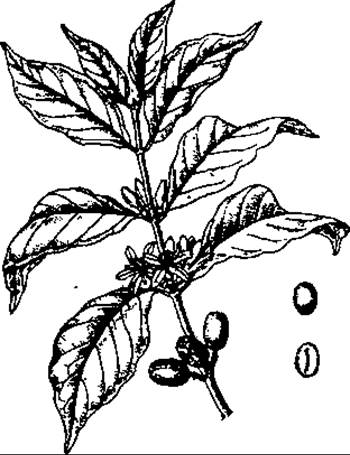
Biological activity and application. Coffee is used as a stimulant for mental fatigue, headaches, and as a first-aid measure for poisoning. Its effect on the central nervous system is due to the presence of caffeine. Decaffeinated coffee is obtained by extracting caffeine from the beans while preserving the taste qualities of coffee beverages. Such coffee contains up to 0.08% of caffeine.
In homeopathy, dried but unroasted beans are used; in pediatrics, they are used for insomnia caused by overexcitation, during teething accompanied by pain and dyspepsia, for headaches intensified by noise, and for cardiac neurosis with severe palpitations.
TEA LEAVES — FOLIA THEAE
Chinese tea — Thea sinensis L. (Camellia — Camellia sinensis O. Ktze.), fam. Theaceae
Chinese tea, camellia; from the Chinese *te* — tea bush. *Camellia* is named after the English botanist Georg Joseph Kamel.
The description of the plant, its distribution, and harvesting are given in the section «Flavonoids».
Chemical composition of the raw material. Tea contains 5% of caffeine («theine») and small amounts of theophylline, theobromine, adenine, xanthine, hypoxanthine, and isatin. Tea tannins account for 15–30% and are represented by catechin and its derivatives (Vitamin P). Essential Oils give tea a strong aroma and a specific scent. Vitamins C, B1, B2, PP, and mineral salts have also been found.
Biological activity and application. The therapeutic properties of unfermented tea are due to a complex of BIOLOGICALLY ACTIVE SUBSTANCES. Considering the stimulating properties of caffeine, tea should be consumed for fatigue, decreased mental activity, and as a first-aid measure. Tea is administered in cases of poisoning that cause central nervous system depression, weakened Heart activity and Respiration, as well as Alcohol poisoning. Due to the presence of theophylline and theobromine, tea exhibits diuretic effects. It should be kept in mind that strong tea is not recommended for individuals with increased excitability, insomnia, organic cardiovascular diseases, atherosclerosis, Hypertension, or glaucoma. Excessively strong tea should not be consumed even by healthy people, as it can cause central nervous system overexcitation, palpitations, a sense of anxiety, terror, etc.
STERCULIA LEAVES — FOLIA STERCULIAE PLATANIFOLIAE (FOLIA FIRMIANAE SIMPLICIS)
Chinese parasol tree — Sterculia platanifolia L. syn. Firmiana simplex (L.) W. Wight., fam. Sterculiaceae
Chinese parasol tree, or Firmiana simplex (syn. Sterculia platanifolia); the genus is named after Count Karl von Firmian, a former governor of Lombardy; the Latin simplex means simple or unbranched.
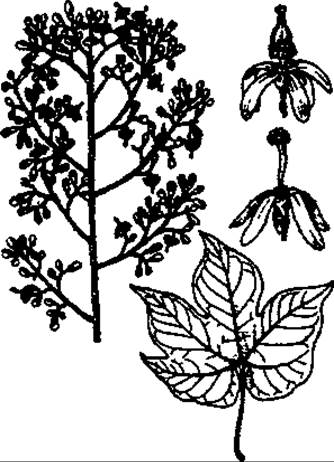
Botanical description. Firmiana simplex is sometimes referred to as the Japanese lacquer tree, though its accepted common name is the Chinese parasol tree. It is a tall, fast-growing deciduous tree reaching a height of 10–30 m. The leaves are alternate, large, up to 35 cm long and 20–40 cm wide, palmately 3- to 5-lobed, resembling those of the plane tree, glabrous or sparsely pubescent beneath, with prominent dark brown Veins. The color ranges from green to light green. The flowers are unisexual, greenish-yellow, small, and gathered in terminal panicles up to 25 cm in length. The fruit is a leathery, 5-parted follicle 3–10 cm long; the seeds are grayish-yellow, globose, and about 1 cm in diameter.
Distribution. Native to China, southern Japan, and the Indochina Peninsula. It is cultivated in Azerbaijan, Georgia, and the southern part of Krasnodar Krai. Small plantings can also be found in Crimea.
Procurement. The leaves of the Chinese parasol tree are harvested without petioles from the beginning of the flowering period until the appearance of the first yellow leaves. Drying is carried out in the shade with good ventilation (air-shade drying).
Chemical composition. The leaves contain Purine Alkaloids, Choline, betaine, tannins (4%), predominantly of the pyrocatechol group, organic acids, and traces of essential oil. The seeds accumulate caffeine.
Biological activity and application. Tincture made from the leaves of Firmiana simplex is used as a stimulating and tonic agent for physical and mental fatigue, as well as for hypotension.
The seeds are used as a coffee substitute.
Last update: 06/08/2026
Editorial and Educational Adaptation: This material has been compiled based on the primary/original source text. The project team performed an editorial review, corrected technical inaccuracies, structured sections, and adapted the content for an educational format.
What was processed:
- elimination of formatting defects (OCR errors, structural breaks, corrupted characters);
- editorial organization of content;
- standardization of terminology in accordance with academic sources;
- verification of factual statements against the original source text.
All mentions of the author, publication year, and origin of the primary text have been preserved in accordance with the source.